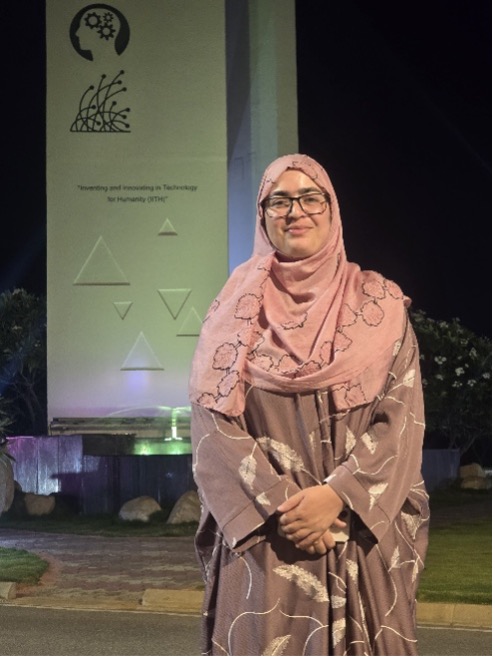
Dr. Mir Sumira is a Fulbright-Nehru Postdoctoral Fellow at the Mittal Institute. During her Fulbright, she is working with Prof. Satchit Balsari, Associate Professor in Emergency Medicine at Harvard Medical School.
Her research focuses on disaster risk reduction, climate resilience, geospatial technologies, and sustainable development, with particular emphasis on the vulnerability and resilience of mountain regions. She holds a Ph.D. in Disaster Management from the University of Kashmir, awarded in December 2024, for her dissertation entitled “Disaster Risk Assessment of Educational Institutions in Central Kashmir – A Micro-Level Approach Towards Disaster Risk Reduction.” Her doctoral research examined the vulnerability of educational institutions to earthquakes, landslides, and floods, employing field surveys, Geographic Information Systems (GIS), remote sensing, and multi-criteria decision-making techniques to advance evidence-based disaster risk reduction.
Sumira’s research interests span disaster risk assessment, climate adaptation, geospatial modelling, environmental sustainability, and resilient infrastructure. Her work explores the intersections of environmental change, land-use dynamics, and disaster vulnerability, particularly in ecologically sensitive and hazard-prone mountain environments. She has contributed to scholarly publications in journals including the International Journal of Disaster Risk Reduction, Natural Hazards, and Environment, Development and Sustainability. She holds a Master’s degree in Disaster Management, specializing in Remote Sensing and GIS, from the University of Kashmir, where she received a gold medal for academic excellence. Her earlier research also addressed wetland ecosystems, including Hokersar Wetland.
Prior to joining Harvard University, Sumira served as a Project Scientist at the Indian Institute of Technology Hyderabad, contributing to the Centre for Godavari River Basin Management and Studies (cGodavari), an initiative dedicated to integrated river basin management and environmental sustainability. Her work involved geospatial mapping, flood hazard modelling, hydrological assessment, water quality analysis, and the development of district-level river management and environmental monitoring frameworks. This experience broadened her engagement with the relationships between environmental systems, climate-related risks, water resources, and institutional approaches to resilience. She was also a recipient of the Coalition for Disaster Resilient Infrastructure (CDRI) Fellowship for the 2023–2024 cohort, further strengthening her commitment to advancing disaster-resilient infrastructure and risk-informed development.
Currently, as a Fulbright-Nehru Postdoctoral Fellow at Harvard University, Sumira is pursuing research entitled “A GIS-Based Digital Land Resilience Model (DLRM) for Climate-Adaptive Metropolitan Regions of Indian Himalayas.” The primary contribution of her research lies in developing a GIS-based Digital Land Resilience Model (DLRM) that integrates geospatial, environmental, and climate-risk indicators into a unified spatial framework for assessing land resilience in Himalayan metropolitan regions. Moving beyond conventional hazard-specific assessments, her research seeks to examine how land characteristics, environmental pressures, and climate-related hazards interact to shape spatial patterns of resilience and vulnerability. By identifying vulnerable areas and priority zones for intervention, the model aims to provide a decision-support framework for climate-adaptive land-use planning, sustainable metropolitan development, and resilience-oriented policy formulation. Through this work, she seeks to advance an integrated, land-centred approach to understanding and strengthening resilience in the ecologically fragile Indian Himalayas.
Beyond her research, Sumira is committed to interdisciplinary academic collaboration, knowledge exchange, and translating scientific findings into practical policy and planning interventions. Her work brings together perspectives from disaster management, environmental science, geospatial analysis, and climate adaptation to address emerging challenges in vulnerable landscapes. Through her postdoctoral research and international academic engagement, she aims to contribute to innovative approaches to land resilience, disaster risk reduction, and climate-adaptive development, supporting safer, more sustainable, and resilient communities across the Indian Himalayas.
Follow her work on LinkedIn.