VAF 10of10 feature Interview – Amra Khan
Celebrating 10 Years of the Visual Artist Fellowship
Amra Khan
Amra Khan
Looking back, how did your time as a Visiting Artist Fellow shape your artistic practice or career?
The Visiting Artist Fellowship at the Lakshmi Mittal and Family South-Asia Institute, Harvard, became an important catalyst in the ongoing evolution of my practice. It offered the time, space, and intellectual breadth to test and deepen ideas already central to my work particularly around visual culture, faith, and gender. Engaging with Harvard’s libraries, courses, and faculty enriched my approach to research, allowing me to think and make with greater precision and openness. That period of inquiry and exchange sharpened my understanding of how iconography operates within contemporary visual culture and expanded my capacity to write and reflect critically on my own process.
Since the fellowship, my practice has entered a period of renewed energy and expansion. Over the past two years, I have produced and exhibited more prolifically than ever before, bridging art-making, writing, and curatorial work. Recent projects include exhibitions in New York, Philadelphia, and AsiaNow 2025 Paris, with upcoming presentations under the United Nations umbrella and a Curatorial Fellowship with the Lahore Biennale Foundation. The fellowship affirmed my belief in the fluidity of artistic practice its ability to inhabit multiple forms of research, collaboration, and expression, strengthening my commitment to working within a broader global and intellectual dialogue.
Were there any specific experiences, people, or opportunities during the fellowship that had a lasting impact on you?
Among the most defining experiences of the fellowship were the moments of access, exchange, and connection that profoundly deepened my practice. The opportunity to work within Harvard’s Fine Arts Library and the archives at the Museum of Fine Arts, Boston, guided by Amanda Steinberg, was transformative. Immersing myself in rare Islamic manuscripts, Mughal paintings, and herbarium collections opened new directions in my understanding of iconography and material culture, bridging research and making in ways that continue to shape my work.
Equally significant was the collaboration with Dr. Satchit Balsari on Hum Sub Eik, an exhibition that brought together art, science, and craft. Contributing to a tapestry created by women artisans across India deepened my appreciation for collective authorship and resilience. My engagement with Boston’s queer archives and cultural spaces further expanded my inquiry into identity, belonging, and representation.
These encounters, intellectual, creative, and deeply personal, fostered enduring friendships and affirmed the importance of generosity, dialogue, and shared purpose in sustaining an evolving artistic practice.
How has your work evolved since your fellowship at Harvard? What are you currently working on or excited about in your practice?
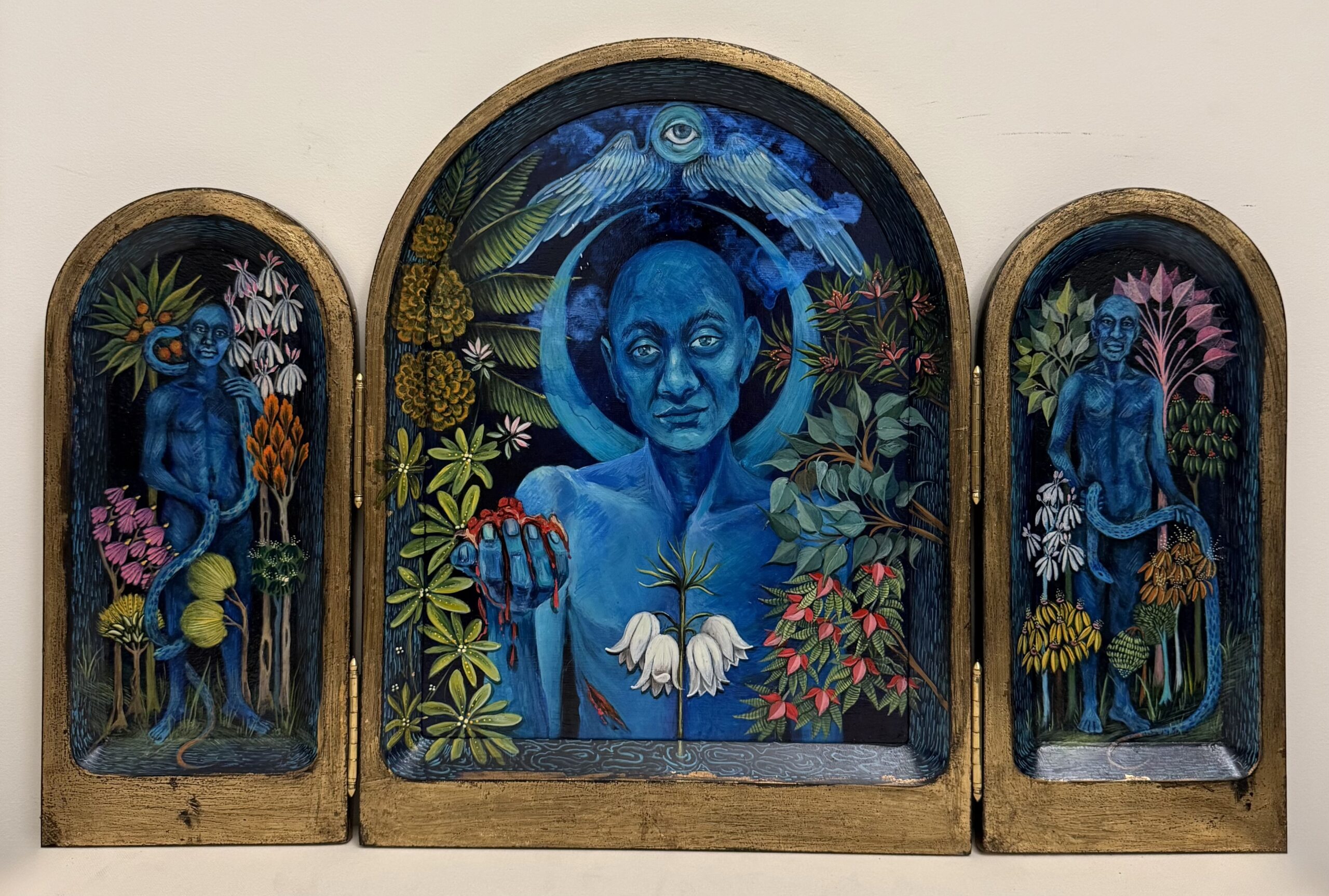
My practice has expanded both materially and conceptually, moving beyond painting into immersive, tactile, and spatial encounters. What began as two-dimensional explorations of gendered archetypes has grown into installations that merge devotional objects, found materials, and architectural remnants. I have become increasingly drawn to working with salvaged wood, textiles, and cultural symbols, transforming these into altar-like structures that question intimacy, ritual, and belonging.
Most recently, I have been creating large-scale embroidered textiles that revisit ancestral patterns from Jalandhar, reinterpreting them through contemporary gestures of care and remembrance. These works consider how personal and collective histories are preserved or erased through domestic and spiritual labor.
Currently, I am developing ‘Where Soft Blades Meet, Beyond the Other Mirror’ a curatorial and research based project under the Lahore Biennale Foundation’s ‘The Thing Is’ fellowship. Expanding from inquiries within my own practice, it examines the barbershop as a site of gendered ritual, care, and visibility in the Pakistani Muslim context. This project marks a new phase in my trajectory, one that bridges making and curating, personal history and collective dialogue, the seen and the unseen.
Whose work is inspiring you right now, and why?
These days I’m inspired by Nan Goldin’s intimate documentation of underground queer life, her work balances hope, despair, humour, and tenderness. Studying her framing and gaze offers me new ways to see and document. This research will inform and further expand my curatorial project, helping translate private, marginalised histories into visual and experiential forms.
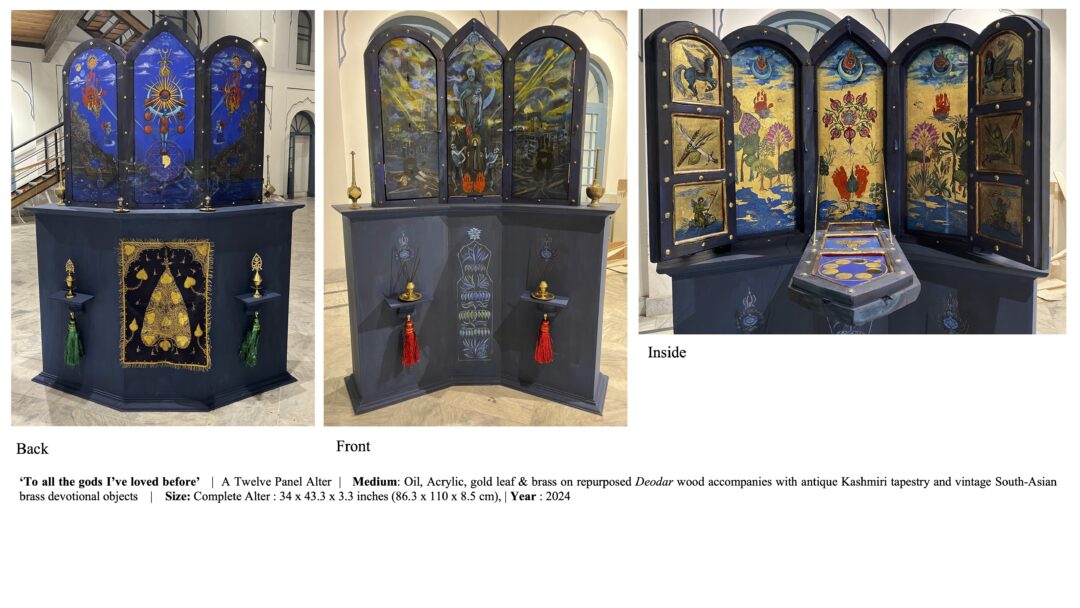
Share one image that captures something meaningful about your practice today. This could be a recent artwork, a studio moment, or you at work.
This sacred altarpiece confronts violence, the demolition of heritage, and the abandonment of cherished objects imbued in familial memory. Its visual language draws from Abrahamic religions, the cosmos, the spirit world, flora, fauna, and pain. Constructed from wood salvaged from a demolished home in Lahore, the twelve-panel freestanding piece invites viewers to walk around and engage. Front panels depict families amid loss and devastation; back panels reveal gods, monstrous forces, and humanity’s wrath. Inner panels whisper hidden paradises and celestial beings. Vintage South Asian ritual objects, rosaries, incense burners, amulets, express what cannot be spoken, bridging history, faith, and intimate human experience.
Explore more of the artist’s work here
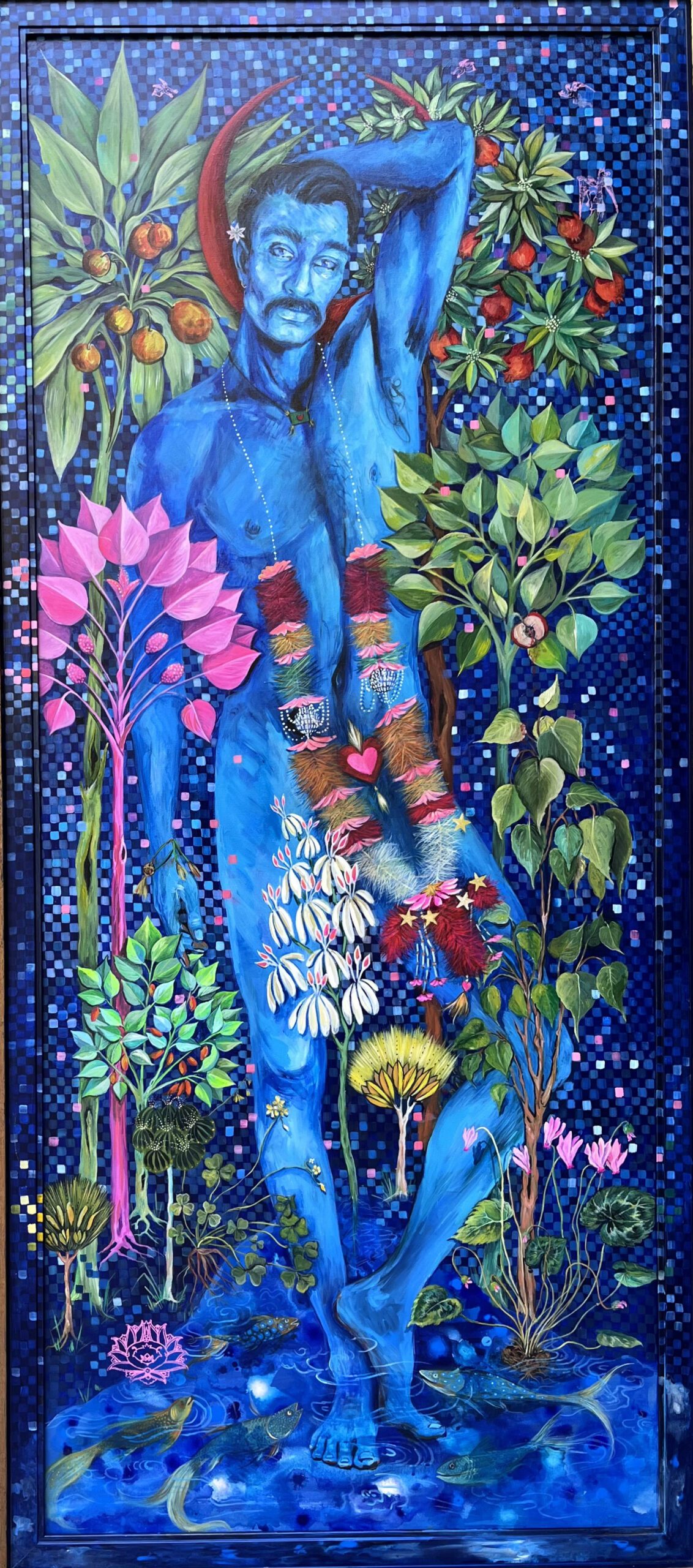
1, Amra Khan _ Firouz _ Acrylics on Canvas _ 72 x 30 inches _ 2025 – Amra Khan
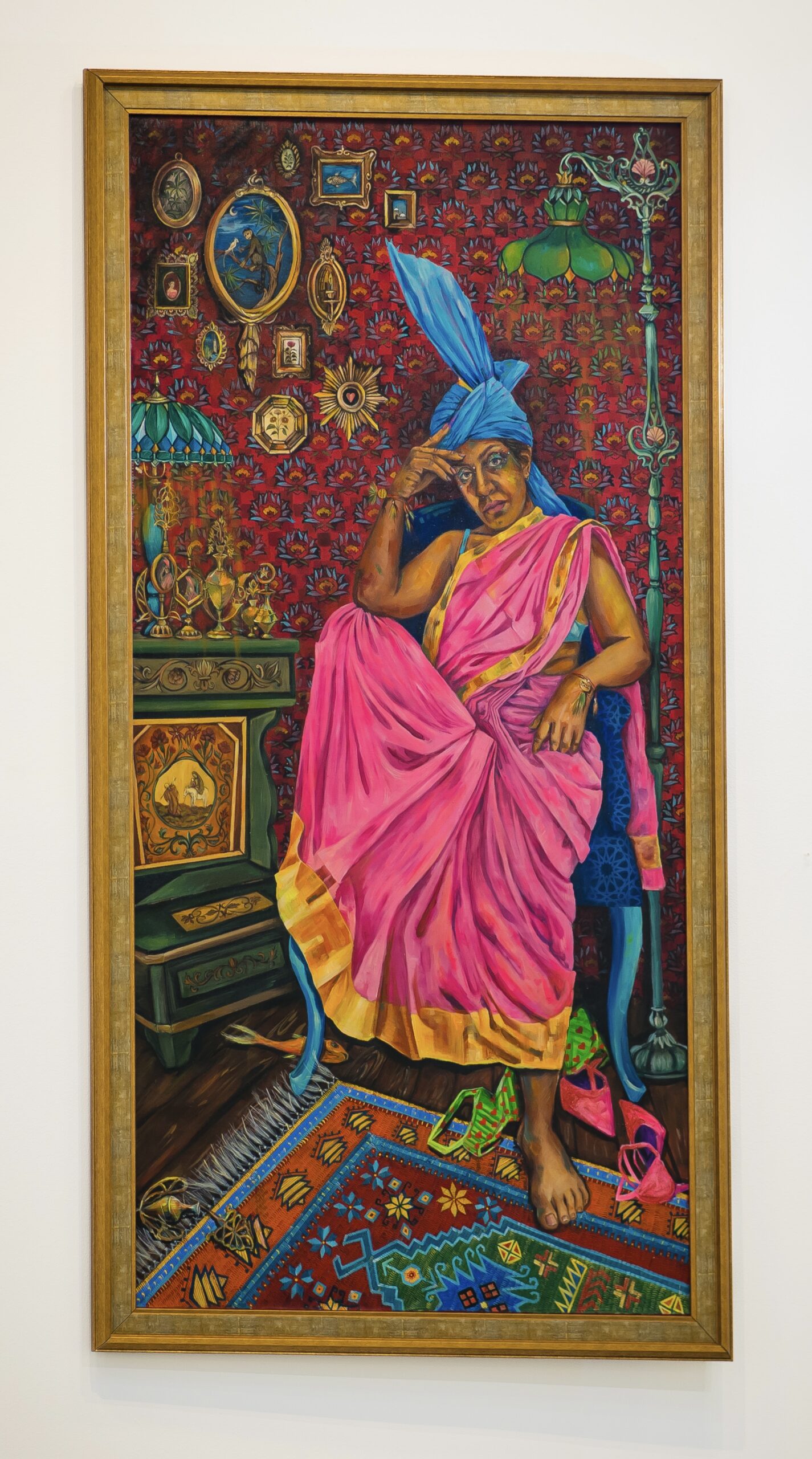
2025 Made In Paint
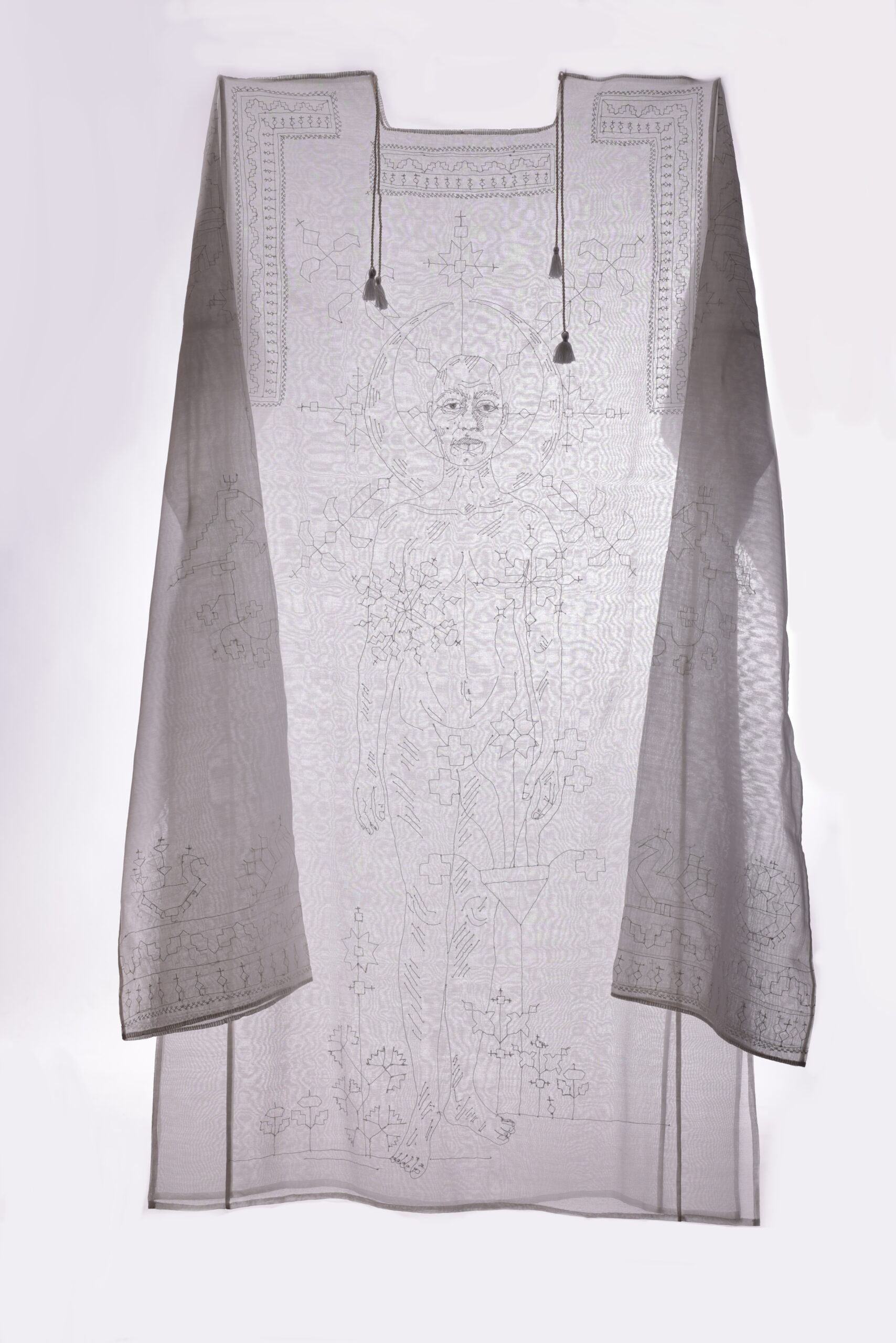
4. Amra Khan Alam Khana Cotton thread on Semi Sheer cotton-poly blend fabric 66 x 30 inches 2025
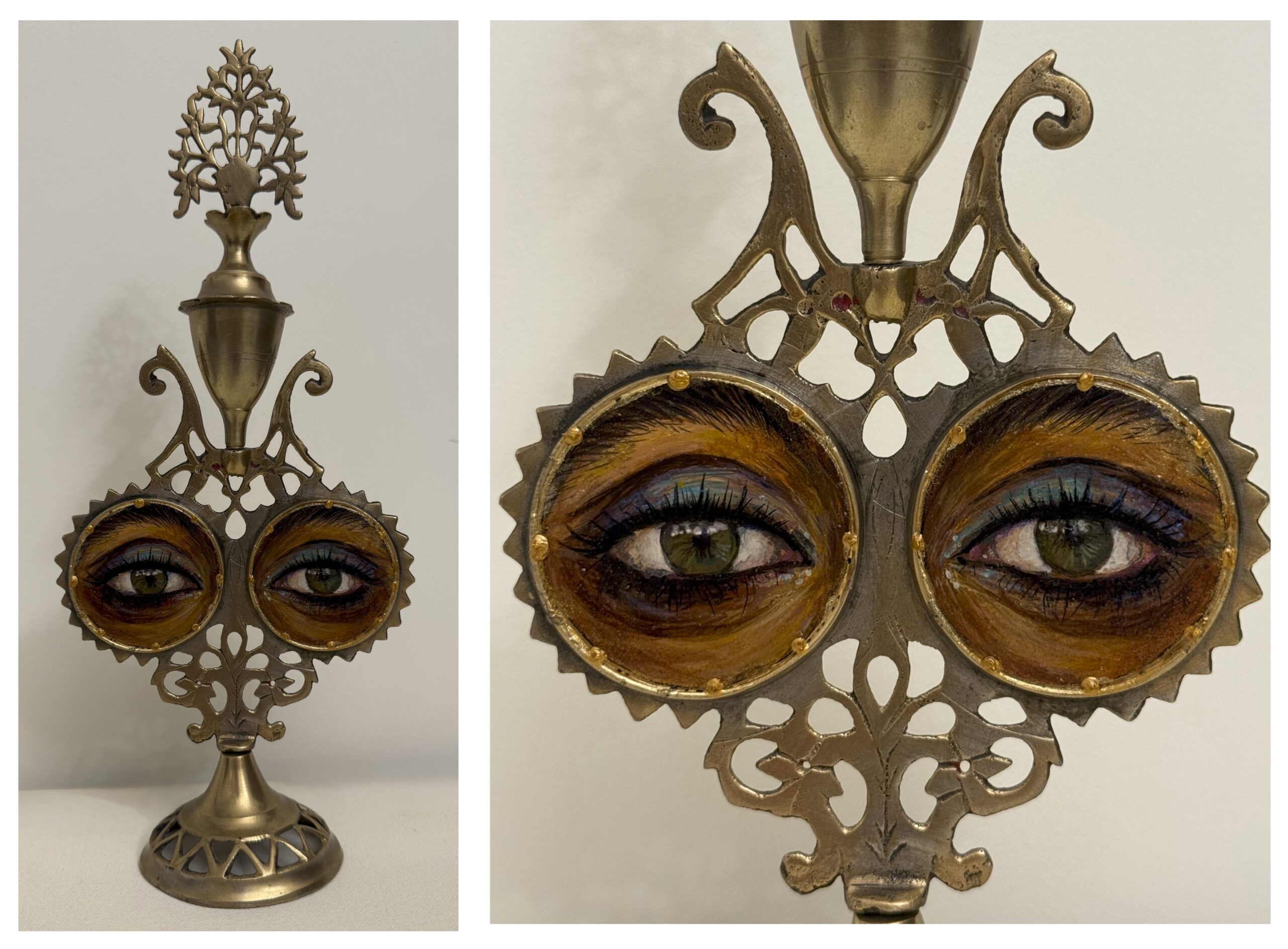
5. Noor-e-Nazar Acrylic and gold-leaf on board 9.7 x 4.4 x 2.5 inches 2025