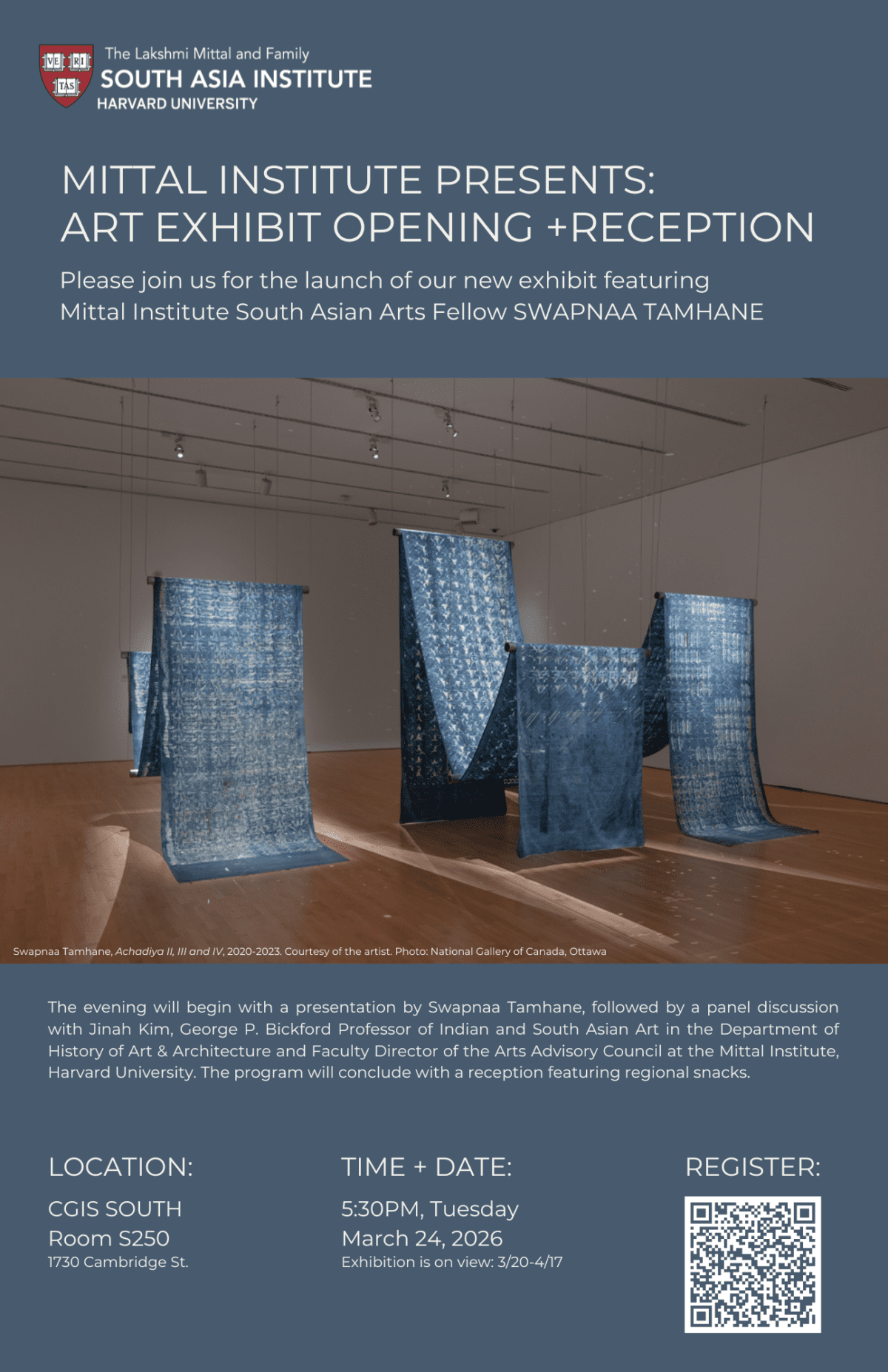
Please join us for the launch of our new exhibit featuring Mittal Institute South Asian Arts Fellow Swapnaa Tamhane
Date: Tuesday, March 24, 5:30pm EST
Venue: CGIS South, S250, Cambridge MA
The evening will begin with a presentation by the fellow, followed by a panel discussion with Jinah Kim, George P. Bickford Professor of Indian and South Asian Art in the Department of History of Art & Architecture and Faculty Director of the Arts Advisory Council at the Mittal Institute, Harvard University. The program will conclude with a reception featuring regional snacks and beverages.
** Please note that the Exhibition is on view from March 20, 2026 through April 17, 2026.
About Swapnaa Tamhane
Swapnaa Tamhane is an artist, curator, and writer whose practice moves fluidly between material research, drawing, and collaborative textile production. She holds an MFA in Fibres and Material Practices from Concordia University in Montreal, an MA in Contemporary Art from the University of Manchester, and a BA in Art History from Carleton University. Her work has been supported by the Social Sciences and Humanities Research Council of Canada, the Canada Council for the Arts, and Kulturstiftung des Bundes. Tamhane is the author of SĀR: The Essence of Indian Design (Phaidon Press, 2016) and HERE (Aga Khan Museum, Toronto, 2017). Her work has been exhibited internationally at Sculpture Park Jaipur; SIGHTINGS at LBEAG, Montreal; Green Art Gallery, Dubai; V&A Museum Dundee; and in solo exhibitions at the Royal Ontario Museum, Surrey Art Gallery, and the Mead Art Museum. She was shortlisted for the Sobey Art Award in 2025.
Her research begins with the material histories of cotton and jute, tracing their entanglement with trade, labor, and colonial economies. From this foundation, her practice extends into handmade paper, archival inquiry, and large-scale textile installations. Tamhane approaches her work through the lens of drawing, expanding mark-making beyond the page through embroidery, chalk pastel, pencil, and spatial gestures made with cloth and mirrors. Working in close collaboration with wood block carvers, printers, embroiderers, and dyers in Kutch, Gujarat, she engages in a reciprocal process of skill sharing and collective authorship.
At the core of her practice is a sustained effort to dissolve and decolonize the hierarchies between art, craft, design, and everyday objects that were institutionalized under British colonial rule in India. Through ornamentation, pattern, and material repetition, she repositions the decorative as conceptual, asserting its intellectual and political weight. Her work foregrounds labor, lineage, and embodied knowledge, offering a critical yet intimate reconsideration of how materials carry memory and how making can function as both resistance and repair.
View Swapnaa Tamhane’s work here
About the South Asian Arts Fellowship
The South Asian Arts Fellowship (SAAF) supports the research and creative practice of an artist, curator, or scholar living and working in North America whose work engages critically with the visual and material cultures of South Asia. The four-week fellowship offers the opportunity to spend focused time on Harvard’s campus in Cambridge, accessing the University’s exceptional academic, curatorial, and archival resources.
Fellows are selected by Harvard faculty and curators. The residency recognizes individuals whose work contributes to advancing understanding of South Asia’s artistic traditions, histories, and contemporary expressions.
During the fellowship period, the fellow is invited to the Mittal Institute at Harvard to conduct research, deliver a public presentation, and engage with faculty and students across the University. Residents are encouraged to utilize the Harvard Art Museums, the Carpenter Center for the Visual Arts, and Harvard’s many libraries and archives to inform and expand their ongoing projects.
The South Asian Arts Fellow benefits from immersion in Harvard’s dynamic intellectual community, gaining access to resources and dialogues that can shape new directions in their creative or scholarly practice.