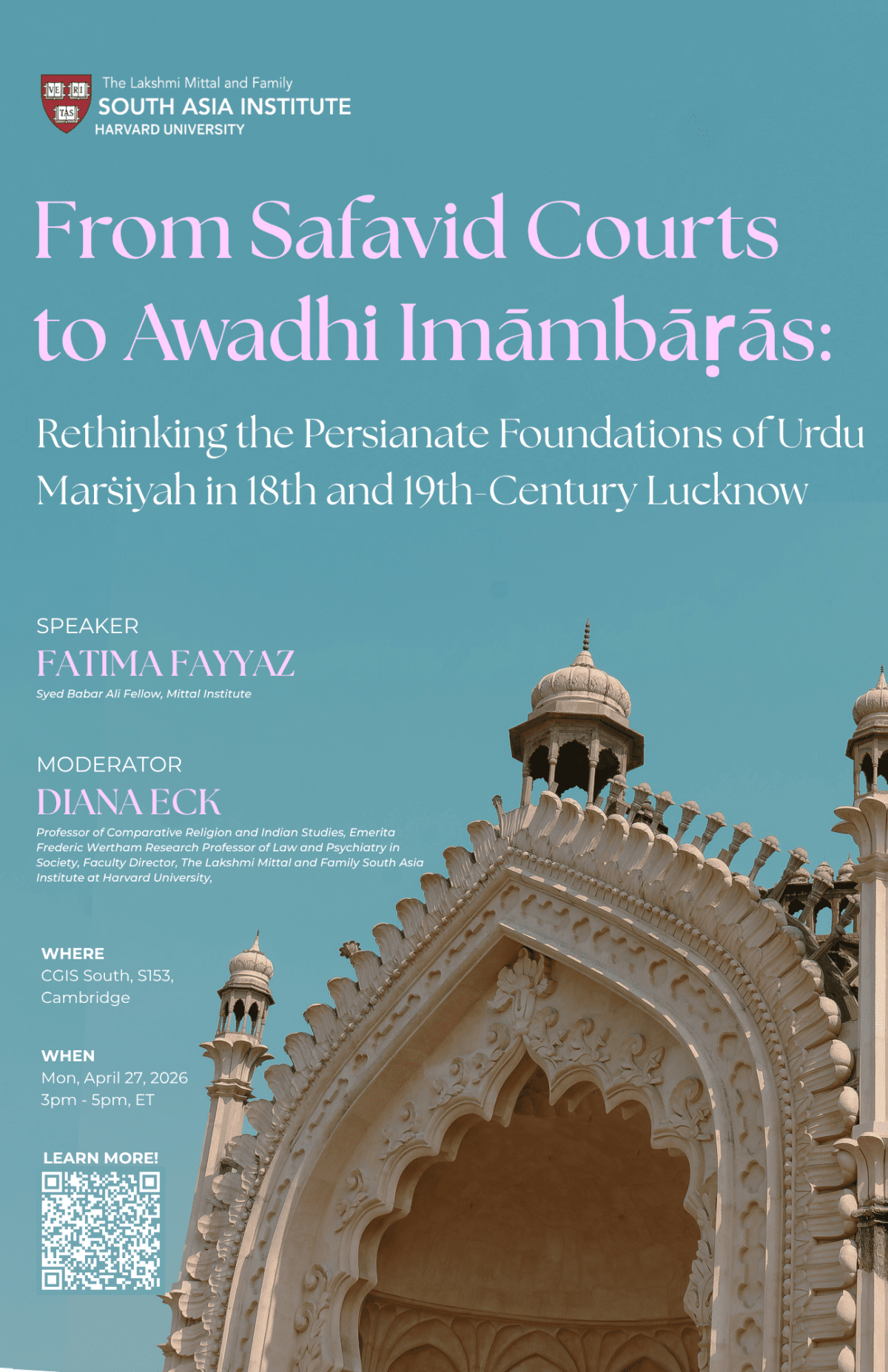
Speaker: Fatima Fayyaz, Syed Babar Ali Fellow, Mittal Institute
Moderator: Diana Eck, Professor of Comparative Religion and Indian Studies, Emerita Frederic Wertham Research Professor of Law and Psychiatry in Society, Faculty Director, The Lakshmi Mittal and Family South Asia Institute at Harvard University,
The reorientation of royal patronage under the Safavid ruler Shah Ṭahmāsp, marked by a preference for composition of marṡiyah (elegy) over the qaṣīdah (panegyric), represents a decisive moment in the reshaping of Persian literary culture and the consolidation of Safavid Shiʿi identity. However, contrary to expectations of a sustained flourishing of marṡiyah within Iran, contemporary tażkirāhs (biographical anthologies of poets) suggest a different outcome. The most significant expansion of Persian marṡiyah occurs beyond Safavid borders, particularly within the cultural and literary milieu of Mughal India.
By tracing the transregional journey of the genre through Iranian émigré poets who secured patronage in Mughal India, especially within the Shiʿi court of Awadh, this study examines the development of Persian marṡiyah in India within the poetic tradition of wāqiʻah-goʾī (episodic narration). Central to this analysis is the dīwān of Mullah Ḳhat̤ā Shūshtarī, an eighteenth-century Iranian émigré poet at the court of Nawāb Āṣif-ud-Daulah in Lucknow and a roẓah-ḳhwān (reciter of Karbala elegies) in the city’s imāmbāṛā (ceremonial hall for Muḥarram observances). This talk argues that Ḳhat̤ā’s work represent both the final efflorescence of Persian marṡiyah in Lucknow and a crucial transitional moment in the vernacularization of the literary idiom from Persian to Urdu. His episodic structuring reveals striking parallels with the narrative strategies later perfected by Urdu’s most celebrated marṡiyah poet Mīr Anīs. While Ḳhat̤ā’s style is anchored in sabk-i hindī (the Indian style of Persian poetry), Anīs develops a distinct style for Urdu marṡiyah. Situating Ḳhat̤ā within this continuum, the paper reconsiders the genealogy of Urdu marṡiyah in Lucknow and foregrounds its Persianate foundations.
Dr. Fatima Fayyaz is Assistant Professor of Comparative Literature and Creative Arts at the Lahore University of Management Sciences (LUMS), Pakistan. Her research focuses on Persian mystical and epic literature across Iran and the broader Persianate world, with particular attention to Central and South Asia. She received her PhD in Persian literature from the University of Tehran, where her doctoral research examined hagiographical texts of Central Asian Sufi orders and the cross-cultural connections between Central Asian and Indian mystics in the fifteenth and sixteenth centuries. Her work also engages extensively with Firdausī’s Shāhnāmeh and its profound influence on various literary genres in 19th-century South Asia, including the Urdu ġhazal, dāstān, and marṡiyah.