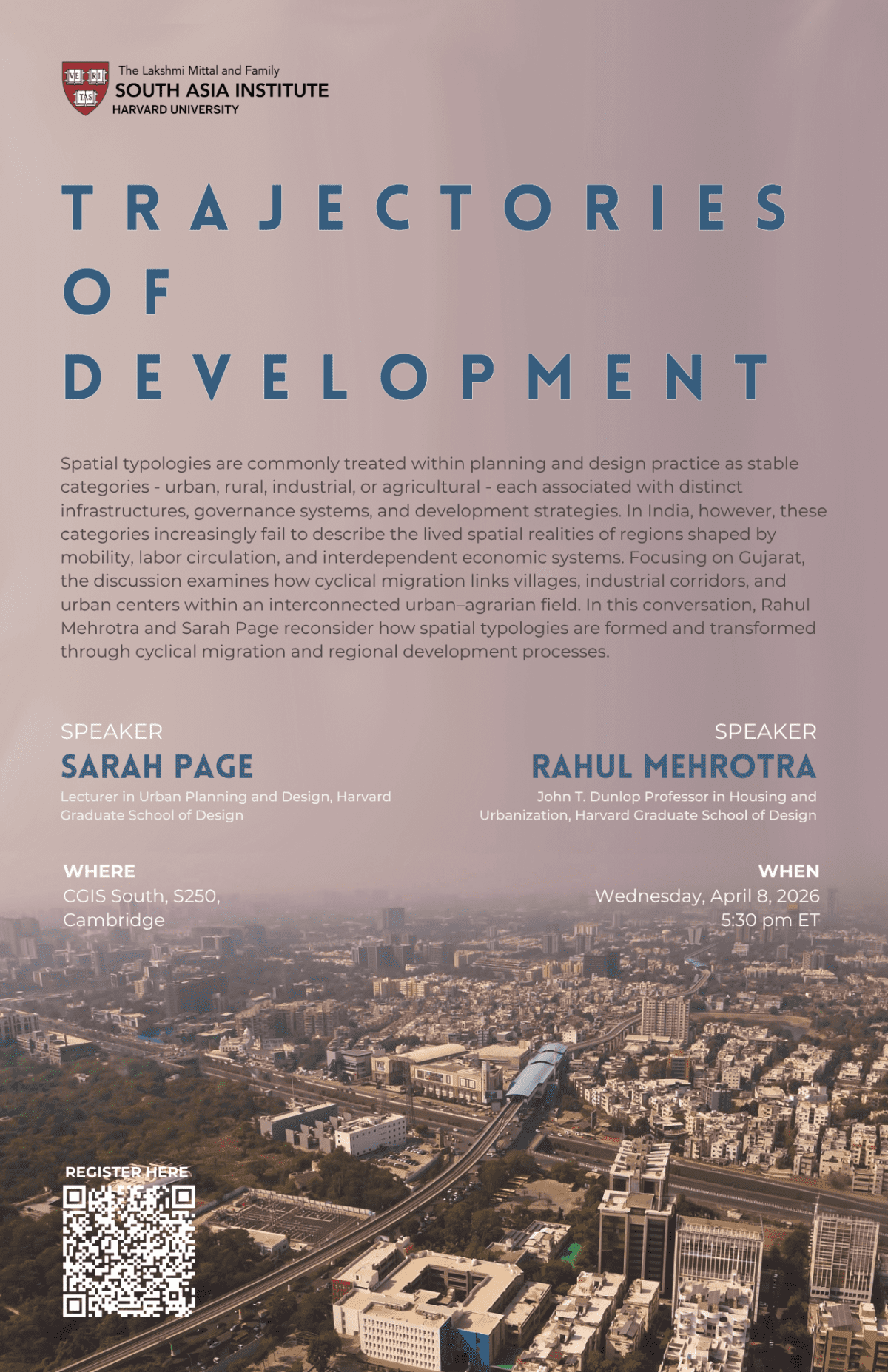
Speakers: Rahul Mehrotra, John T. Dunlop Professor in Housing and Urbanization, Harvard Graduate School of Design
Sarah Page, Lecturer in Urban Planning and Design, Harvard Graduate School of Design
Spatial typologies are commonly treated within planning and design practice as stable categories—urban, rural, industrial, or agricultural—each associated with distinct infrastructures, governance systems, and development strategies. In India, however, these categories increasingly fail to describe the lived spatial realities of regions shaped by mobility, labor circulation, and interdependent economic systems. In this conversation, Rahul Mehrotra and Sarah Page reconsider how spatial typologies are formed and transformed through cyclical migration and regional development processes.
Focusing on Gujarat, the discussion examines how cyclical migration links villages, industrial corridors, and urban centers within an interconnected urban–agrarian field. Seasonal agricultural labor demands, fluctuations in wage opportunities, and public programs shape patterns of mobility that reorganize settlement structures, land use practices, and regional infrastructure systems. These movements produce landscapes structured not by fixed urban–rural boundaries but by the circulation of labor, resources, and capital across multiple spatial scales.
Drawing on ethnographic research and spatial analysis, the presentation argues that cyclical migration is a key mechanism through which spatial typologies are continually reconfigured. Recognizing these dynamics requires design and planning disciplines to move beyond static territorial models and engage with regions as mobile, interdependent systems. By foregrounding mobility and rural–urban interdependence, the discussion proposes new conceptual frameworks for planning and design that better address the spatial realities of a mobile population and support more equitable and ecologically resilient forms of rural development.