WHEN
Tue, Mar 10, 2026 at 05:30pm, ET
Join us for a talk with Seema Kohli, an internationally renowned visual artist from India, as she reflects on the circle as a generative, communal form that dissolves boundaries between body, spirit, stone, and goddess, and considers how this lineage continues in her own contemporary practice through painting, drawing, and sculpture.
More InfoWHEN
Fri, Feb 27, 2026 at 02:00pm, ET
Please join us for a seminar on South Asian politics co-hosted by the Saxena Center at Brown University, the Weatherhead Center for International Affairs at Harvard University, and the Mittal Institute at Harvard University, featuring speaker Rachel Brule, Associate Professor of Global Development Policy at Boston University’s Frederick S. Pardee School of Global Studies.
More InfoWHEN
Fri, Feb 13, 2026 from 12:15pm — 01:15pm, ET
Join us for a discussion with Shashi Tharoor, Sugata Bose and Diana Eck on the chapter ‘Whither Secularism and Pluralism?’ of Dr Tharoor’s book Our Living Constitution: A Concise Introduction & Commentary.
More InfoWHEN
Wed, Feb 11, 2026 from 06:30pm — 08:00pm, IST
Join us for a webinar on “Rethinking Nutrition and Food Systems for Planetary Health in South Asia,” hosted jointly by the Mittal Institute and Harvard T.H. Chan School of Public Health–India Research Centre. This webinar brings together leading experts in nutrition, epidemiology, and food policy to examine the relevance, feasibility, and equity implications of planetary health diets in South Asia.
More InfoWHEN
Tue, Feb 3, 2026 at 06:00pm, ET
This panel explores how heat is actually experienced in daily life – inside homes, workplaces, and cities. Drawing on perspectives from building science, urban design, and environmental health, Profs. Rajan Rawal and Gary Adamkiewicz will examine how everyday environments shape thermal exposure, behavior, and health. Moderated by Prof. Rahul Mehrotra, the discussion will highlight gaps between measured conditions and lived experience, and consider how design, infrastructure, and policy can better address the growing burden of heat where people live and work.
More InfoWHEN
Wed, Jan 21, 2026 from 09:00am — 05:00pm, IST
The public launch of the report of the Lancet Commission on a Citizen-Centred Health System for India on January 21, 2026 in New Delhi marks the culmination of a multi-year effort to synthesise evidence and outline reform pathways for a health system that is equitable, forward-looking, and accountable to India’s citizens. The event will be in hybrid format.
More InfoWHEN
Fri, Dec 19, 2025 from 09:30am — 12:30pm, IST
Join us for a seminar on “Colonial Surveillance in Asia.” This seminar aims to explore the persistence and evolution of colonial surveillance under various imperial regimes in Asia.
More InfoWHEN
Wed, Dec 3, 2025 from 06:30pm — 07:30pm, IST
Join us for a webinar on “Beyond the Haze: Interdisciplinary Perspectives on Air Pollution.”
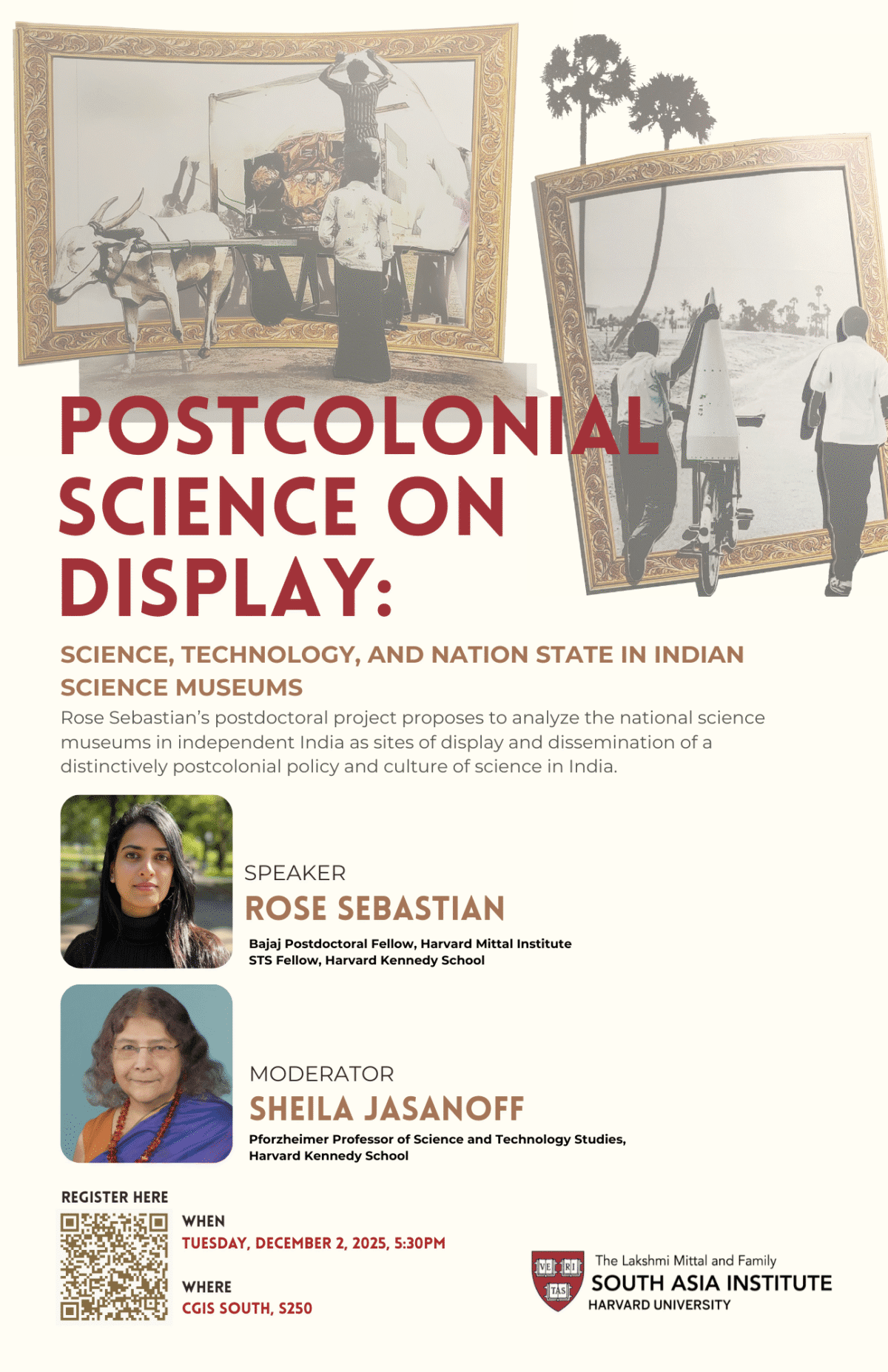
More InfoWHEN
Tue, Dec 2, 2025 at 05:30pm, ET
Dr. Rose Sebastian’s postdoctoral project proposes to analyze the national science museums in independent India as sites of display and dissemination of a distinctively postcolonial policy and culture of science. This interdisciplinary project aspires to bring together the analytical approaches of Cultural Studies and Science and Technology Studies (STS). It extends the concepts of postcolonial hybridity and ambivalence to cultures of science, and analyzes the co-production of the technoscientific and the political in postcolonial India from an STS framework.
More Info