WHEN
Tue, Nov 5, 2019 from 06:00pm — 07:30pm, ET
Economic corridors — ambitious infrastructural development projects throughout Asia and Africa — are dramatically redefining the shape of urbanization. As these corridors cut across croplands, the conversion of agricultural lands into new urban uses has erupted in volatile land conflicts. This talk will focus on urbanization along the first economic corridor built in India, the […]
More InfoWHEN
Mon, Oct 28, 2019 from 06:00pm — 07:30pm, ET
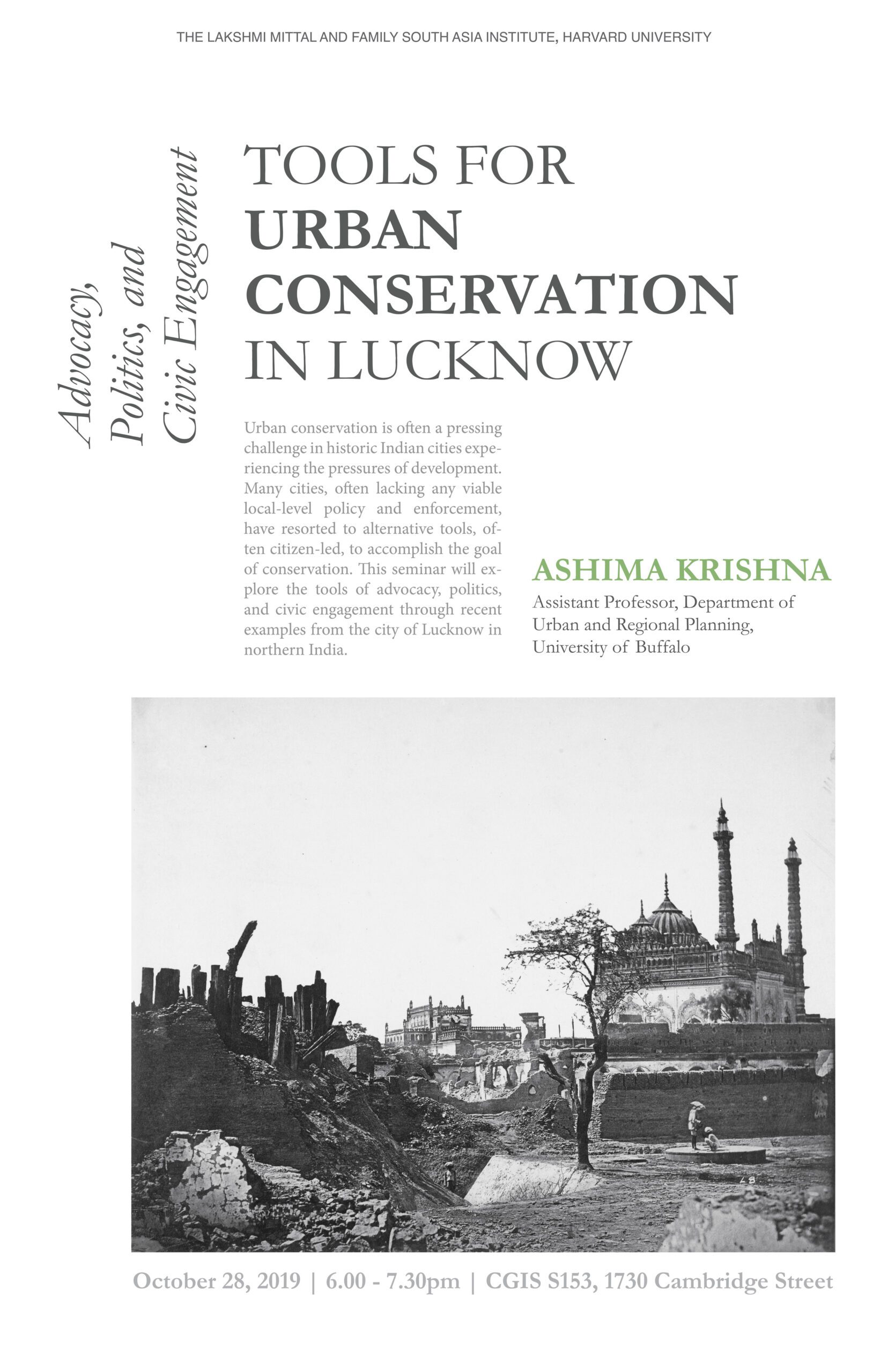
Urban conservation is often a pressing challenge in historic Indian cities experiencing the pressures of development. Many cities, often lacking any viable local-level policy and enforcement, have resorted to alternative tools, often citizen-led, to accomplish the goal of conservation. This seminar will explore the tools of advocacy, politics, and civic engagement through recent examples from the city of Lucknow in northern India.
More InfoWHEN
Fri, Oct 25, 2019 from 04:00pm — 05:30pm, ET
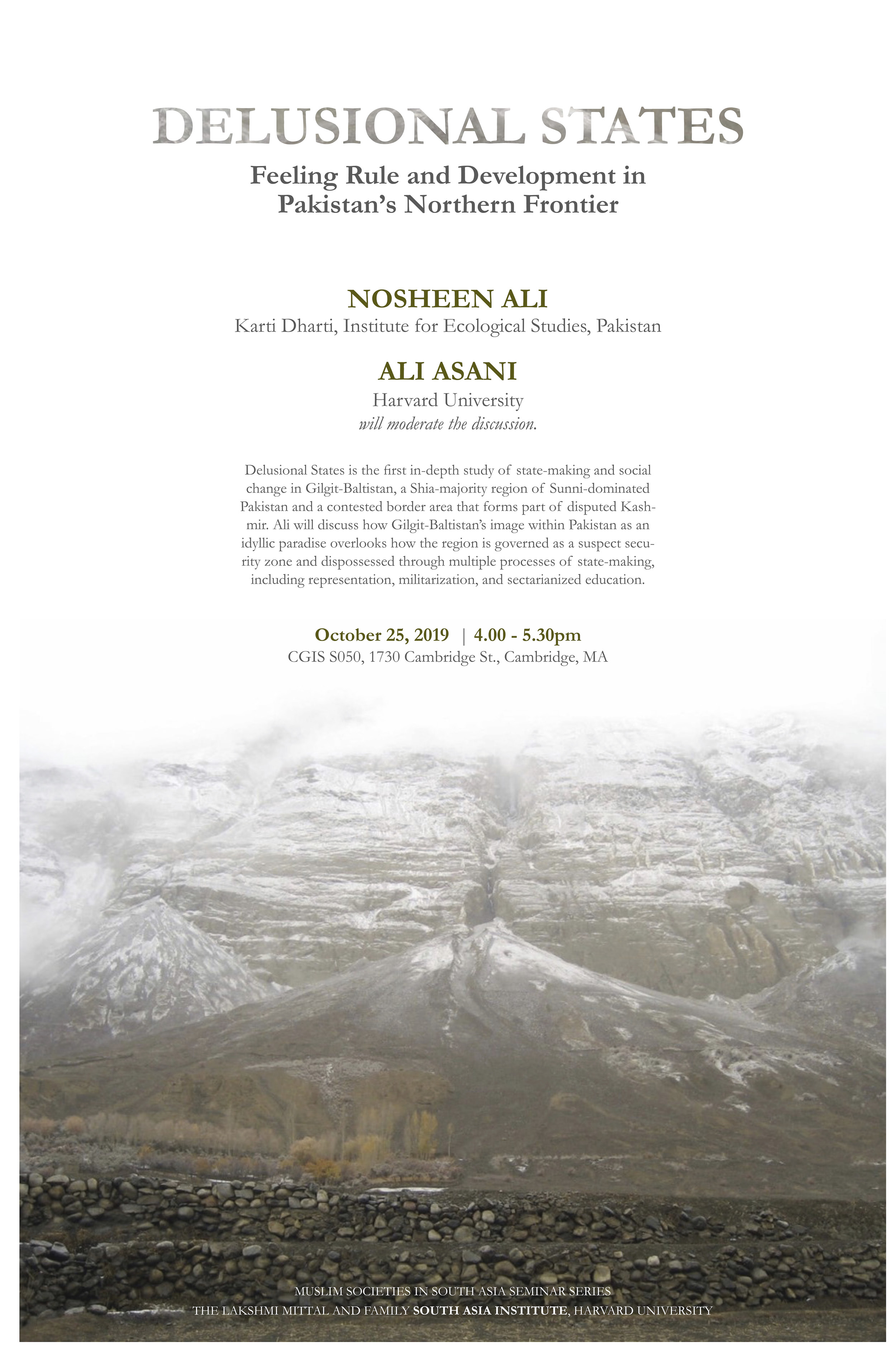
Delusional States is the first in-depth study of state-making and social change in Gilgit-Baltistan, a Shia-majority region of Sunni-dominated Pakistan and a contested border area that forms part of disputed Kashmir. Ali will discuss how Gilgit-Baltistan’s image within Pakistan as an idyllic paradise overlooks how the region is governed as a suspect security zone and dispossessed through multiple processes of state-making, including representation, militarization, and sectarianized education.
Speakers:
Nosheen Ali, Karti Dharti, Institute for Ecological Studies, Pakistan
Ali Asani, Harvard University, will moderate the discussion
More InfoWHEN
Wed, Oct 23, 2019 from 06:00pm — 07:30pm, ET

After the 1880s, Mysore was established as the home of the royal family. Despite its interrupted and uncertain status as a “capital” city, it became the site of an experiment in ornamentalism by the 20th century. It was among the first cities in India to have a City Improvement Trust in 1903, a few years after the Bombay Improvement Trust was set up in 1898. In the Trust’s negotiations with the municipality on the one hand, and the Palace establishment on the other, we see a specific form of material and temporal “ordering” that drew as much on the sovereign power of the monarch — though mediated by an increasingly powerful bureaucracy — as on a creative adaptation of the diverse forces, techniques, and devices more properly associated with “governmentality.” How does the invention of Royal Mysore challenge existing conceptions of the colonial city as a site of modernity?
Speaker:
Janaki Nair, Professor of History, Jawaharlal Nehru University
More InfoWHEN
Fri, Oct 11, 2019 from 04:30pm — 06:00pm, ET
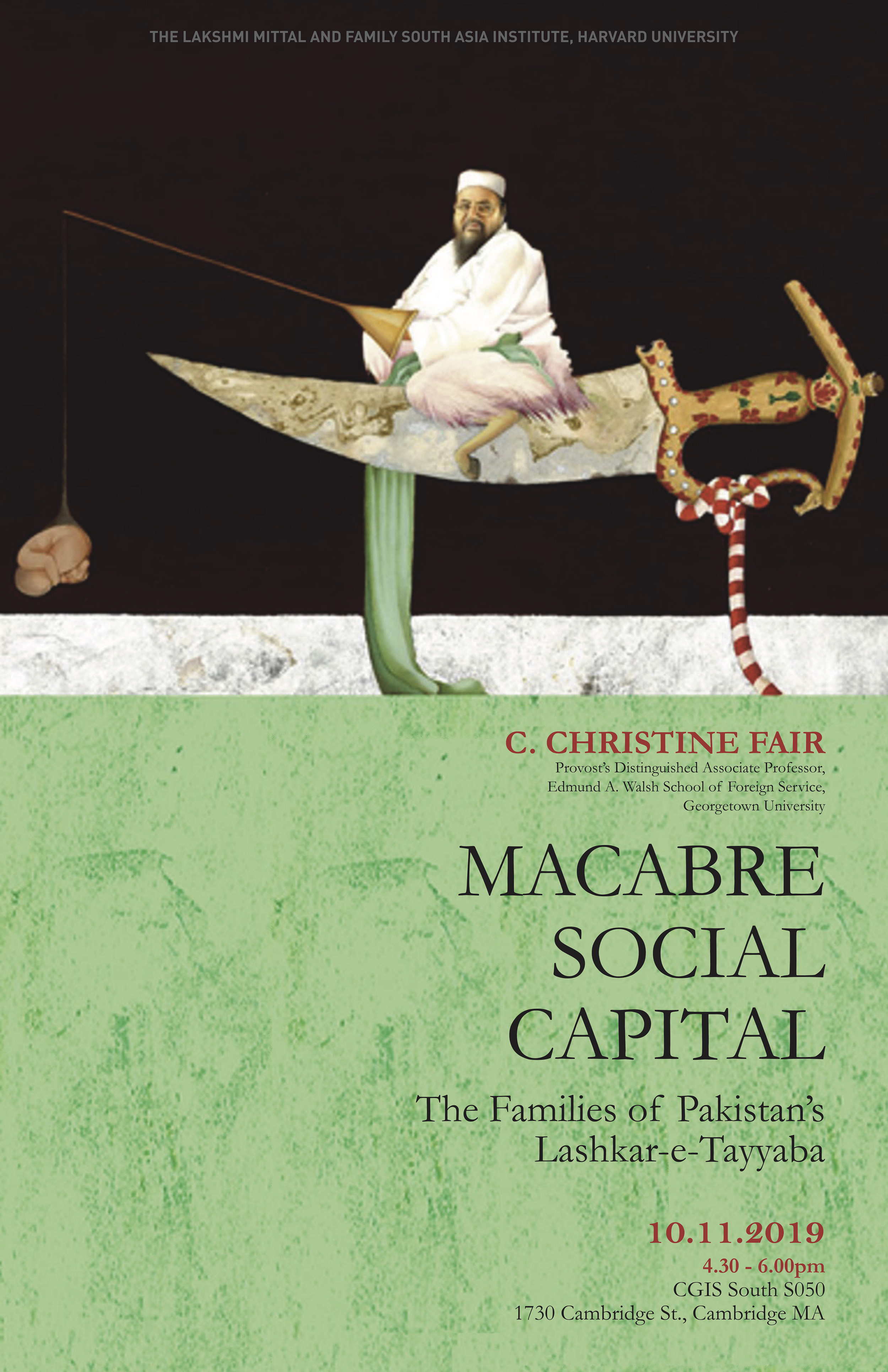
Lashkar-e-Tayyaba is the most competent, lethal, and loyal proxy of the Pakistani state, operating in India, Afghanistan, and elsewhere in South Asia and beyond. In this presentation, C. Christine Fair will draw from a narrative analysis of a ten percent random sample of nearly 1,000 biographies of slain LeT fighters to delve into the battlefield motivation of the fighters. She will reveal the dark role that families play in a young man’s decision to fight in Pakistani terrorist organizations, deriving various forms of social capital from a male family member’s participation in so-called “jihad.”
Speaker:
C. Christine Fair, Provost’s Distinguished Associate Professor, Edmund A. Walsh School of Foreign Service at Georgetown University
Moderator:
Kristin E. Fabbe, Assistant Professor of Business Administration, Harvard Business School
More Info