
Watch the “Reflections on Workplace Mental Health: A Formal and Informal Workforce Perspective” video. For subtitles, be sure to toggle the closed captioning button on.
A recent webinar, “Reflections on Workplace Mental Health: A Formal and Informal Workforce Perspective,” convened prominent voices from academia, policy, and worker organizations to discuss the critical importance of mental health in both formal and informal work settings. The discussion highlighted how different workplace contexts influence well-being and what steps are needed to build more supportive environments for workers.
Opening the conversation, Vikram Patel, Paul Farmer Professor and Chair of the Department of Global Health and Social Medicine, welcomed participants. He framed the theme by observing, “One of the most important lessons that has come from science is how the environment that we live in are in a constant dance with our minds and our mental health and well-being.”
Prof. Patel brought focus to the Indian context, where most employment lies outside the formal sector, “Oftentimes, when we hear conversations about workplace mental health, it is heavily biased towards the kinds of workplace that people in high-income countries might find themselves in. However, in India, work can mean very many different things. For example, more than 80% of our population would be considered to be self-employed, a large proportion of whom would be either daily wage laborers.” He emphasized that addressing mental health requires understanding the diversity of work arrangements in the country.
One of the most important lessons that has come from science is how the environment that we live in are in a constant dance with our minds and our mental health and well-being.
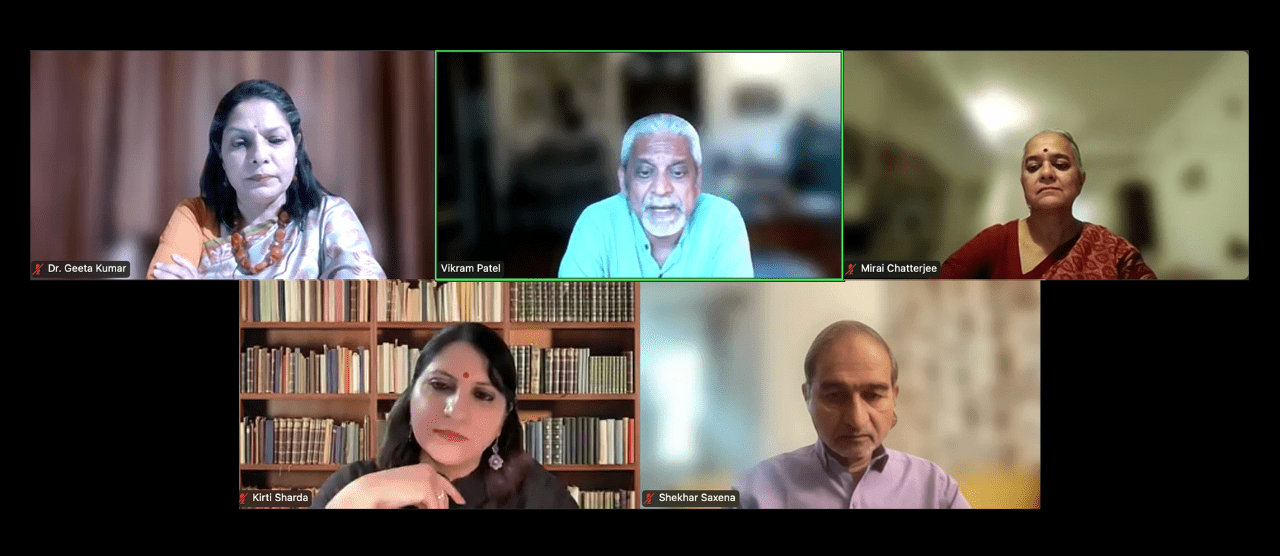
Clockwise from the top-left: Geeta Kumar, Vikram Patel, Mirai Chatterjee, Shekhar Saxena, and Kirti Sharda.
The first panelist, Shekhar Saxena, underlined the importance of drawing a distinction between mental health and illness. He remarked, “When we talk about workplace mental health, we must recognize that mental health is not merely the absence of mental illness, but the presence of positive well-being.” He added, “The conditions of the workplace, whether formal or informal, play a major role in either supporting or undermining that well-being.” His comments stressed that good mental health is not simply about treating problems but creating enabling environments.
Adding her perspective, Geeta Kumar reflected on organizational changes and their impact on workers: “Shifts in workplace structures, demographics, and expectations have direct implications for mental health.” She elaborated, “We are witnessing rising stress levels, burnout, and pressures of productivity that affect employees across levels. Organizations must think beyond token gestures and integrate mental health into their core culture.”
Representing the voices of informal workers, Mirai Chatterjee brought the discussion to the lived realities of those outside the formal economy. She reflected on the world of informal work, observing, “These workers face insecurities, lack of social protection, and daily stress that are rarely acknowledged in mainstream conversations on mental well-being.” Her intervention reminded participants that workplace mental health is a structural issue as much as an individual one.
Kirti Sharda offered the viewpoint of students and young professionals entering the labor force. She recalled, “As students, we are already dealing with stress, competitiveness, and uncertainty about the future. These factors follow us into the workplace.” She continued, “Young people entering their careers often struggle with balancing expectations, learning curves, and personal well-being, which makes support systems especially important.” Sharda highlighted the importance of recognizing early-career vulnerabilities and building preventive frameworks.
In his closing reflections, Vikram Patel returned to summarize the spirit of the discussion. He noted, “We have heard today how mental health is shaped by different forms of work, from the structured environment of formal employment to the precarious conditions of informal labor.” Concluding with a call to action, he stated, “It is vital that workplace mental health is not treated as an afterthought but integrated into broader policies for labor, social protection, and human rights. Only then can we ensure well-being for all workers.”
The webinar underlined that workplace mental health must be recognized as a collective responsibility, shaped by organizations, policies, and communities alike. By bridging the perspectives of formal and informal workers, the conversation called for inclusive approaches that value dignity, well-being, and resilience across the world of work.
Written by Yuvika, Climate Coordinator at the Mittal Institute India office.
☆ The views represented herein are those of the interview subjects and do not necessarily reflect the views of the Mittal Institute, its staff, or its steering committee.