
Watch the “Rethinking Water Crisis, Narrative Designs, and Strategies of Resilience” video. For subtitles, be sure to toggle the closed captioning button on.
The Mittal Institute India office hosted “Rethinking Water Crisis, Narrative Designs, and Strategies of Resilience,” the end-of-fellowship seminar of Dr. Nobonita Rakshit, India Fellow at the Mittal Institute. The session was chaired by her mentor, Doris Sommer, Ira and Jewel Williams Professor of Romance Languages and Literatures and of African and African American Studies at Harvard University.
Opening the seminar, Professor Sommer reflected on the intellectual journey of the fellowship and the value of sustained interdisciplinary engagement. “It’s been a great pleasure to work with Nobonita this year. I’ve learned much from her,” she said, situating Rakshit’s work at the intersection of narrative practice, culture, and development. Emphasising the importance of experiential engagement, she added, “It’s one thing for people to read statistics, even to read narratives, and another thing to walk with people.”
Dr. Rakshit’s presentation drew from her fieldwork and research on water crises to examine why collective action on water remains elusive despite widespread awareness. “We don’t ignore the crisis because we are careless or evil, we ignore it because for most of us, the taps still run,” she observed. Reflecting on responsibility and accountability, she noted, “Water is a collective responsibility. [People have the attitude that] I don’t want to take responsibility, [because] my tap is running still.” Her work explored how narrative forms—particularly graphic and participatory storytelling—can help bridge this gap between awareness and action by fostering empathy and deeper public engagement.
We don’t ignore the crisis because we are careless or evil, we ignore it because for most of us, the taps still run.
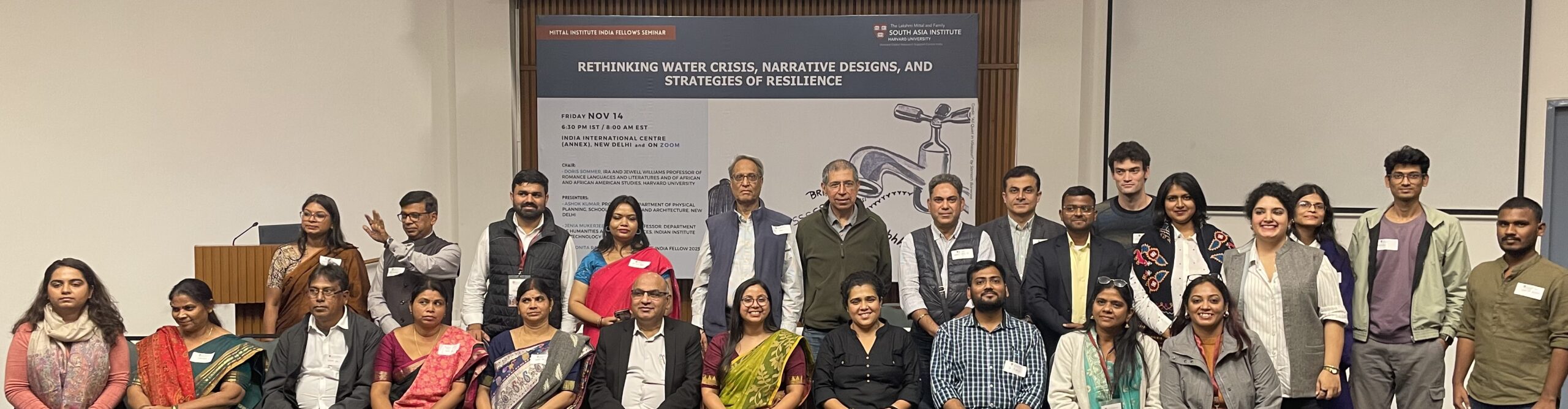
Group photo from the seminar on Rethinking Water Crisis.
The discussion was enriched by responses from fellow panelists, including Ashok Kumar, Professor, Department of Physical Planning, School of Planning and Architecture, New Delhi, who reflected on the normative dimensions of water governance. “Values, human values as well as water values, I consider these as a kind of software in the human mind—the foundational belief systems that steer our actions and impact our motivations,” he noted, underscoring the need to engage belief systems alongside technical and policy solutions.
Drawing on shifts within academia, Jenia Mukerjee, Associate Professor, Department of Humanities and Social Sciences, Indian Institute of Technology Kharagpur, reflected on how approaches to research and action have evolved over time. “Twenty years back there was a caution that academicians at best can come up with perspectives for action, but not actions,” she said, arguing that such boundaries are no longer tenable. She emphasised that responding meaningfully to contemporary ecological crises requires moving beyond awareness: “It is not only awareness, but it is also larger and deeper engagement and actions.”
The seminar concluded with a Q&A that explored questions of scale, methodology, and impact, including how narrative and cultural practices can translate into sustained institutional and policy change. The session offered a reflective close to Dr. Rakshit’s fellowship, foregrounding the role of narrative, values, and interdisciplinary collaboration in reimagining responses to India’s water challenges.
Written by Angarika Datta, Communications and Outreach Manager at the Mittal Institute India office.
☆ The views represented herein are those of the panelists and do not necessarily reflect the views of the Mittal Institute, its staff, or its steering committee.