
Prof. Eliana La Ferrara, Professor of Public Policy, Harvard Kennedy School and Aditi Bhowmick, Center for International Development Ph.D Affiliate, Concentrations in Development Economics & Labor Economics are inaugural recipients of the Mittal Institute’s Faculty Climate Grant program. Their project, co-sponsored by the Women and Public Policy Program at the Harvard Kennedy School, examines how climate change, debt, and gender norms combine to harm female sugarcane cutters in drought-prone Maharashtra, India. As local livelihoods collapse, couples migrate for months to cut cane, taking large advances that lock them into hard, poorly regulated labor. Women work long days with little rest or sanitation, making menstruation so difficult that hysterectomy can seem like a practical solution, especially in communities with high child marriage and early childbirth. The project now focuses on how climate-driven migration, debt-based labor contracts, and limited bargaining power together drive these severe reproductive health risks. We spoke with both researchers to learn more about their findings.

Aditi Bhowmick, CID Ph.D Affiliate, Concentrations in Development Economics & Labor Economics
Mittal Institute: What motivated you to examine the intersections of climate change and gender inequity in India, and what led you to choose South Asia as the regional focus of your work?
Aditi Bhowmick: For as long as I can remember, what keeps me up at night and makes me passionate about my work is the chance to focus on women’s issues in South Asia. It’s what I live for and what I hope to dedicate the next decade of my career to. That’s my motivation for working on gender in this region.
South Asia is at a fascinating moment. Economically, India is roaring ahead, but that trajectory is out of step with gender inequality. For most of the 21st century, female labor force participation has been stagnant, and although there is now an uptick, we have to ask what kinds of jobs women are working in, if at all. Most women in the workforce are working in deeply precarious, exploitative conditions on the margins, and at the other extreme, in urban areas, leaving the labor force altogether. How did this come about and what can we do about it? These are the questions I grapple with constantly, and I could work on them forever.
This project is especially compelling because of the workers at its center: climate change–induced distress migrants engaged in circular migration. Every issue I care about in the Indian context is present here: caste inequality, violence and lack of safety at work, health and reproductive health inequities, women’s bargaining power in the workplace, child marriage, layered on with incredibly complex power relations. For a project like this, the question was not whether to get involved, but how exactly to get involved to improve the wellbeing of these women.
This project is especially compelling because of the workers at its center: climate change–induced distress migrants engaged in circular migration.
Eliana La Ferrara: I can speak a bit about my background. I wouldn’t claim expertise on South Asia; most of my research has focused on Africa, with some work on Brazil. I began at the intersection of development and political economy, studying ethnic fragmentation, collective action, and eventually conflict. Over time, I became interested in the customary norms that different ethnic groups followed and the broader role of culture in development. I started asking what belief systems underpinned certain practices. I studied matrilineal societies in Africa and, more recently, norms around gender that are particularly harmful to women’s health, such as female genital cutting. Gender norms and harmful practices came to seem like another core constraint to development, as societies were reproducing beliefs that systematically disadvantaged women.

Eliana La Ferrara, Professor of Public Policy, Harvard Kennedy School
When Aditi joined the Ph.D program, she approached me very early, around visiting day, and said, “I know you work on gender norms; I want to come to HKS to work on gender norms with you.” Aditi is a force of nature, and she drew me into questions around women’s conditions in India: the deep gap between rising education and growth on the one hand, and traditional belief systems that continue to hold women back on the other. These became closely aligned with the questions I was already focused on.
India is an extraordinarily rich and fascinating context, with stark contrasts in how society has evolved. When I traveled to Maharashtra for fieldwork in January, I saw a completely different world from my last visit in terms of urban economic opportunities, but also gender norms that seem remarkably persistent in many parts of the region. I am now drawn to this setting because, if I want to study questions that materially affect women in poor communities, this is a place where my work can matter.
I am now drawn to this setting because, if I want to study questions that materially affect women in poor communities, this is a place where my work can matter.
The second piece of our research project is the role of climate change. This is one of the defining challenges of our time. In the past, I studied the effects of climate shocks on conflict in Africa. The fact that I can now integrate climate into my social norms research makes the work feel both relevant and urgent. It’s the combination of deeply entrenched, gendered belief systems and the severity of climate impacts in this part of the world that pulls me toward working more in this context.
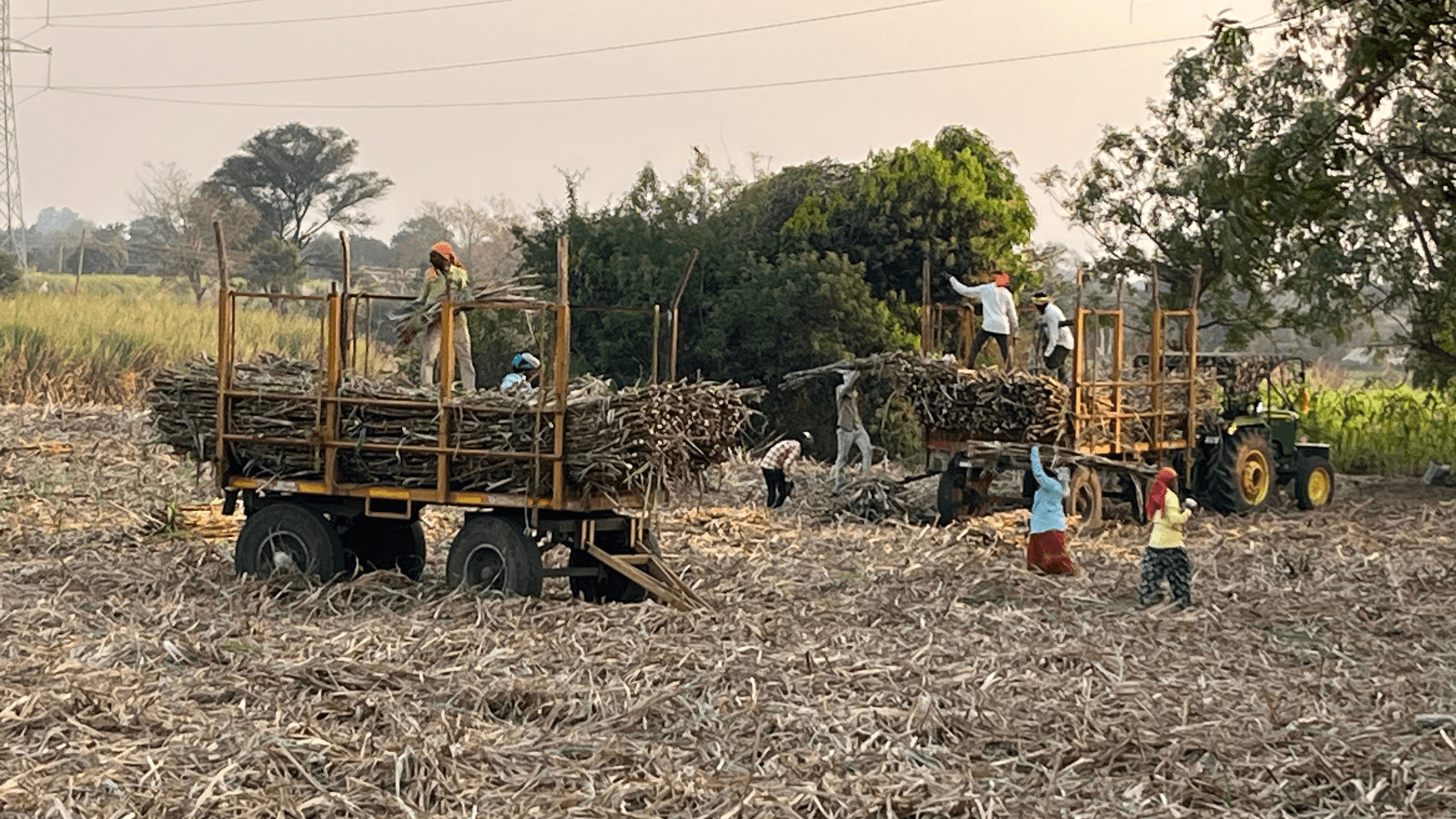
A group of sugarcane cutters in Maharashtra, India.
Mittal Institute: Can you briefly explain your project—how climate-driven seasonal migration for sugarcane cutting in India is linked to labor arrangements and women’s working conditions?
Aditi Bhowmick: Sugarcane cutting, or sugarcane harvesting, is one form of seasonal agricultural migration. It’s temporary migration in the sense that workers stay at the worksite for 6–8 months at a time, then return home, even though they repeat this year after year.
Seasonal and circular migration from rural areas has long been a feature of labor markets in South Asia and other developing regions. What has changed is that this kind of migration is now rising, partly because climate change is shrinking livelihoods in the home regions. As climate shocks reduce local income opportunities, workers’ outside options deteriorate.
These workers are already in a highly vulnerable position vis-à-vis the contractors or farmers who hire them. Climate-related shocks — especially drought in our study area — worsen that vulnerability. Sugarcane cutters typically live in drought-prone parts of Maharashtra in western India. In the summer months, there is virtually no work in their villages. For many, migrating every year to harvest sugarcane is the only sustained source of livelihood, and they have been doing it for 15–20 years or more.
The labor arrangement is distinctive: workers are hired as couples, a husband and wife together. They receive an upfront payment to help them survive the lean season, with the understanding that they will migrate that year and “work off” this advance. This creates a binding dynamic: during the lean season they have already spent the payment, which locks them into repaying it through their labor. Labor-tying contracts and debt bondage have been historically studied in India and South Asia, but this case is notable because it is tightly linked to contemporary migration. Similar arrangements exist in other sectors such as brick kilns, where workers also take large advances and then live and work on-site for extended periods.
Under pressure to work off the advance, and given that their livelihoods depend on labor contractors, the conditions for women are especially harsh. Female sugarcane cutters perform physically demanding work, typically from around 7:00 a.m. to 6:00 p.m. In this setting, menstruation can be debilitating due to the nature of the work and the lack of rest or adequate facilities. But they cannot afford to take a day off, even when in severe pain, so they often work through it. In that context, a hysterectomy can appear to be an attractive solution that allows them to keep working without interruption.
In many cases, their health is already compromised to the point that hysterectomy is sometimes presented as medically necessary. The couple-based hiring norm intersects with another local norm: child marriage. These sending communities have high rates of child marriage, which we know from the public health literature has its own long-term impacts on morbidity and reproductive health. So there is a convergence of factors — early marriage, intense physical labor, and poor health — that heightens the likelihood of hysterectomy.
To summarize: climate change has increased seasonal migration by shrinking local livelihood options, which in turn creates greater scope for labor exploitation. Within this climate-driven context, female sugarcane cutters face acute reproductive health risks. When you combine child marriage, grueling work conditions, and lack of alternatives, hysterectomy emerges as a disturbingly common outcome.
We initially approached this issue from the perspective of reproductive health and hysterectomy. As we learned more, it became clear that the deeper problems lie in women’s (and their husbands’) lack of bargaining power, the structure of the labor contracts, and the broader working conditions. Our current work is focused on understanding those underlying structures and how they contribute to the outcomes we observe.
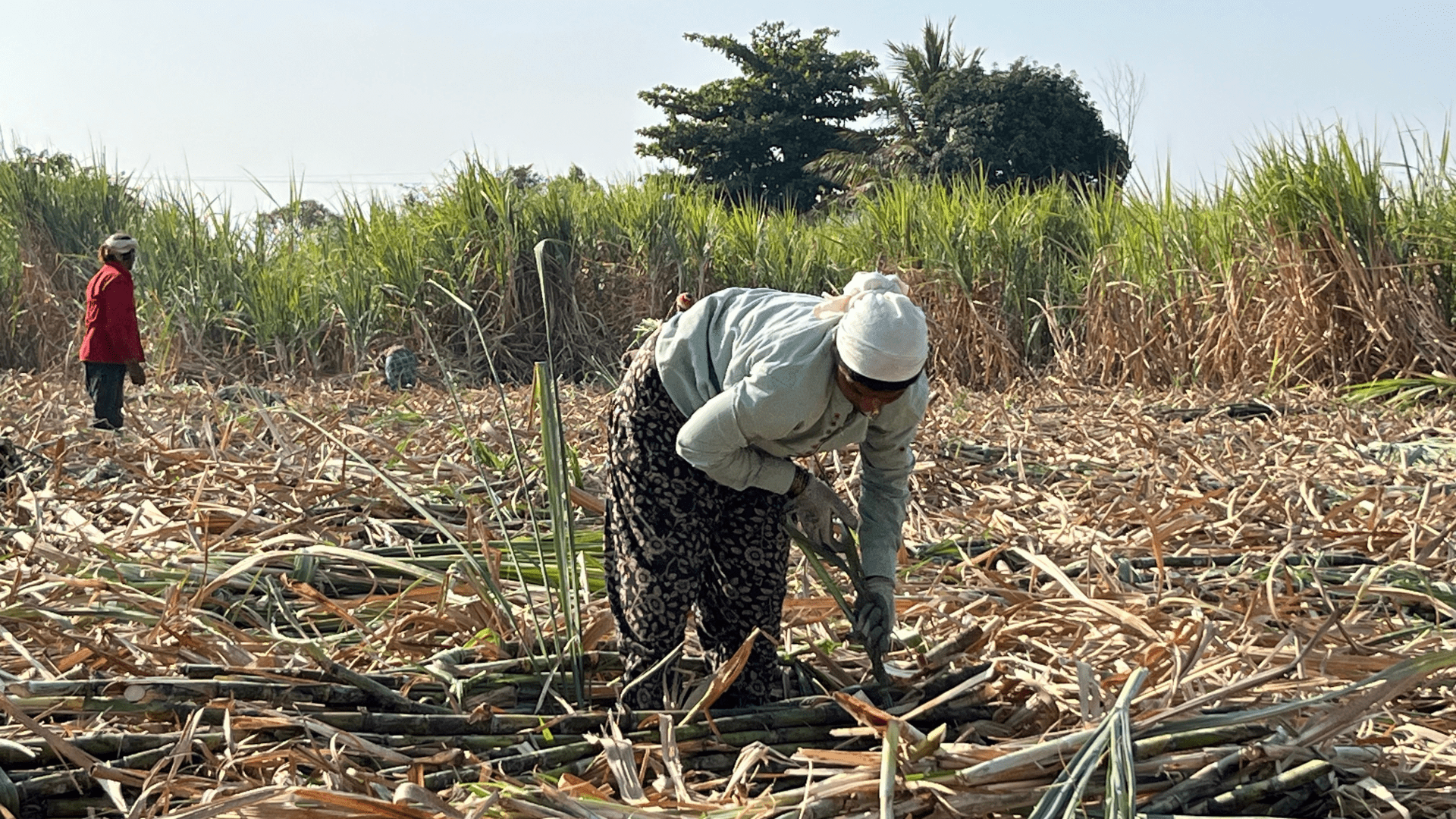
A sugarcane cutter in Maharashtra, India.
Eliana La Ferrara: I’d like to add a few details that stay with me, building on Aditi’s summary.
First, on the migration itself and the extremely harsh living conditions during the 5–6 months away: we asked workers why they keep going year after year and whether they have other options. On our most recent visit, they told us that outside of the sugarcane season, they get at most 10–15 days of work in a year. Therefore migration for sugarcane cutting is essentially their only reliable source of income. Other agricultural work is scarce and very poorly paid. They know conditions are brutal, but they hold on to this work because it offers sustained earnings. That’s also why women feel they absolutely cannot afford to lose these arrangements.
Once on site, menstruation becomes a major issue in a context where breaks are practically impossible. The entire group has to load a truck at the end of the day, and payment is based on the total tonnage of cane cut. Each worker is assigned rows to harvest; if one person falls behind, the group cannot finish loading. Every woman feels responsible for maintaining the pace, because the more cane they load, the more they earn and the faster they pay down the group’s debt. The pressure not to stop doesn’t always come from overt coercion, but from the shared recognition that they must work off the advance.
In this setting, taking time out to manage one’s period feels impossible. They work in remote fields with no private space or water. Most women use cloth rather than pads because they cannot afford sanitary products. There is often nowhere to wash the cloth, so they wear it wet or unchanged for the entire day. This creates serious risks of infection and health problems that go far beyond the pain of cramps. Under these circumstances, the idea of eliminating periods altogether can seem deeply appealing: “If I could get rid of this, I could work.”
From our perspective — coming from societies where women tend to have children later — it was shocking to see high hysterectomy rates among women aged 25–35. But in these communities, because of child marriage, many start having children at 14 or 15. By 25, a woman may already have three or four children. She does not see hysterectomy primarily in terms of lost future fertility. For her, it can look like an acceptable trade-off: no more periods, no more pregnancies; she feels she has already done her part.
This is reinforced by the way hysterectomy is sometimes promoted. In some private clinics, providers have financial incentives to perform surgeries. Women may be encouraged to undergo the procedure without a full understanding of the long-term health consequences. In some cases, as Aditi noted, conditions like uterine prolapse or other complications mean surgery is medically justified, so not all hysterectomies are unnecessary. But in many other cases, they could potentially be avoided if women had better information, better working conditions, and real alternatives.
We’ve pieced these patterns together from multiple sources, including our own focus groups. We’re now trying to understand more systematically how climate stress pushes more people into migration, how that in turn may lower the age at marriage — since marriage allows a girl to join a couple and start earning in sugarcane cutting — and how this entire trajectory ultimately feeds into higher rates of hysterectomy.
We’re now trying to understand more systematically how climate stress pushes more people into migration, how that in turn may lower the age at marriage — since marriage allows a girl to join a couple and start earning in sugarcane cutting — and how this entire trajectory ultimately feeds into higher rates of hysterectomy.
That is the pathway and argument Aditi outlined, and I wanted to add these more concrete details to illustrate what this looks like on the ground.
Mittal Institute: Can you walk me through your recent fieldwork in India—whom you spoke with, what you observed at different stages of the migration cycle, and how your partnership with the women’s labor collective shaped that work?
Eliana La Ferrara: We’ve conducted qualitative interviews with workers at both stages of the migration cycle. One round took place in the summer, when we met them in their villages as they were waiting for the sugarcane season to begin, essentially a period with no other work. We did in-depth interviews then, collecting qualitative information on working conditions, demographics, and especially their experiences of menstruation in the fields. Several women told us that sometimes the pain is so intense they borrow money from the labor contractor to pay for a painkiller injection, get the shot, then return to work because they simply cannot afford to take time off.
This winter, we were able to visit them again at the actual sugarcane worksites, which was extremely illuminating. We visited their makeshift camps at the very start of their day — around 4:30–5:00 a.m. — and saw firsthand the conditions, including the lack of sanitation and toilets. We then observed their work in the fields for the rest of the day: how they cut, bundle, and load cane together. That experience gave us a much clearer picture of the daily realities they had described.
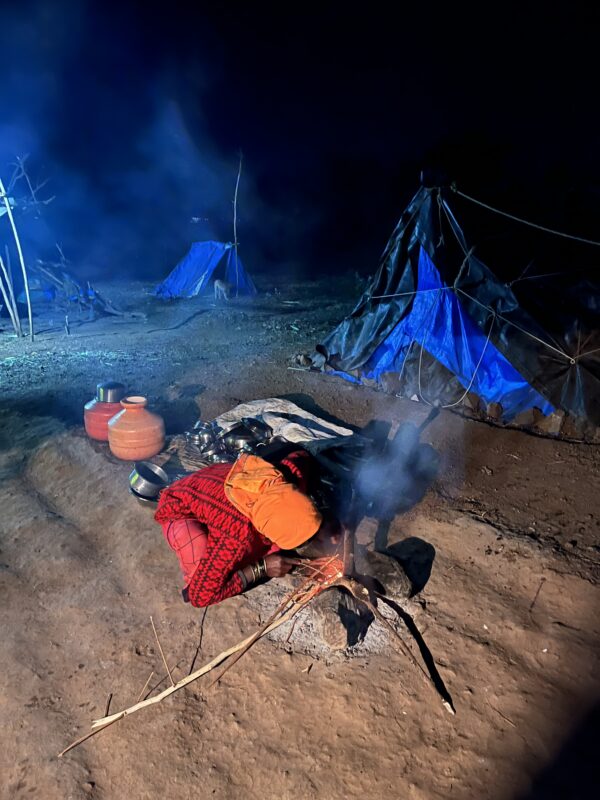
A sugarcane worker starts her day at 4:30 am, here seen starting a fire outside her temporary dwelling (tent) for the season.
As you guessed, this is a very vulnerable group, and we are outsiders, so building trust has been essential. We have been fortunate to partner with a women’s agricultural labor collective. They operate nationally and, in Maharashtra, have worked with sugarcane cutters for nearly three decades. They focus on issues like land and water rights for landless workers and have deep experience specifically with sugarcane cutters. This is a women-led collective with coordinators at district, subdistrict, and village levels, many of whom are former sugarcane cutters themselves.
They have been our conduit in multiple ways. First, they possess an enormous wealth of knowledge and insight about what is happening on the ground. Without them, it would have been very difficult to gain access to workers or to have them open up to us. Second, their long-standing relationships with communities and contractors made it possible for us to conduct interviews during the work season. Talking to women for one or two hours meant reducing daily productivity, so we needed contractors’ consent. Our partner organization’s credibility made those arrangements feasible.
Our original project proposal to Mittal did not include fieldwork. We had planned to rely on existing datasets that had never been linked before, investing heavily in processing and merging them so that we could identify common units, run the analysis, and quantify the relationships we were interested in. Once we began to find patterns in the data, such as links between climate shocks, migration, and child marriage, we needed to understand the mechanisms behind them.
That’s what led us to the field. In focus groups, we asked women directly: at what age did you marry? Most answered 13 or 14. When we asked why girls in their communities marry so early, they immediately referred to sugarcane migration, without any prompting from us. Parents migrate for six months at a time, and they try not to take school-aged children because that would mean missing an entire term. Leaving an adolescent girl behind is seen as dangerous, both in terms of potential abuse and the perceived risk to her “virtue” and safety. The norm, therefore, is to marry her off so that she becomes her husband’s responsibility, and at the same time, she can join a couple for sugarcane cutting and start earning.
These discussions helped us interpret what we were seeing in the secondary data: climate shocks that push people into migration are also associated with higher child marriage rates. The mechanism is tied to how sugarcane is cut and the longstanding practice of hiring couples. This visit gave us essential context. While our qualitative work so far consists of focus groups and interviews, it now informs how we interpret the statistically robust, macro-level results, and helps us articulate the mechanisms that link climate shocks, migration, child marriage, and women’s health outcomes.
Mittal Institute: Approximately how many women did you speak with during this round of fieldwork, and how did the topic of climate and drought arise in your conversations with them?
Eliana La Ferrara: For the recent fieldwork, we visited two groups of sugarcane cutters, each with about 20 women. In total, we spoke with roughly 30–40 women. Not all conversations were one-on-one. We held group discussions with the full teams and then conducted individual interviews with about six or seven women, focusing particularly on how they track daily production and manage finances.
In these interviews, we are very careful not to frame answers. Our goal is to understand the explanations that women themselves hold, so we use indirect or very open-ended questions. The climate angle emerged clearly and unprompted. We didn’t ask, “Is climate change the reason you migrate?” Instead, we asked what they could do if they stayed in the village — what other agricultural work or alternatives they had. Their response was that there is essentially nothing: repeated droughts mean very little work. They also told us that even this year the sugarcane season will be shorter. They expected to be away for six months, but because there is less cane, it will likely be only four or five. That is serious, because they took advances assuming a six-month season.
So climate came up in their own narratives: there is less cane, there have been droughts, and opportunities at home have shrunk. We then pair these accounts with objective weather data, identifying where droughts have been more or less severe, and hope to trace migration patterns and related outcomes in that way.
Mittal Institute: Thinking about real-world impact, how can your findings help shape more effective policy interventions aimed at reducing gender-related health inequalities linked to climate change?
Eliana La Ferrara: One thing I can say, at a more macro level, is that if climate‑induced migration is at the root of this, then policies that reduce the impact of climate shocks in origin areas are crucial. That could include index insurance or developing alternative livelihoods that are less dependent on agricultural productivity. In that spirit, Aditi’s own work on digital jobs for marginalized populations points to alternative livelihoods as a potential solution.
A second approach is to improve conditions within the existing system, assuming people continue cutting sugarcane. That means improving the terms of agreements with contractors and helping workers avoid remaining trapped in debt. We are exploring the idea of financial tracking tools or training for couples — ways to plan advances better and track repayments and income over the season to strengthen their financial management.
We are still in early discussions with our partner organization about what is feasible, especially given very low literacy rates, which rule out some standard interventions used elsewhere. But we see clear potential to design tools tailored to this context.
Stepping back, the core problem is the extremely poor outside options: there is almost no other work for these marginalized groups. So at the macro level, developing alternative livelihoods in these regions is something state authorities should be seriously considering.
Aditi Bhowmick: Looking ahead to next year, we’ve broadly settled on ground-up financial empowerment of these workers as our main focus. As you’ve already noted, their situation is very complex: they take advances, must anticipate weather shocks, and face the risk of death and other emergencies.
Our plan is to see what we can do on the financial empowerment front through a sustained engagement with the workers and the collective. We’re not trying to reinvent the wheel. We are talking closely with the collective to understand interventions they have already piloted, what has worked, and what has failed, and then building from there. We’re combining their experience with evidence from development economics research, and using that to design a financial empowerment intervention to target the relentless debt traps these women are caught in, and hopefully ultimately improve their bargaining power in some form.
Interview conducted by Kellie Nault, Writer/Editor at the Mittal Institute
☆ The views represented herein are those of the interviewees and do not necessarily reflect the views of the Mittal Institute, its staff, or its steering committee.