
The Mittal Institute India office hosted the Rethinking Nutrition and Food Systems for Planetary Health in South Asia webinar, moderated by S.V. Subramanian, Professor of Population Health and Geography, Social and Behavioral Sciences, Harvard T.H. Chan School of Public Health. The speakers included Walter Willett (Professor of Epidemiology and Nutrition), Shilpa Bhupathiraju (Assistant Professor of Nutrition and Epidemiology), and Purnima Menon (Senior Director, Food and Nutrition Policy; Acting Senior Director, Transformation Strategy).
Prof. Subramanian opened by underscoring the scale of the regional challenge: South Asia is home to “nearly two billion people — about 25% of humanity,” marked not only by population size but by extraordinary population density. The region faces severe water scarcity, largely semi-arid conditions, and heavy reliance on fragmented smallholder agriculture. With freshwater constraints, stagnating productivity since the Green Revolution, and limited scope to expand land, these are structural pressures. At the same time, rising incomes mean that “it’s not just the need for food — people want food of different types,” making sustainable nourishment an increasingly urgent and complex task.
Building on this, Prof. Willett reflected on the EAT–Lancet Commission, launched to answer whether it is possible to “feed the world a diet that is both healthy and sustainable.” The 2019 report, “Food in the Anthropocene: the EAT–Lancet Commission on healthy diets from sustainable food systems,” introduced the “planetary health diet,” a largely plant-forward, flexitarian pattern summarized simply as “1 plus 1”, about one serving of dairy and one serving of another animal-source protein per day, with red meat kept low. The 2025 report, “The EAT-Lancet Commission on healthy, sustainable, and just food systems,” added a third dimension — food systems that are not only healthy and sustainable, but also just. He noted that global adoption of this pattern could prevent roughly 15 million deaths per year, but only if three shifts occur together: dietary change, improvements in agricultural production, and major reductions in food loss and waste. Importantly, he emphasized that country-specific analyses are publicly available through an interactive platform on the EAT website, allowing users to explore dietary, production, and environmental scenarios across contexts. Compared to 2019, the 2025 report carries a stronger message of urgency: environmental changes are not linear, and we are approaching tipping points, meaning action cannot be delayed.
Global adoption of [the planetary health diet] could prevent roughly 15 million deaths per year, but only if three shifts occur together: dietary change, improvements in agricultural production, and major reductions in food loss and waste.
Prof. Shilpa translated these principles into the cardiometabolic context, particularly for India and other LMICs. Drawing on evidence from the MASALA cohort, “Adherence to the EAT-Lancet Planetary Health Diet and Cardiometabolic Risk Markers in the Mediators of Atherosclerosis in South Asians Living in America (MASALA) Study,” and recent national data, she emphasized that diet quality matters enormously for South Asians.
The healthiest cardiometabolic patterns closely resemble planetary health diets — rich in whole grains, legumes, fruits, vegetables, and nuts, and limited in refined grains and processed foods. Importantly, she cautioned that “even within vegetarian diets, the quality matters.” In India, high consumption of refined carbohydrates combined with low protein intake is particularly concerning in a population already predisposed to insulin resistance and diabetes. Traditional foods such as millets and pulses, she noted, are real national assets that align with both metabolic health and planetary sustainability.
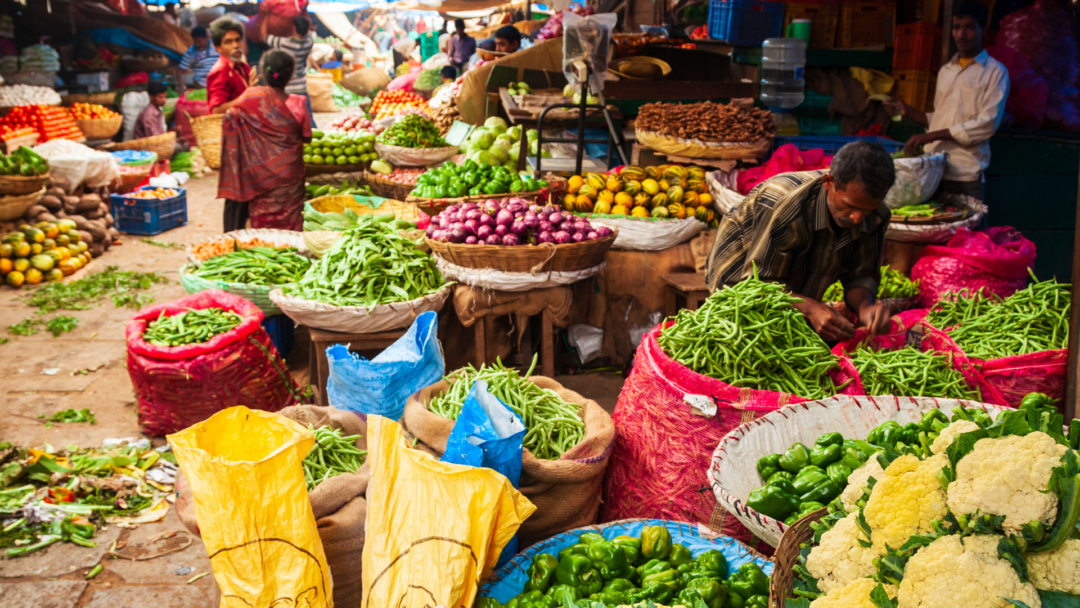
Fruits and vegetables at a market | Adobe.
Dr. Purnima brought a practical, systems-level perspective, drawing on IFPRI’s Global Food Policy Report and field research across South Asia. She emphasized that transforming diets requires addressing what drives food choices: affordability, accessibility, availability, and desirability. In many South Asian countries, more than half the population cannot afford a healthy diet. Even rural farming families depend predominantly on markets for food, and ultra-processed foods are increasingly shaping preferences. “People are not choosing in a vacuum,” she noted — choices are shaped by price, access, and environment. She also highlighted gender inequities, observing that while men and women both engage in agriculture, food preparation “in all the countries where we did the surveys” is done predominantly by women. Sustainable transformation, she argued, requires coherent policy, effective implementation, and engagement across production systems, markets, and social norms.
The session closed with a forward-looking question: if one change could be prioritized over the next decade to improve both planetary and human health in South Asia, what would it be? Prof. Shilpa called for promoting more plant protein and reducing refined grains. Dr. Purnima emphasized empowering consumers, particularly young people to demand more and better from the food system, noting that “food systems do respond to what people want.” Professor Walter added that beyond any single shift, “this does need to be a transformation that involves all sectors of society.” Only collective, coordinated action, he concluded, can deliver lasting benefits for both human and planetary health.
Written by Yuvika, Climate Coordinator at the Mittal Institute India office.
☆ The views represented herein are those of the interview subjects and do not necessarily reflect the views of the Mittal Institute, its staff, or its steering committee.