
Fowzia Karimi, an Afghan-American writer and illustrator, joined Harvard University this academic year as a Radcliffe Fellow. Fowzia’s work weaves fable, dream, memory, biology, and war while exploiting the interplay between text and image on the page. At Radcliffe she is working on The Age of Flowers, a collection of Afghan fairy tales brought to life with her watercolor paintings. We spoke to Fowzia to learn more about her work at Harvard.
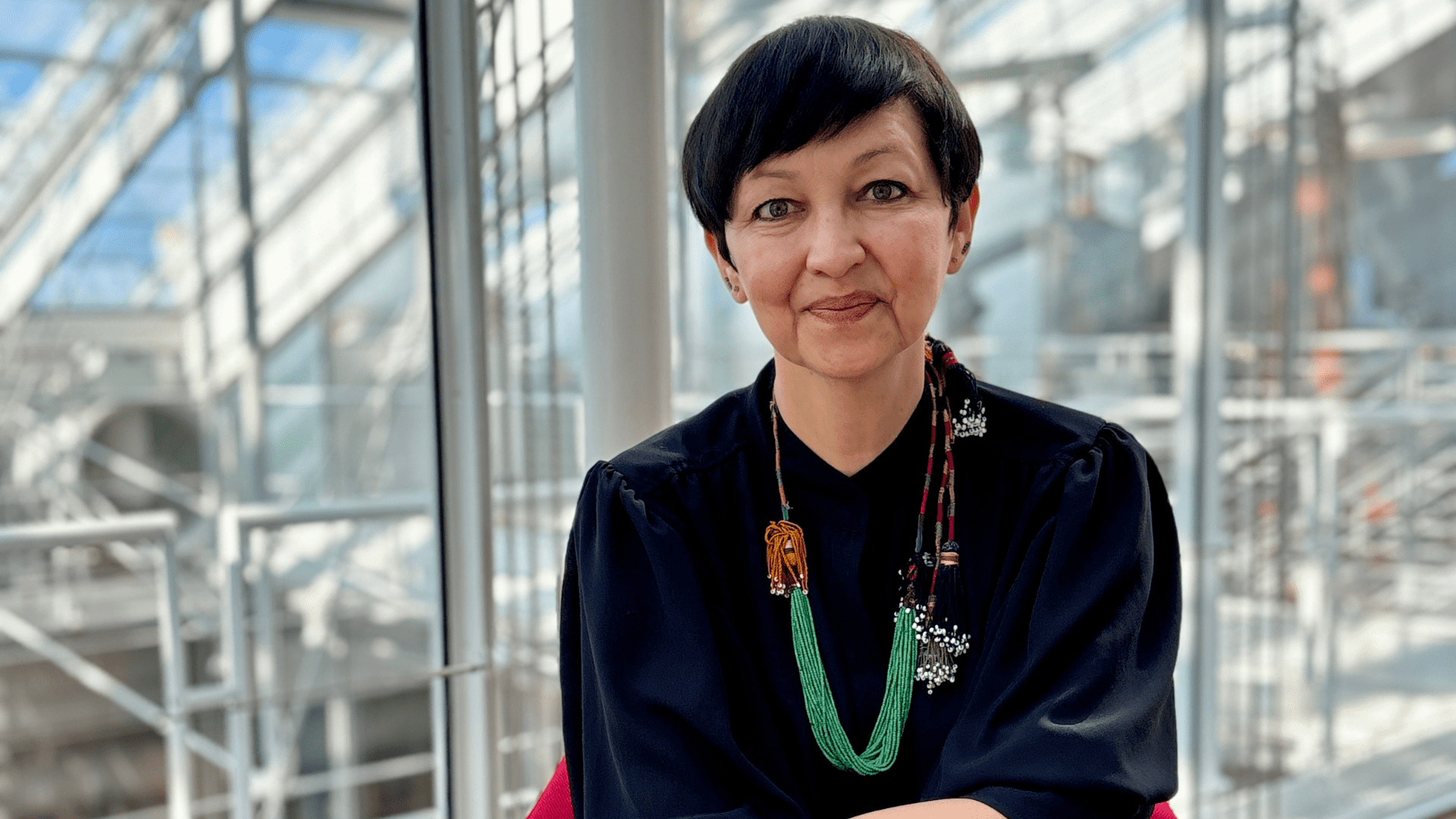
Radcliffe Fellow Fowzia Karimi, a writer and illustrator from Afghanistan | Photo by Christian Fagerlund.
Mittal Institute: Fowzia, thank you for speaking to us! Can you tell us how you first discovered the intersection of writing and illustration in your work? Was there a particular moment, story, or experience that made you realize this was the form you wanted to pursue?
Fowzia Karimi: I would say it was there from the beginning. I’ve always had a very active inner visual apparatus; both in waking life and in my dreams, images play vividly and continuously. On the other hand, books and reading were not family tradition during my early childhood in Afghanistan. But storytelling was because the oral tradition was vital and ubiquitous. The fairy tales I listened to as a little girl conjured fantastical imagery in my mind. When I was old enough to read and write, I found myself wanting to illustrate what I wrote because the visual vocabulary was already there and married itself beautifully to that of language. Beginning in grade school, unprompted, I often illustrated my homework assignments. I’ve always illustrated my journals. I feel that each, text and image, use their own unique mechanisms to communicate. When I turned to books, the practice was already well-established in my life and I felt that the work I created wasn’t complete, or didn’t fully speak, unless I wrote and illustrated it.
Mittal Institute: Your work seamlessly weaves together words and images. How do you determine which elements of a story are best expressed through illustration and which through text?
Fowzia Karimi: I don’t often consciously make that decision. When writing, I feel that language has substance and can be shaped, much as a vessel can be shaped in clay. It is malleable, it gives in places, it’s resistant in others, pushing back with its own integrity or logic. The practice of writing, for me, is a very three-dimensional, almost corporeal, experience, not unlike shaping clay with ones hands.
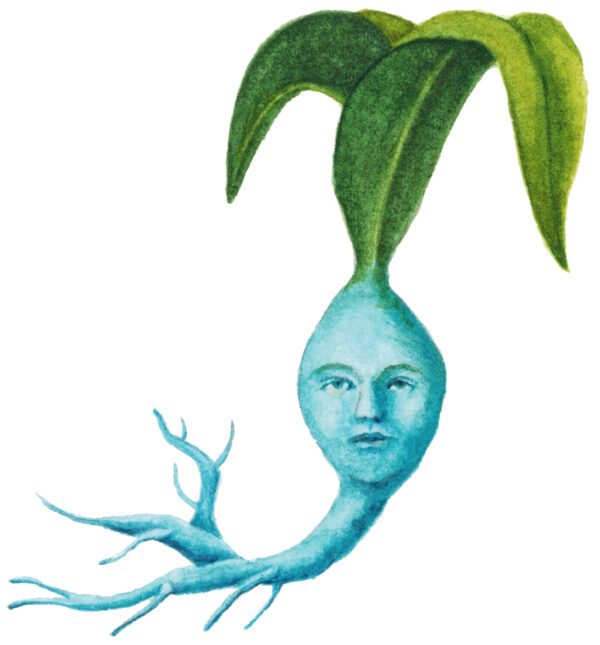
Illustration from Above Us the Milky Way. A mythological turnip-like creature, created to accompany the piece “Shadow Play.” Though not directly referenced in the text, the image evokes the sense of wonder and quiet magic experienced by the five sisters on their uncle’s farm in Afghanistan.
Images, perhaps paradoxically, arrive already formed in my mind, as if formed and cast in the unconscious. Unbidden, images make their entrance onto the stage, often loudly, even awkwardly, and with a sort of urgency, as if to say, “Yes, you’ve got that bit of the story fixed in writing, but it isn’t complete without this!” These images are often symbolic, speak through both form and color, and point to things I myself may not be consciously aware of. But they make sense as soon as I see them and I do my best to depict them on the page as they first appeared in my mind.
Mittal Institute: You are the author and illustrator of Above Us the Milky Way (Deep Vellum, 2020), a personal abecedarium chronicling war, migration, beauty, love, longing, and loss. When you created this book, did the words or images come first, or did they evolve together? And what do you hope readers take away from this book?
Fowzia Karimi: The words came first because the story, based on my early childhood, had always been there, almost like an incantation. But as I wrote, the images followed to illuminate aspects of the story that language couldn’t touch. For example, a painting of a victim of the war, wrapped in shrouds and anointed by his innocence, speaks to the indiscriminate nature of war. When you think about the untold number of Afghans killed in a war that is about to enter its fifth decade, many of them buried in unmarked or mass graves during the most devastating years of the war, language can’t touch the loss. But a quiet painting may, at least, attempt to honor the innocent war-dead.
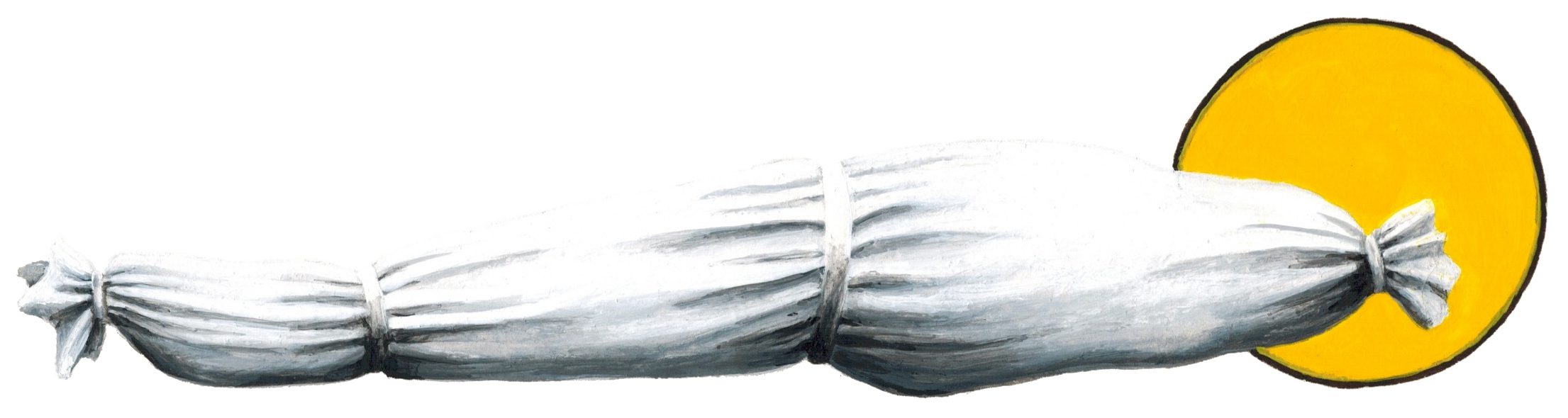
Illustration from Above Us the Milky Way. This illustration depicts a teenage boy facing conscription into the Soviet army. In an attempt to protect him, his mother conceals him in a funerary shroud; tragically, he dies of fear. The scene draws on a real story passed down through the artist’s family, set against a time when the presence of the dead was an all-too-common reality.
Mittal Institute: Much of your work reflects war and displacement. How do you transform such heavy themes into art?
Fowzia Karimi: With love. Love for all that has been lost—innocence, life, culture, home, family. Love for those who’ve suffered these losses. And love for art. Art, through its processes, metabolizes and transforms even the darkest elements into something akin to light.
Art, through its processes, metabolizes and transforms even the darkest elements into something akin to light.
Mittal Institute: Your current work, The Age of Flowers, is an illustrated collection of Afghan fairy tales, gathered from interviews with Afghans in Kabul and the diaspora, preserving stories nearly lost after decades of war. What inspired you to focus on this topic, and how did you go about finding and collecting these stories, especially given that many had been nearly lost?
Fowzia Karimi: Fairy tales were a regular part of my early childhood. Each family had their own gifted storyteller(s). In our family, it was my aunt Guljon. Her fairy tales were utterly transportive and inspired in me a lifelong love for story. When we immigrated to Southern California, I somehow found their analogs at the local library and read voraciously from volumes of the Brothers Grimm, Hans Christian Andersen, and Russian fairy tales. In fact, it’s how I learned to read in English. I’ve never stopped reading those tales, but over the years, I realized I couldn’t recall the Afghan tales at all. Every so often I’d ask others in the diaspora if they could recite any and found, again and again, that no one could remember them. When my aunt Guljon came out to visit from Germany in 2012, I got a recorder and sat down with her, thinking I was going to the source. But she too had forgotten many of them. This created a sense of urgency in me and I began carrying my recorder with me on visits to family and friends. It was mainly the older women who remembered the tales, and most of them have now passed on. The recordings I made sat quietly for a dozen years, while I worked on other projects. My endeavor has been a creative, not an ethnographic one, so my hope is that many more stories survive.
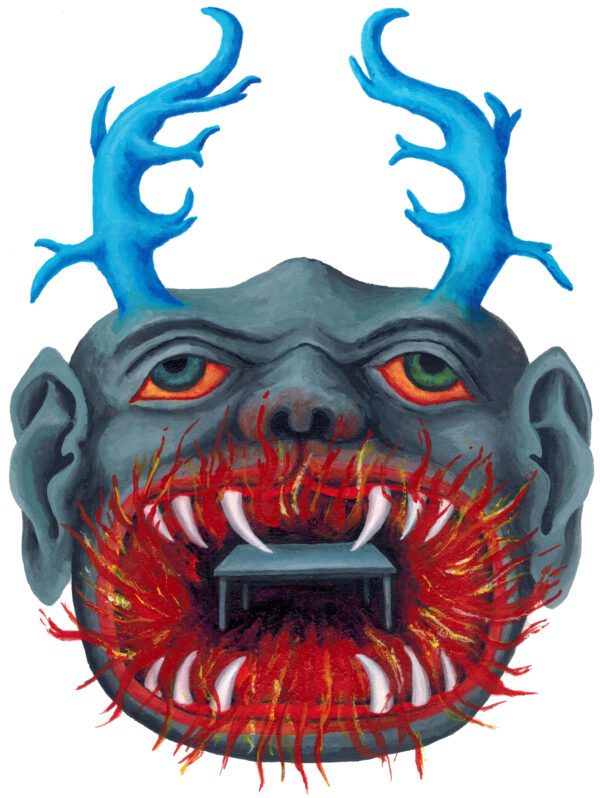
Illustration from Above Us the Milky Way. Inspired by the medieval motif of the “Hellmouth,” this image reimagines the form as the entrance to a Soviet-run torture chamber. It accompanies a piece recounting the imprisonment and torture of a family friend, transforming a historical symbol into a stark reflection of lived experience.
Mittal Institute: Were there particular tales that stood out to you as particularly powerful or poignant during your research?
Fowzia Karimi: As I’ve been transcribing and translating the Afghan fairy tales, I’ve been amazed by how elements or entire tales have analogs in the Western tradition. It should be unsurprising as the oral fairy tale tradition is an ancient one and these stories have traveled with humans over millennia and across continents. But it’s still a thrill to come across a scene that has a maiden letting down her extraordinarily long hair so that a witch with a poison apple might climb up into her locked tower (a scene analogous of both Rapunzel and Snow White).
Mittal Institute: You describe the book as a “palimpsest” of history and war. How do you hope The Age of Flowers will impact readers, particularly those unfamiliar with Afghan folklore?
Fowzia Karimi: I think that readers may come away with the same understanding I’m having as I work on the book, that the Afghan tales are not very different from ones they are familiar with. The larger, and less explicit, story of war as an agent of cultural erasure will hopefully come through as well.
Mittal Institute: How has your time at Harvard influenced your research, storytelling, or artistic process?
Fowzia Karimi: The Radcliffe Fellowship at Harvard has been nothing but a boon. The environment created by the Radcliffe staff and my fellow fellows is wonderfully charged and inspired, while being supportive and conducive to doing focused work. This project has been with me for over a dozen years and the fellowship has allowed me to finally and fully dive in. And what I’ve found is that it’s much more expansive and the process even more blissful than I’d anticipated. Like the animal helpers in fairy tales, books, once started, have an uncanny way of guiding their author through the journey of creating them.
☆ The views represented herein are those of the interview subjects and do not necessarily reflect the views of the Mittal Institute, its staff, or its steering committee.