The South Asian Studies Colloquium at Harvard brings together scholars, students, and enthusiasts to share research and ideas across disciplines. With presentations by graduate students, faculty, and visiting fellows, plus a guest lecture series, each session encourages lively dialogue and feedback. Open to the entire Harvard community, the colloquium fosters connections, sparks cross-disciplinary conversations, and explores the rich histories and cultures of South Asia.
We spoke with Colloquium organizers Seton Uhlhorn, a Mittal Institute Graduate Student Associate and Ph.D candidate specializing in classical Urdu literature, and Afeef Ahmed, a Ph.D candidate who studies Early Modern South India and the Indian Ocean, to learn more about what inspired the series.
Mittal Institute: Thank you, Seton and Afeef, for speaking with us. To start, could you share what drew you to Harvard’s South Asian Studies Department? We’d also love to hear about your specific research interests and how your time in the department has shaped your career goals.
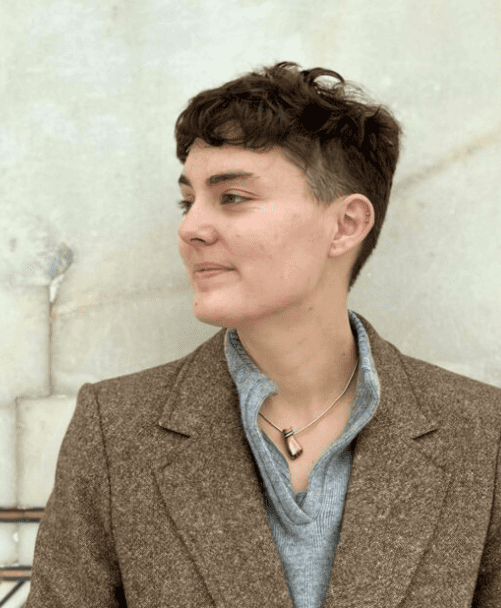
Seton Uhlhorn, a Mittal Institute Graduate Student Associate and Harvard Ph.D candidate
Seton Uhlhorn: I applied to Harvard’s Department of South Asian Studies and accepted my admissions on the recommendation of my undergraduate advisor at the University of Texas at Austin, as it was where he completed his doctoral work, he told me about what a collaborative place Harvard and Cambridge/Boston was and when I arrived, I was immediately impressed by the faculty and my peers across departments. I work on classical Urdu literature, led by questions of form and genre. My dissertation is on the late-eighteenth-century poet-grammarian, Inshallah Khan Insha who is well known for writing the first grammar of Urdu by a native speaker and the canonical short story of Queen Ketki (rani ketki ki kahani). Our department allows a great deal of independence to each PhD student, allowing us to each chart a unique path of study. The independence of study, I think, will continue to benefit me even long after I graduate, as it has empowered me to ask my own questions and follow my interests wherever they lead.
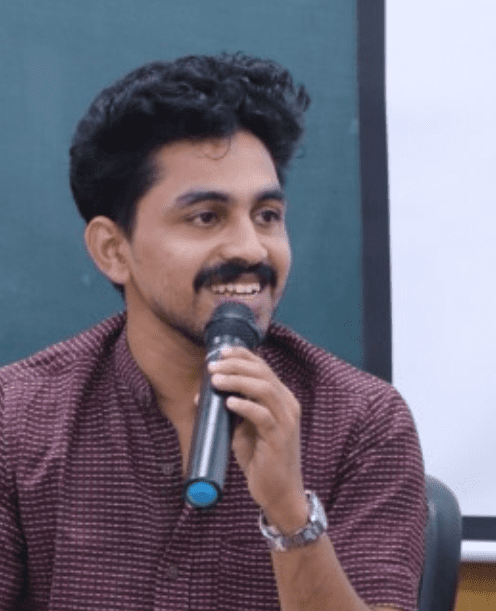
Afeef Ahmed, a Harvard Ph.D candidate
Afeef Ahmed: For me, it was the intellectual vibrancy and textual focus of the Department of South Asian Studies that attracted me, primarily. The possibility of collaborating with excellent departments and universities around made my choice easier. I work on the Indian Ocean littorals of 17th and 18th-century South India by focusing on the formations of muslim communities in the Malabar and Coromandel Coasts. By using a combination of philological and archival research, I try to understand how the agricultural practices and riverine waterways, along with their trans-oceanic connections, helped them to form a distinct Islamic tradition in South India. The department’s focus on textual traditions has helped me to take texts seriously in my research and not as passive sources of evidence.
Mittal Institute: What inspired the creation of the South Asian Studies Colloquium, and how has its mission evolved since its founding?
Seton Uhlhorn and Afeef Ahmed: The South Asian Studies Colloquium has seen many iterations over the last decade under different names. All of the graduate-led student programming, including ours, which current students Poorna Swami and Aaron Minnick have also organized, was designed to build bridges among academic disciplines focused on the study of South Asia. The students in the Department of South Asian Studies are but a small number of the students and faculty engaged in research related to the subcontinent. We have always hoped that our programming would become a hub or home for students working on South Asia, both within and beyond our own department.
Mittal Institute: Could you describe how a typical session unfolds and what makes the feedback process unique or valuable?
Seton Uhlhorn and Afeef Ahmed: We usually have two types of events for the colloquium. One is the Senior Scholar Lecture, and the other is the Work-in-Progress presentations. For the Senior Scholar Lectures, we usually invite accomplished scholars in South Asian Studies to speak on their areas of expertise, including their upcoming works. We plan it so that it serves as an opportunity for our faculty and students to connect with them and their work, and vice versa. The Work-in-Progress meetings are usually held as informal events where both faculty and students can present their works-in-progress, such as rough drafts of articles, dissertation chapters, and even abstract ideas. These meetings are venues where they can get feedback from their peers and fellow scholars to meet the next writing goal.
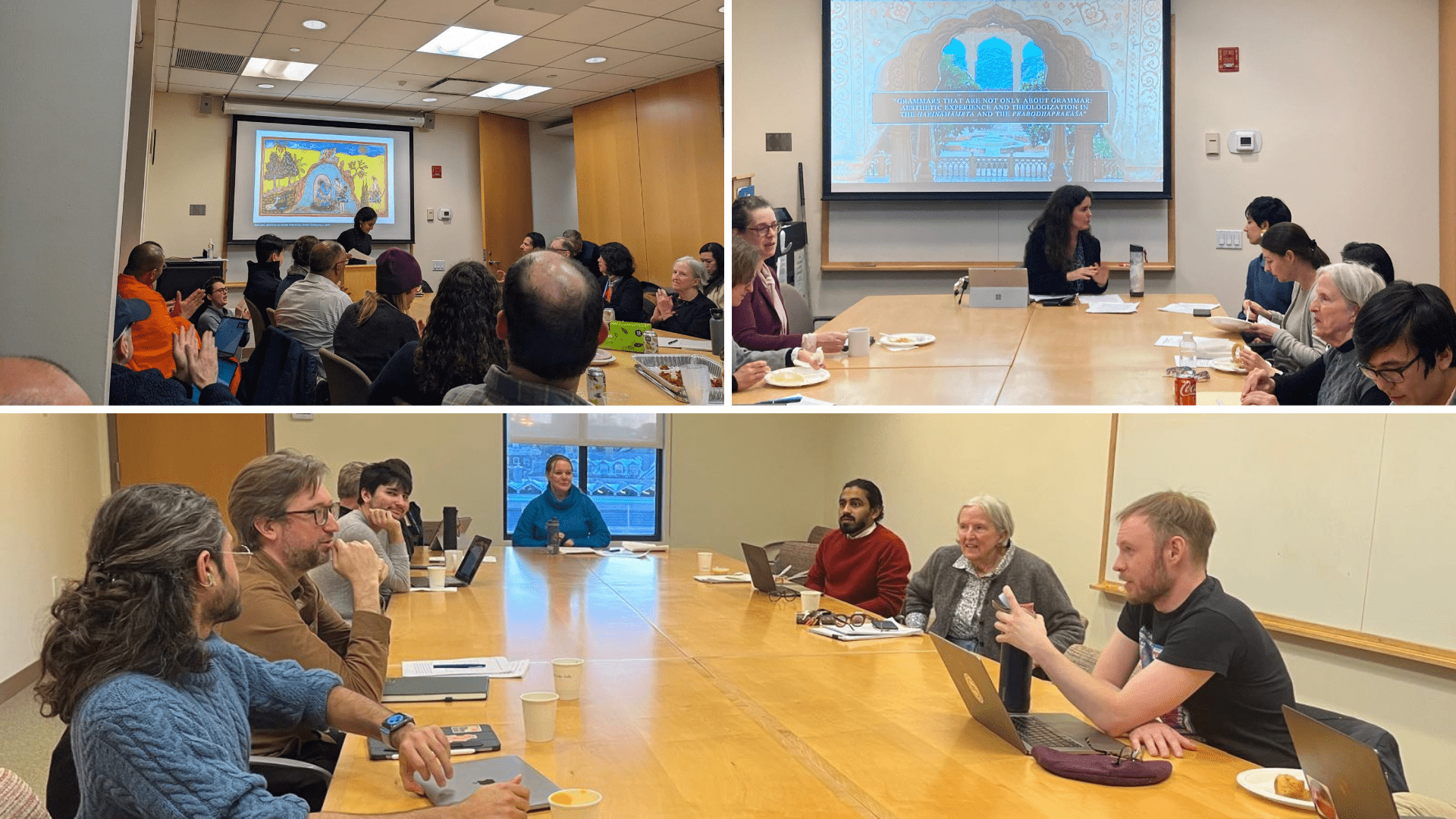
Images from past South Asian Studies Colloquiums.
Mittal Institute: A unique component of the program are guest lectures. How are guest speakers selected, and how do they complement the graduate and faculty research presentations?
Seton Uhlhorn and Afeef Ahmed: The Colloquium guest lectures are usually expert talks by accomplished scholars in the field. We usually bring in diverse kinds of speakers, given that South Asia has such a rich and long history of texts, traditions, and practices. For instance, our inaugural guest lecture this year was by Eric Gurevitch, an assistant professor of the History of Sciences at Harvard. Prof. Gurevitch gave a talk on Sanskrit texts and the artisanal history of Western India. In contrast, our most recent speaker, Fransencsa Orsini, Professor Emerita of SOAS and one of the finest scholars of Indo-Persian, Hindi, and Urdu literature, gave a talk on A.R Khatoon, whom she fondly calls Urdu’s Jane Austen. This diversity, we believe, ensures that the guest talks stay true to the commitments of the department and South Asian Studies in general, thus serving its purpose of addressing the South Asian region in its breadth and depth.
Mittal Institute: Can you share a memorable lecture or moment from the series that sparked discussion or collaboration?
Seton Uhlhorn and Afeef Ahmed: Even though we usually organize our events as either expert talks or work-in-progress meetings, we have conducted a workshop led by Franseca Orsini. The workshop dealt with Cold War magazines and print culture, where magazines in Hindi, Urdu, English, and German were read closely. This event drew attention from diverse departments, including comparative literature, European studies, Near Eastern languages and civilizations, and Cold War studies. Since Prof. Orsini’s work spans different languages and genres across various regions, we collaborated with Mahindra Persianate Studies and the Agha Khan Center for Iranian Studies to organize this lecture-workshop series. This event is a great example of the diverse and meaningful collaborations that an academic community like Harvard can foster. We want our events to be as diverse as this, so that even a student of European studies or comparative literature finds something useful in them for their own work. This ambition, we believe, is also helpful in imagining academia as a community that flourishes on mutual collaborations. This event was a testament to that.
This event is a great example of the diverse and meaningful collaborations that an academic community like Harvard can foster.
Mittal Institute: What are the future plans or goals for the colloquium in terms of topics, participation, or outreach?
Seton Uhlhorn and Afeef Ahmed: We plan to continue our core work, including guest lectures and work-in-progress meetings. Along with that, we also plan to diversify our events by offering more workshops, working groups, and seminars. Regarding our participants, we are really glad that our work-in-progress meetings have attracted attention from those outside our academic community. We intend to extend it to the larger South Asian community and to people interested in South Asia. The South Asian Studies Department occasionally organizes South Asian Tea evenings, where the community can join and interact with students and others in the area. In the future, we plan events to coincide with the tea with the goal of more community participation. We also hope to collaborate with the Lakshmi Mittal Institute on future events, especially as we expand our scale and outreach.
☆ The views represented herein are those of the interviewees and do not necessarily reflect the views of the Mittal Institute, its staff, or its steering committee.