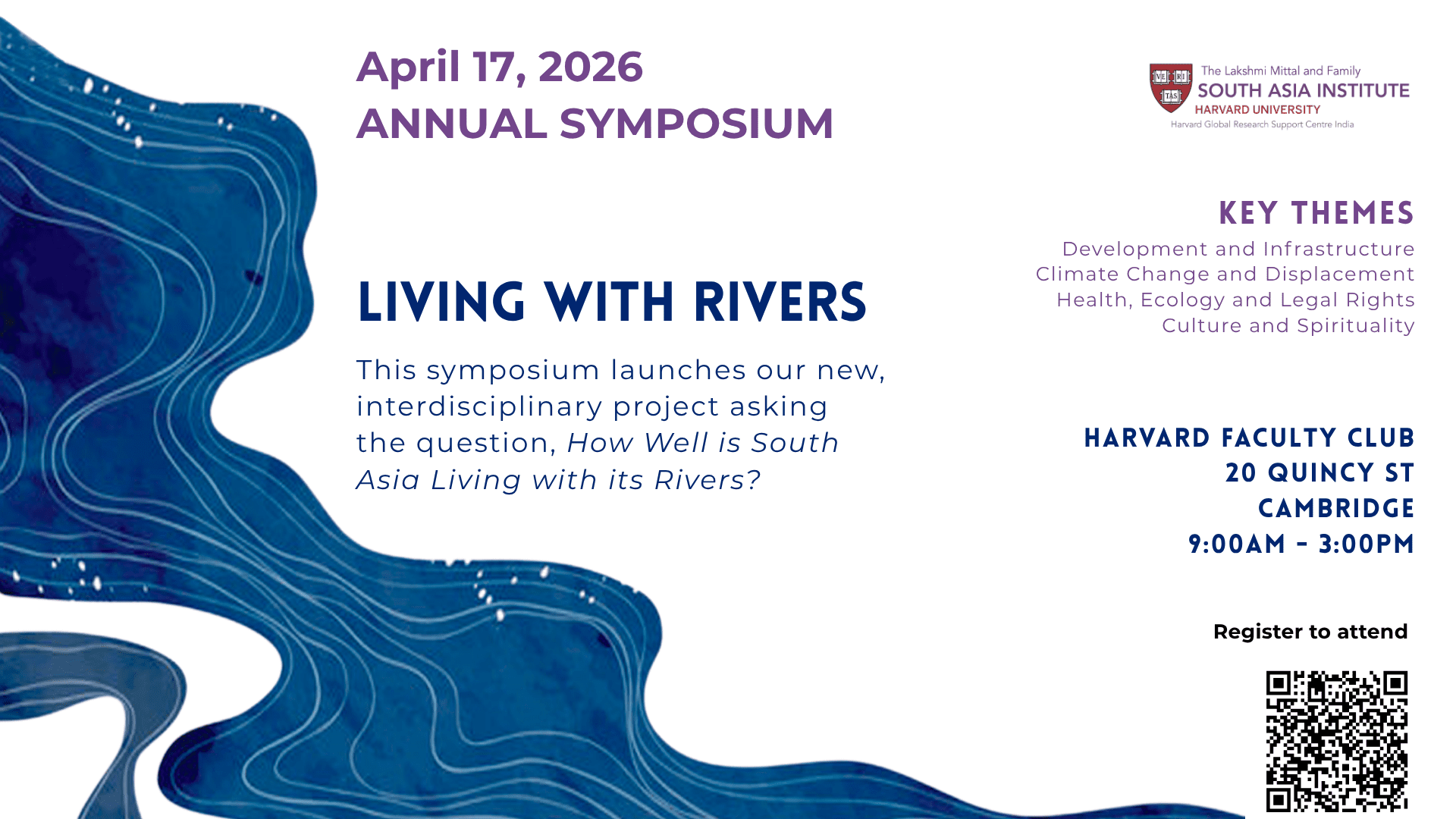
The Mittal Institute’s Annual Symposium: Living with Rivers on April 17 marks the launch of Living with Rivers, our new interdisciplinary initiative. Bringing together leading scholars and policy experts, the symposium will explore a central question: How well is South Asia living with its rivers? Among this year’s speakers is Nagaraja Rao Harshadeep (Harsh), Global Lead for Disruptive Technology in the Sustainable Development Practice Group, World Bank.
We spoke with Harsh about bridging the gap between water data and decision-making.
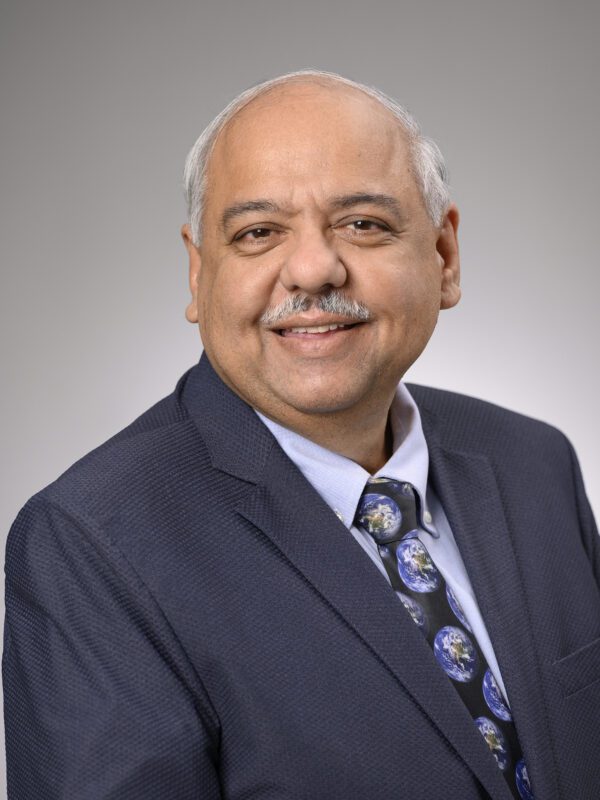
Nagaraja Rao Harshadeep
Mittal Institute: Harsh, you’ve worked extensively across watersheds, data systems, and emerging technologies. Where do you see the biggest gap today between the data we have and the decisions we actually make about water?
Nagaraja Rao Harshadeep: I have been privileged to work in several interconnected areas for us towards a more livable planet (which is part of the new World Bank Group mission).
We try to help all strengthen aspects of the data value chain – to go from data to information to knowledge to decision support. Often the challenge is that we don’t explore all aspects of the data value chain ecosystem. Fragmented views result in fragmented solutions and there is a need to explore the chain not starting from the data but from the planning and operational decisions to be supported. A key challenge in this regard is a legacy (especially in the developing world) of decisions not well-rooted in data and analytics (a culture of “data-free analysis and analysis-free decision making” as a colleague put it when I joined the Bank three decades ago this year).
Other challenges include a lack of open data, poor access to cloud infrastructure and digital services, challenges with modern skills, modern tech skills in the agencies responsible, and access to evolving global good practices.
Mittal Institute: How does your work push us to see water not just as a resource to manage, but as a system we’re fundamentally part of?
Nagaraja Rao Harshadeep: Harvard was the birthplace not only of environmental systems engineering (or sanitary engineering as it was called when Gordon Fair was in my old Department) but also on the creation of the entire field of integrated Water Resources Systems Analysis thinking during the Harvard Water Program – I was privileged to benefit by learning from professors who had worked with this seminal program that originated in the late 1950s. The program had brought together engineers, economists, and social scientists (in fact, Arthur Maass who led this program was a political scientist) to develop a multi-sectoral approach to optimizing water resources planning and management.
This need to think in a more integrated systems ways was ingrained in those of us who went to Harvard studying water and environmental systems in subsequent decades. The inspiration that those molded through the Harvard Water Program – especially my late professors Peter Rogers, Myron Fiering, and Robert Dorfman – provided me will forever shape the way I think about everything!
The inspiration that those molded through the Harvard Water Program … will forever shape the way I think about everything!
I didn’t fall too far from the tree, and in the last three decades at the World Bank (can’t believe that this year, it will be 30 years since I joined the Bank on Earth Day!) I have managed to lead or support a range of operational projects and analytical activities in all parts of the planet (from Malawi and Afghanistan to Central Asia and the Amazon). In more recent years, as I transitioned from an actor in a lead role to best supporting actor, I have been a Global Lead for Watersheds to promote more multi-disciplinary thinking in a spatial, hydrologic systems context and more recently a Global Lead for “Disruptive Technology” to help reimagine our support to countries using a new range of evolving technologies. It has also been a pleasure to create a Disruptive “KIDS” (Knowledge, Information & Data Services) Helpdesk to support our frontline teams with support on cutting-edge technologies and rapid research. As the designated “AI Champion” for our “Planet” Global Vertical (that includes water, environment, agriculture, and climate) at the World Bank Group, I am also helping us better understand and responsibly leverage Artificial Intelligence in our work.
This has helped us institutionalize the integrated planning and management of river basins or watersheds at all scales – from project-level micro-watersheds to national systems to transboundary basin cooperation in the Nile, Amazon, Aral Sea, Ganges-Brahmaputra and many other basins that represent fundamental development challenges and new cooperative opportunities. This is essential to knit together traditionally “siloed” disciplines such as agriculture, energy, land and water resources management, forests, ecosystem services, and climate into a more “systems” framework shaped by my learning at Harvard.
[These water systems are also getting more complex – or at least our understanding of these is getting more nuanced – for example, evaporation from one part of a system can come down as precipitation in a completely different system – and, as we learn more about the moisture cycles in these “precipitation-sheds” and “atmospheric rivers”, we get a whole new appreciation for new systems linkages. So deforestation in the Congo or Amazon doesn’t just impact that basin but also others hundreds of miles away!]
Mittal Institute: In your opinion, what would it take to fundamentally rethink our relationship to water?
Nagaraja Rao Harshadeep: Rethinking our relationship to water requires what I like to call the three is:
– Information: Identify the larger systems context; find improved ways to tap into a range of new technologies (satellites, aerial/drone surveys, open data services, cloud analytics, and AI) to improve the data value chain. Enhance open data and open science. Learn from evolving global good practices. Become knowledge-driven institutions.
– Institutions: Improved awareness of systems linkages; collaboration across institutions that work in different sectors and different areas of a water system, representing different stakeholders at different levels of governance (e.g. transboundary, national, provincial, district, …local communities).
– Investments: Make the necessary institutional and physical investments to monitor and optimize water and associated natural resources management to benefit people and ecosystems – including addressing issues of water quality and climate resilience.
Mittal Institute: What gives you the most hope in this space right now?
Nagaraja Rao Harshadeep: This need to modernize the way we plan and manage water resources is slowly but surely taking root, with countries learning from each other and evolving global good practices.
It is great to see some positive signs in terms of the capacity and systems in our client countries improving especially with a new generation of experts and improving connectivity and access to global good practices. Our clients are asking for cleaner waters that are more intelligently managed and more equitably shared with all. They are often helping break the bonds of weighty historical legacies to reimagine the future in a more collaborative manner.
…However, it is also concerning at times to see some continue a tradition of conflict or withdraw at times circling the wagons instead of cooperating with others. This makes you realize that this is a long journey but there is a next generation that is waiting to innovate.
And paradoxically, despite the legitimate concerns regarding AI and other technologies, I strongly believe that these tech advances also gives us hope – a new way to level the playing field providing open access to knowledge to assess and improve water management based on evolving global good practices. We are working on some new ways to modernize hydroinformatics and basin analytics and use AI in very innovative ways.
☆ The views represented herein are those of the interview subjects and do not necessarily reflect the views of the Mittal Institute, its staff, or its Steering Committee.