
Robert Meade, a postdoctoral researcher at Harvard, is studying how prolonged heat exposure affects human health by bridging controlled lab experiments with real-world conditions. His work moves beyond short-term heat stress to examine cumulative impacts on the body. Through the Mittal Institute’s Community HATS project in India, Meade collaborates with local partners to track how extreme heat affects informal women workers’ health, sleep, and livelihoods. The research reflects a broader shift toward community-led, real-world approaches to understanding and addressing the growing health risks of climate-driven heat.

Robert Meade
“If you really want to understand a problem, you have to get out there and be in it,” says Robert Meade, a postdoctoral fellow in Epidemiology at the Harvard T.H. Chan School of Public Health and a member of the Salata Institute for Climate and Sustainability South Asia Climate Adaptation Cluster and Mittal Institute’s Community HATS research team. This approach has guided his work on the health impacts of sustained heat exposure, taking him from controlled lab studies in Canada to fieldwork in South Asia.
In the lab, Meade has also taken part in his own experiments, including heatwave simulations and sessions inside the Snellen calorimeter—a chamber he describes as “almost medieval-looking,” where researchers can measure exactly how much heat the body expends. His work also extends beyond the lab, focusing on how people experience prolonged heat in their daily lives.
Sustained exposure, Meade explains, places strain on multiple systems in the body and increases the risk of a range of health effects. Even when core temperature remains stable, systems like the heart and kidneys are still under stress. “It’s not just about heat stroke,” he says. “It’s about all of these additional pressures on the body that build over time.”
His research reflects a broader shift in the field: a move toward understanding the cumulative, often overlooked impacts of heat, rather than focusing solely on immediate symptoms.
From Lab to Street: Tracking Heat Exposure in India
Meade, who grew up in Canada with a longstanding interest in human kinetics, has long been curious about how physical activity affects the body. After earning a doctorate in human kinetics with a specialization in thermal physiology from the University of Ottawa, and a master’s in public health from the Harvard T.H. Chan School of Public Health, he has focused his research on bridging a critical gap in heat-health science: linking thermophysiology, or the body’s response to heat, with real-world health outcomes. “Sometimes, when we compare how we think heat should impact the body with the factors that emerge as important in epidemiological models, they don’t line up very well,” he explains.
Through both laboratory research and fieldwork in India, Meade is focused on “trying to bridge that gap” by tracing how heat exposure moves through the body to affect health. “I want to better chart how heat experienced by a person transmits through their physiology to impact their health,” he says.
He goes on to explain that, “Thermophysiology was originally focused on occupational and military settings,” noting that traditional studies typically involved brief, tightly controlled exposure to high temperatures at heavy levels of exercise or work. “But with climate change, the general population is now experiencing similar levels of heat stress.”
And as global temperatures rise, Meade is part of a reframing in how scientists study heat exposure, moving beyond short, intense experiments to reflect the prolonged conditions people now face.
To better reflect those conditions, Meade and his doctoral advisor, Glen Kenny, developed day-long heatwave simulations at the University of Ottawa Human and Environmental Physiology Research Unit. “We lowered the temperature to resemble an overheated indoor environment, but extended the duration,” Meade says. “The goal was to capture something closer to what people actually experience during a heatwave.”
The work has since expanded to multi-day exposures in a thermal chamber designed like a small apartment, where participants live under controlled heat conditions. “It lets us study the cumulative effects of heat in a way that’s much closer to reality,” he says.
Still, Meade notes that even these simulations have limits. “Our lab exposures are now up to three days, but that doesn’t completely mimic the experience of an informal worker in India—someone spending hours in the sun and then returning to an overheated, poorly ventilated home, with little relief even overnight.”
Enter Meade’s work with Community HATS, an ongoing field study in India that follows more than 350 women working in the informal economy across a variety of indoor and outdoor environments. The Self Employed Women’s Association (SEWA) in India, together with an interdisciplinary team at Harvard and the Centre for Advanced Research in Building Science and Energy (CRDF) at CEPT University, Ahmedabad, is measuring heat’s effects on heart rate, sleep quality, and even wages. The goal is to capture the broader, day-to-day consequences of living and working in extreme heat.
“If you want to sum up my work, it’s about bringing the lab into the real world to understand how people actually experience heat and how it impacts their bodies.”
“If you want to sum up my work,” Meade reflects, “it’s about bringing the lab into the real world to understand how people actually experience heat and how it impacts their bodies.”
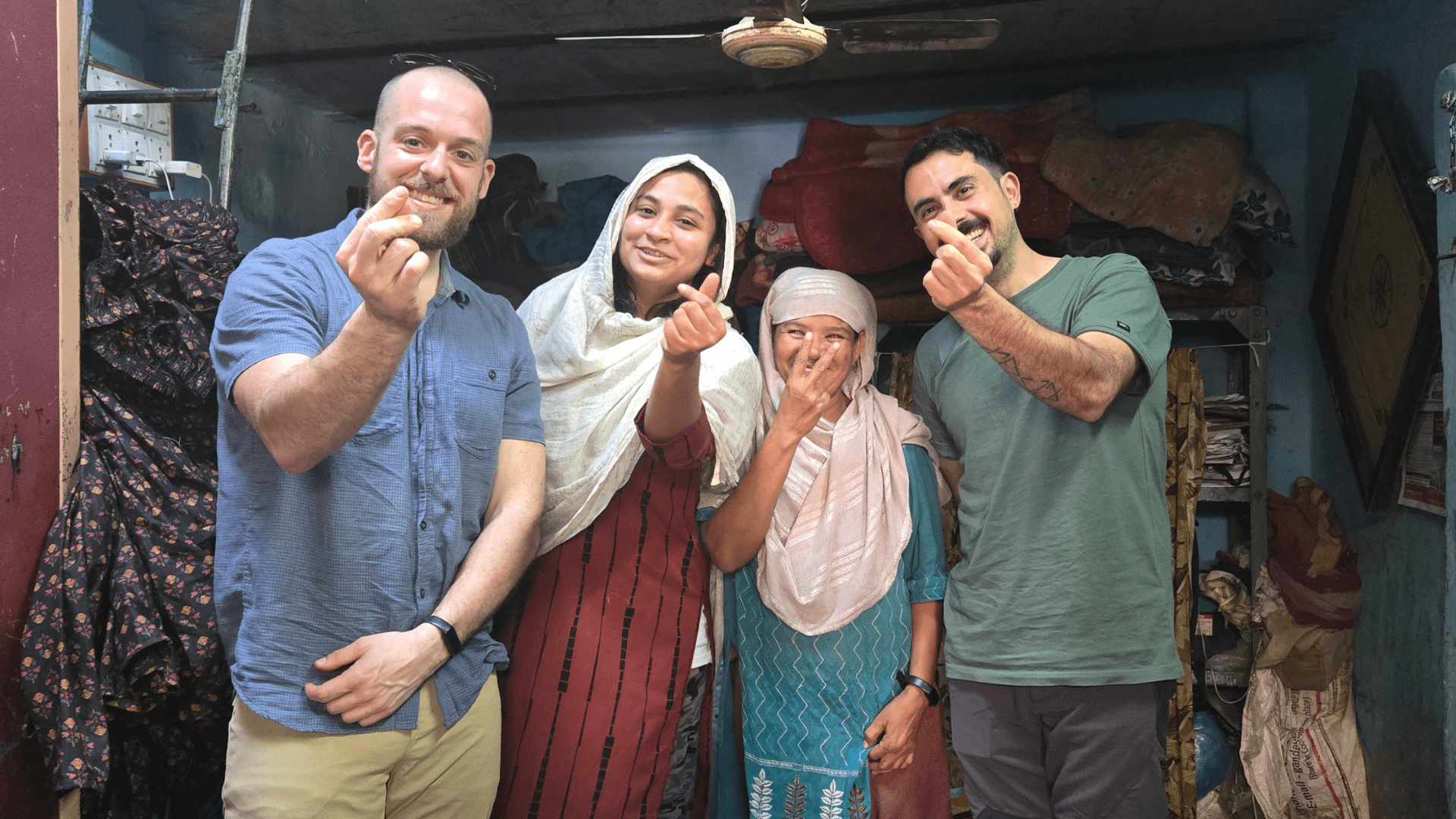
Robert Meade (left) and Felipe Gonzalez‑Casabianca (right) with SEWA members.
Community HATS: A Worker-Led Approach to Heat Research in India
Community HATS grew out of a collaboration led by Mittal Institute Steering Committee members Prof. Satchit Balsari, Associate Professor in Emergency Medicine, Harvard Medical School, and Prof. Caroline Buckee, Professor of Epidemiology, Harvard T.H. Chan School of Public Health, and faculty from across the school constituting the South Asia Climate Adaptation Cluster at the Salata Institute. Co-designed with the Self-Employed Women’s Association (SEWA), a union that has advocated for informal workers for decades, this project seeks to address questions most relevant to communities most impacted by extreme heat. Following previous work with SEWA studying community resilience during the pandemic, “SEWA members kept bringing up heat as another immense challenge impacting their lives and livelihoods.” Meade explains.
Rather than arriving with a predefined research agenda, the team partnered with SEWA to respond directly to that need. “We didn’t go to India and say, ‘We want to study heat,’” Meade explains. “They were already trying to test adaptations, so our role is more of a technical partner, helping them to set up the systems needed to measure how heat impacts their workers and how different interventions might help alleviate those impacts.”
A key part of that effort is a data platform developed by Felipe Gonzalez‑Casabianca, Research Affiliate, designed to help organizations like SEWA assess heat impacts without requiring constant oversight from medical or physiology experts. The tool allows for more precise measurements beyond simple surveys.
This approach reflects a broader shift in heat research worldwide, where scientists are increasingly partnering with communities on the front lines. “Anywhere it’s hot, there’s work happening,” he adds, “but ours is among the most extensive in terms of both participants and the level of detail we’re capturing.”
Vulnerable Populations: Most At Risk
Meade’s research identifies two main drivers of heat vulnerability: unavoidable exposure and a reduced ability to cope. Informal workers face particular risks from prolonged labor in high temperatures and limited access to cooling. Low-income populations, young children, and pregnant women are also especially vulnerable due to financial, behavioral, and physiological constraints.
His heatwave simulation studies show that older adults face added risk because aging and conditions like diabetes can impair the body’s ability to regulate temperature. Together, his work emphasizes that heat risk is shaped not just by exposure, but by a combination of social and biological factors.
When the Heat Doesn’t End: New Insights from the Data
Analyzing data from homes in Ahmedabad, Meade and team found that indoor environments behave very differently from outdoor conditions. “Homes don’t fluctuate as much,” he says. “They may be slightly cooler during the day, but they stay hot overnight.” For workers who spend long hours in the sun and return home expecting relief, that can mean near-constant exposure.
The research also points to a gap in how heat is measured. During the monsoon season, air temperatures fall, leading many to assume conditions are safer. But when humidity is factored in, the picture changes. “ “Even as air temperature drops, rising humidity keeps the indoor heat index elevated across both summer and monsoon”Meade explains.
That creates a disconnect between lived experience and official data. “By the end of the monsoon, indoor heat index can be up to 10°C higher than outdoor conditions,” he notes. “That’s very different from what weather stations report, and what we use to trigger heat warnings and action plans.”
The effects show up in both health and livelihoods. Heart rate remains stable up to a point, then spikes, with more cases of tachycardia at higher temperatures. Sleep is also affected: “People are sleeping less, and the quality of that sleep is worse,” Meade says, pointing to declines in both total sleep and deep sleep.
Perhaps most striking are the effects on wages. “Across the temperatures we studied, wages can drop by about 40%,” he explains. For day-rate workers, that loss is immediate. Some are unable to work at the same pace in extreme heat, while others face reduced demand as customers stay home.
“These are the kinds of downstream impacts you can’t fully capture in a lab,” Meade says. “Laboratory studies help us understand the mechanisms, but to see how heat affects livelihoods, you have to go into the real world.”
“Laboratory studies help us understand the mechanisms, but to see how heat affects livelihoods, you have to go into the real world.”
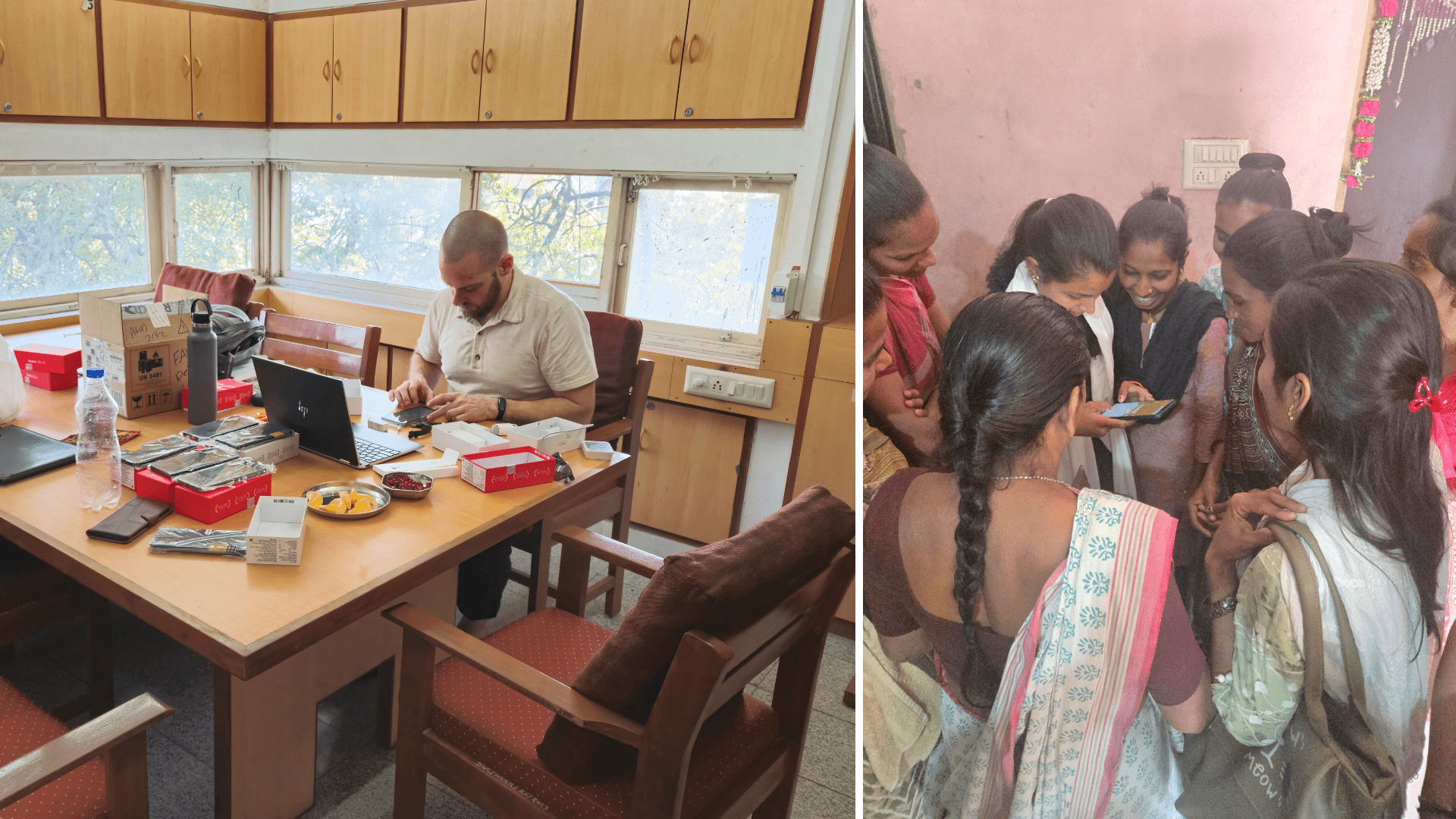
Left: Robert sets up sensor bundles in the India field office | SEWA ground team teaching other members how to use the platform.
Turning Heat Research into Action
For Meade, the next phase of heat research is not just understanding the problem; it’s testing what actually works to solve it.
“All the effects we’re measuring—elevated heart rate, poor sleep—if you tell workers this, they’ll tell you flatly, ‘We know,’” he says. “So the question becomes: what can we do about it?” Rather than relying on abstract models or laboratory studies, the Community HATS platform allows researchers to test interventions directly in people’s daily lives.
One example is “cool roofs,” which are designed to reflect solar radiation and slow the increase in indoor temperatures. Working with partners like the SEWA and CRDF, the team compares homes with and without these changes, tracking impacts on heart rate, sleep, and overall wellbeing. “It’s not just, ‘Does cooling help the body?’” Meade says. “It’s, ‘Does it improve people’s lives in meaningful ways?’”
The work builds on laboratory research but tests it under real-world conditions, where feasibility matters as much as effectiveness. “Something can be 100% effective in a controlled setting,” Meade notes, “but completely impractical outside the lab.”
The effort is deeply interdisciplinary, bringing together experts across fields, from global health to economics to climate science, including collaborators like Professors Gary Adamkiewicz, Peter Huybers, Tarun Khanna, and Dan Schrag. “When you move into the real world, you’re not just dealing with physiology,” Meade says. “You’re looking at health outcomes, livelihoods, and how these risks will evolve as the climate changes.”
By combining diverse perspectives and testing solutions in context, Meade’s work aims to move beyond measuring heat’s impacts toward identifying scalable, practical strategies to reduce them.
“Many of these workers don’t have time to wait for a long scientific process where we test strategies in the lab, then pick one and test it in the field,” explains Meade. “If we can use studies like Community HATS to directly test adaptations and then scale the effective ones, we can get to meaningful, contextually grounded heat adaptation much faster.”
By Kellie Nault, Writer/Editor at the Mittal Institute
☆ The views represented herein are those of the interview subjects and do not necessarily reflect the views of the Mittal Institute, its staff, or its Steering Committee.