
In this edition of our Alumni Spotlight we spoke with Dr. Lakshmi Priya, an officer of the Indian Administrative Service (IAS). She hails from the state of Kerala, and is a medical doctor by training. Dr. Lakshmi Priya is a recipient of the prestigious Prime Minister’s Award for Excellence in Administration for her project Sampoorna, which helped reduce childhood malnutrition by 95.6% in the district of Bongaigaon in the state of Assam where she worked as district collector.
She has been instrumental in the reduction of maternal and child death rates in the state of Assam, as former State Mission Director (MD) of National Health Mission (NHM). She is also an accomplished Carnatic musician who has performed in over a hundred venues, including the Rashtrapathi Bhavan, and Indira Gandhi Centre for the Arts, New Delhi.
As a Fulbright-Nehru Master’s fellow, Dr. Lakshmi Priya studied public health at the Harvard University, which helped broaden her vision, and focus further on policy formulation and the smooth implementation of health-related administrative innovations. She shared more about her work and experiences in the interview below.
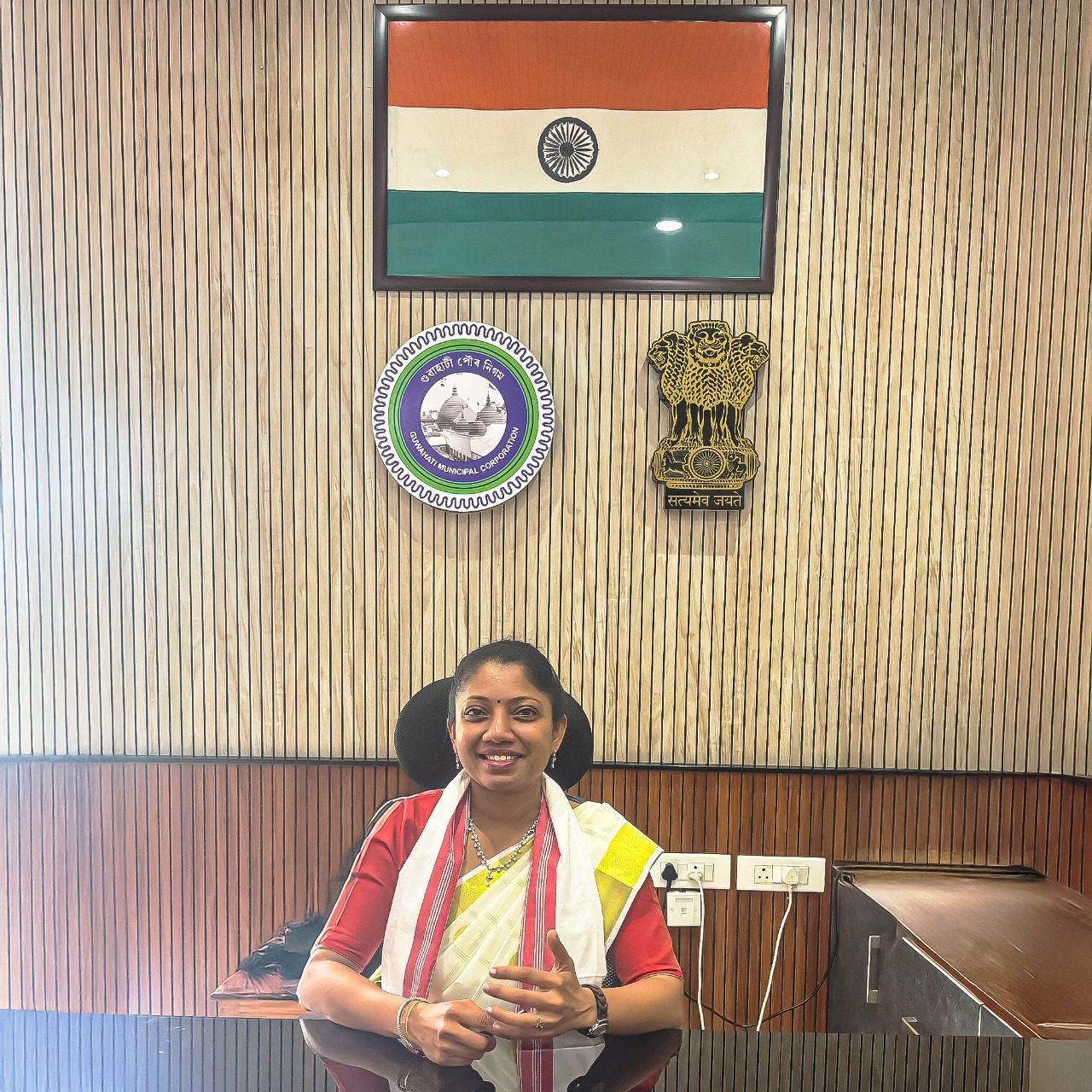
Mittal Institute: You’ve served in diverse administrative roles, from Sub-Collector to Commissioner, across Assam. How have these experiences shaped your approach to governance and leadership?
Dr. Lakshmi Priya: I’ve been fortunate to work across multiple levels of government: subdivision, district, state, and with the Government of India. Each of these operates very differently. The resources vary, the expectations are distinct, and the stakeholders change with every role. You’re constantly shifting between crisis response, disaster management, programme implementation, and, eventually, policy design.Over time, these experiences have pushed me toward what I now see as the most realistic model of leadership: adaptive leadership. I encountered it more formally during
my time at Harvard, particularly through Professor Marshall Ganz. What struck me was not that it was new, but that it gave language to what we were already living through in governance. That constant need to respond, recalibrate, and work with complexity. That’s the approach I try to practice today.
Mittal Institute: You’ve consistently advocated for participatory governance and women’s empowerment. How have you translated these principles into action?
Dr. Lakshmi Priya: One of the most meaningful examples is a project called Sampoorna (complete/whole), which focused on reducing childhood malnutrition. It was recognised with the Prime Minister’s Award for Excellence in Public Administration in 2021. At its core was the idea of “positive deviance.” We paired two mothers from the same Anganwadi, one whose child was malnourished, and another whose child was healthy. They worked together in what we called a “buddy mother” model. Across the district, nearly 4,000 mothers came together to support around 2,000 malnourished children. But it didn’t stop there. We involved Panchayat members, linked women to self-help groups, and turned it into a collective effort. The idea was simple: no single individual drives change at this scale, it has to become a shared responsibility. The results were significant. A 95.6% reduction in childhood malnutrition within a year. But more than the numbers, it reinforced something fundamental: participatory governance, with women at the forefront, is not just effective, it’s essential.
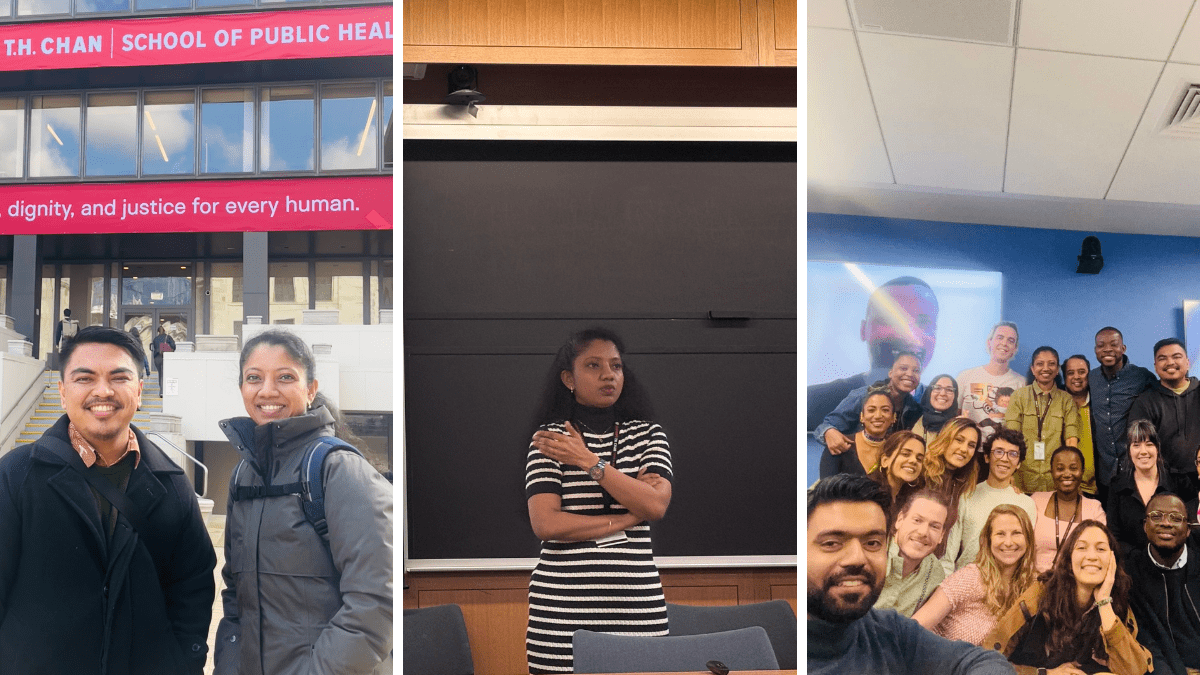
(l-r) Dr. Lakshmi Priya (right) in front of the Harvard T.H. Chan School of Public Health; Dr. Lakshmi Priya making a presentation; Dr. Lakshmi Priya with her classmates.
Mittal Institute: How did your time at the Harvard University as a Fulbright-Nehru Master’s Fellow shape your thinking on public health and governance?
Dr. Lakshmi Priya: Those nine months were transformative. Academically, they were among the most enriching periods of my life. But what stayed with me most was the community; the peer group, the conversations, the exposure to different ways of thinking. You realise very quickly that people across the world are driven by a similar desire to do meaningful work and contribute in some way. The approaches may differ, sometimes even conflict, but that shared intent is powerful. It also made the world feel both larger and more accessible. You’re no longer working in isolation, but are a part of a global network of people thinking about similar challenges. That has definitely shaped how I approach collaboration now, especially in public health and policy spaces.
Mittal Institute: You are currently serving as Secretary to the Government of Assam, Skill Employment & Entrepreneurship Department. What are your priorities in this role?
Dr. Lakshmi Priya: Skill development is emerging as a central pillar of economic and social progress. What makes it particularly interesting is that it cuts across sectors such as health, construction, hospitality, technology. The goal is twofold. First, to strengthen the skilling ecosystem so that employability improves across levels. And second, to ensure that this translates into broader development outcomes: better health, education, and quality of life. There’s also a growing focus on global mobility with upskilling individuals to access opportunities beyond India. But at its core, the work is about enabling people to participate meaningfully in the economy, wherever they are.
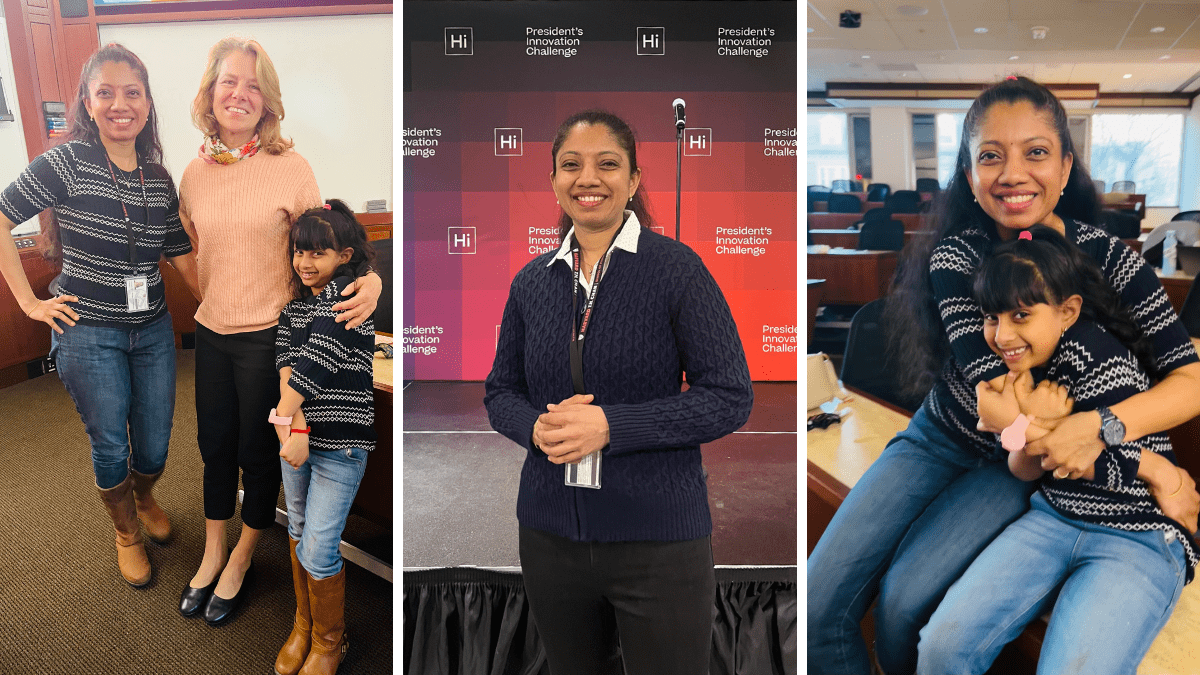
(l-r) Dr. Lakshmi Priya (left) and her daughter; Dr. LakshmiPriya at Harvard President’s Innovation Challenge; Dr. Lakshmi Priya with her daughter.
Mittal Institute: Public service can be demanding. What has kept you grounded through your journey?
Dr. Lakshmi Priya: Failures, more than anything else. You come in with a vision to create impact, to drive change. But things don’t always go as planned. In fact, more often than not, they don’t. Murphy’s Law tends to apply quite consistently in administration. Even programmes that later succeed are built on multiple failed attempts. Sampoorna, for instance, came after several iterations that didn’t work. On a personal level, being a woman in public service has also shaped this journey. There are interruptions, like stepping away for childbirth, and there are expectations and judgments that come with the role. But in many ways, those experiences keep you grounded. And then there’s the support system of people who are honest, who will tell you when something isn’t working. That has been invaluable.
Mittal Institute: Outside of administration, you are a trained Carnatic musician. How has music influenced your life and leadership?
Dr. Lakshmi Priya: Music has been a constant in my life. I started training very young, and with that came the discipline of waking up early, practicing consistently, learning from teachers who embodied excellence. More than the art itself, it instilled a way of thinking: respect for process, patience, and the understanding that mastery takes time. There have also been moments when music has been a source of stability, like something to hold on to when everything else felt uncertain. In that sense, it has been less of an activity and more of a companion. I may not practice as regularly now as I would like to, but its influence stays with how I approach work, how I think about growth, and how I navigate challenges.
☆ The views represented herein are those of the interviewee and do not necessarily reflect the views of the Mittal Institute, its staff, or its steering committee.