
What role can school meals play beyond nutrition? For Sarthak Agarwal ’27, a doctoral candidate in Population Health Sciences at Harvard University, this question is central to his dissertation research on school feeding programs as a policy lever for advancing public health, equity, and access among children. With support from a Mittal Institute student grant, he visited VVMVP free schools in Bengaluru, India, where meals are provided alongside uniforms, books, and transportation to help reduce barriers to schooling. In the Q&A below, he reflects on this massive initiative, and what policymakers can learn from it.
Mittal Institute: What were your goals with your student grant, and why did you pursue this project/location?
Sarthak Agarwal: My doctoral dissertation examines school feeding programs as a policy lever for advancing public health nutrition among school-aged children. I applied for the Mittal Institute’s student grant to go beyond desk research and witness how school meals are integrated with the broader landscape of social safety nets in India. I visited the VVMVP free schools in Bengaluru, India during the Winter 2025 term. The VVMVP model integrates free school meals with additional provisions to reduce barriers to schooling, including free uniforms, free books, and free transportation. My objectives for this visit were to understand their model from an implementation perspective: how the program is delivered in practice, what barriers the program is designed to mitigate, and how these provisions are operationalized across diverse settings.
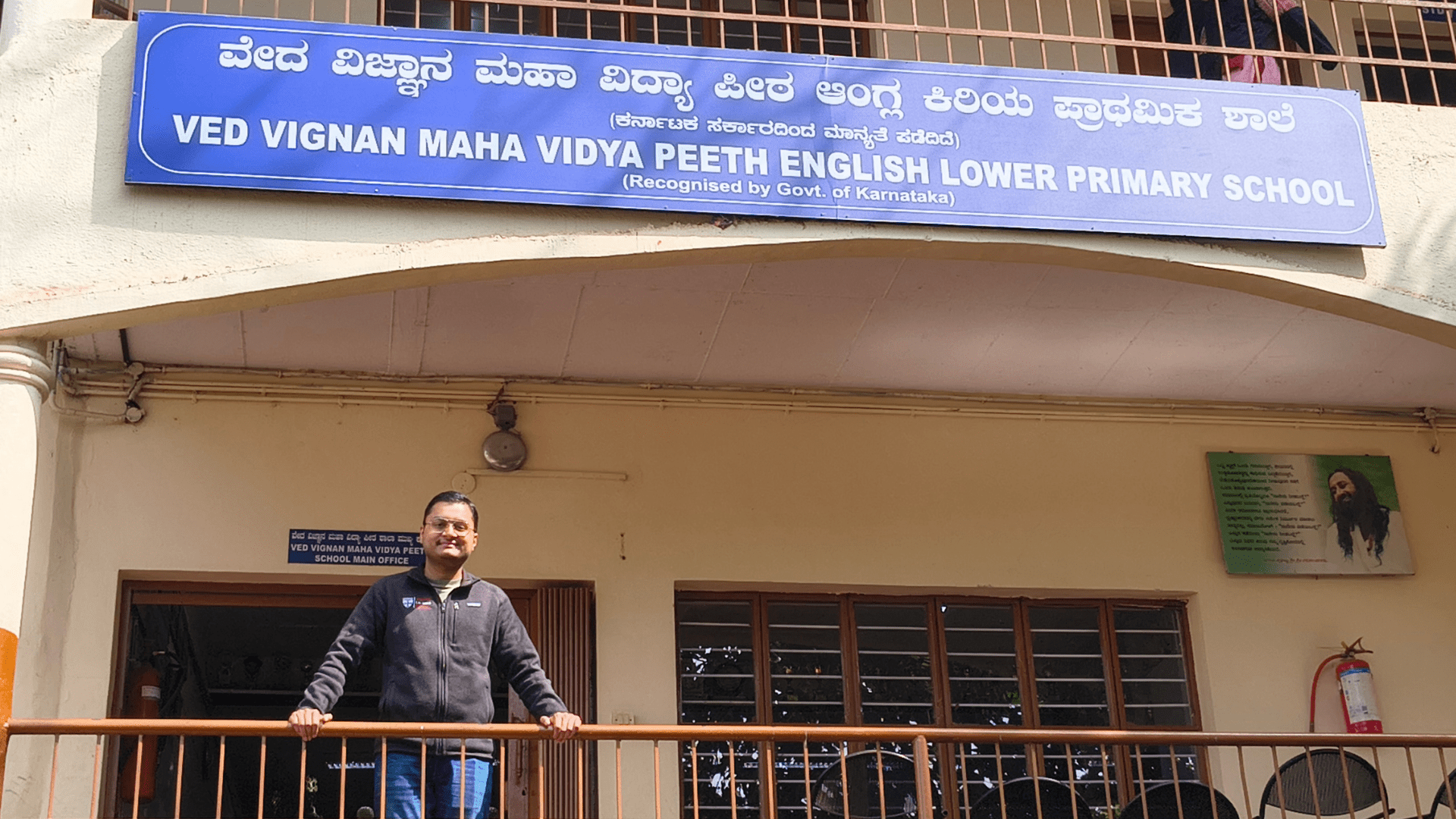
Sarthak Agarwal at a site visit to a VVMVP school in Bengaluru, India.
Mittal Institute: Tell us about what was most impactful about this experience.
Sarthak Agarwal: It was fascinating to see how food provision operated as part of a bundled intervention rather than an isolated input. Through observations of the school environment and engagement with teachers, program staff, and leadership, I gained a clearer sense of how school meals are embedded in children’s daily routines and paired with other supports that encourage attendance and learning. This is immensely meaningful because many of these children come from the margins of the society who otherwise would likely be deprived of the opportunity of schooling. This experience deepened my understanding of school meals not only as a nutrition intervention, but also as a policy mechanism that can support dignity, social connection, and children’s agency.
This experience deepened my understanding of school meals not only as a nutrition intervention, but also as a policy mechanism that can support dignity, social connection, and children’s agency.
Mittal Institute: Bring us into your daily life during your grant? What was it like? Who were you meeting? What institutions were you visiting?
Sarthak Agarwal: I spent time at the VVMVP free schools in Bengaluru, India where I toured classrooms and common spaces and observed the flow of the school day. I had discussions with teachers and program staff about day-to-day operations, student needs, and the practical barriers associated with student enrollment and attendance. I also met with school leadership and program coordinators to understand how the model is designed; how supports such as uniforms, books, and transportation are bundled with school meals, and how these components are managed across diverse settings. These were complemented by structured reflection and note-taking, which provided further context for my dissertation work.
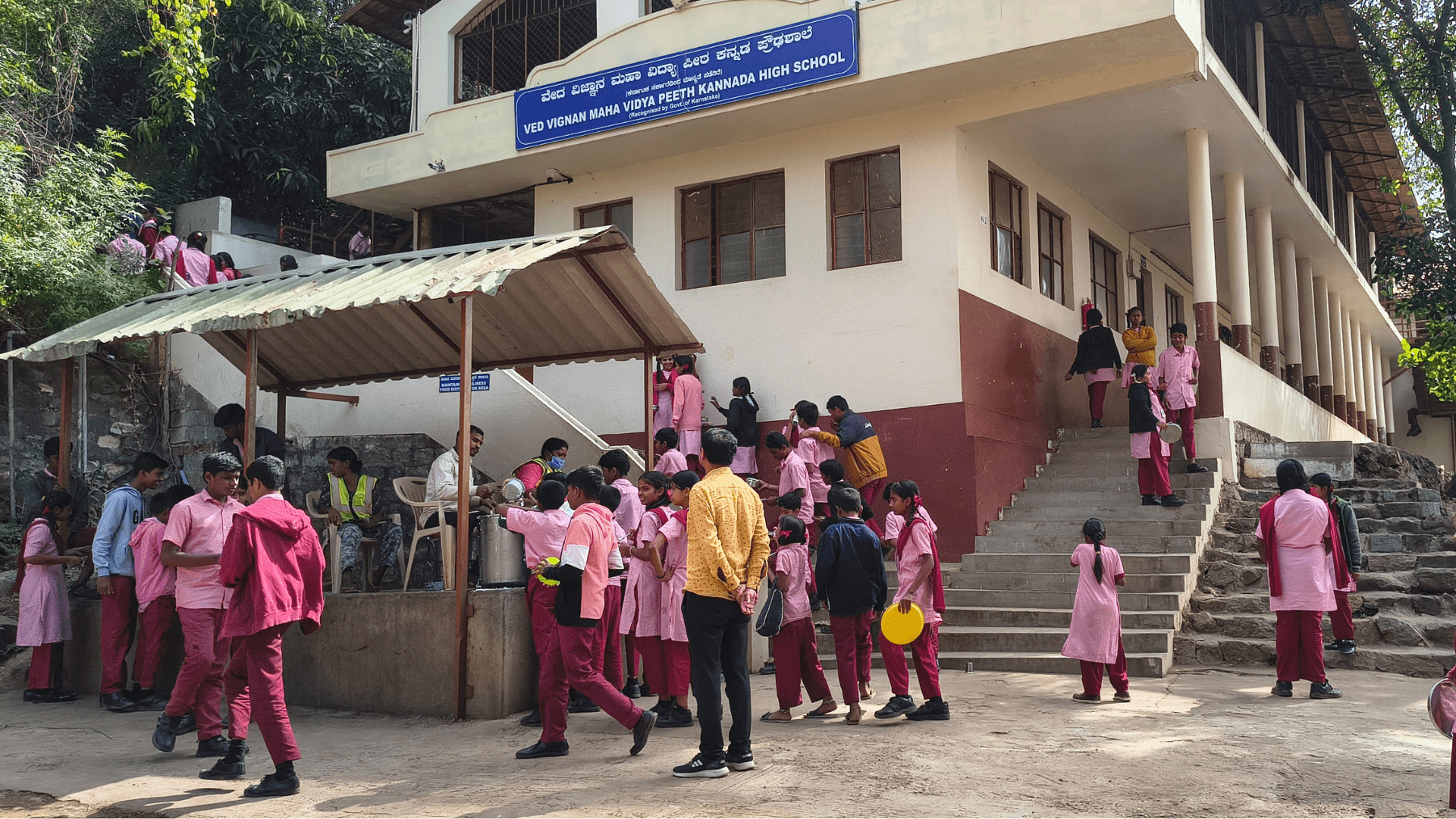
Lunch time at a VVMVP school.
Mittal Institute: How will this experience help you to reach your academic goals?
Sarthak Agarwal: This experience strengthened the grounding of my doctoral dissertation and provided further context for situating my research, which focuses on school feeding programs, with attention to gender, nutrition, and education equity. Visiting the VVMVP free schools in Bengaluru, India enabled me to observe firsthand how free meals provision must be positioned alongside other supports to reduce barriers to schooling for children from the margins of the society. The visit gave me a clearer sense of the implementation realities on the ground, which will inform my ongoing engagement with stakeholders and policymakers. It also helped me refine the kinds of questions I hope to explore in the future.
Mittal Institute: What’s the most memorable moment from your time on the student grant?
Sarthak Agarwal: A couple of heart-touching moments will stay with me forever. On multiple occasions, I watched groups of three to five students share a single tiffin box. They were not just sharing food, but also care, connection, and companionship. For them, school meals served a social purpose as much as a nutritional one. I was also struck by the attentiveness of children as young as in primary school, toward food waste. More than once, a child asked the server to stop serving more because they did not want it to be wasted. These experiences directly feed into how we think about school meals as a nutrition intervention, but also as a policy mechanism that can support dignity, social cohesion, and children’s agency.
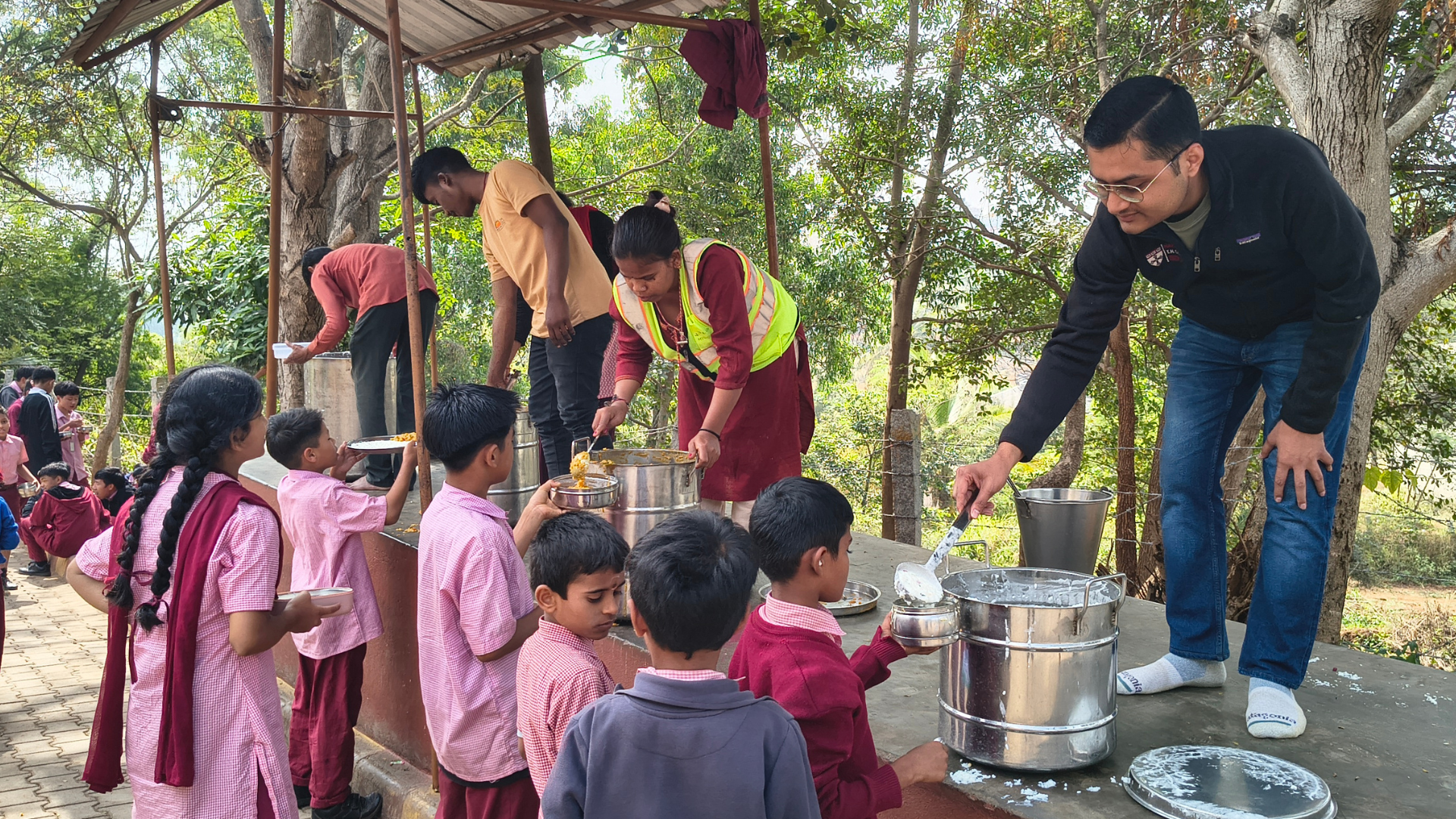
Sarthak Agarwal (far right) serving lunch at a VVMVP school.
☆ The views represented herein are those of the interview subjects and do not necessarily reflect the views of the Mittal Institute, its staff, or its steering committee.