
As Harvard seniors prepare to graduate this May, three students are reflecting on an experience that took them far beyond the classroom. Liz Zheng, an applied mathematics concentrator; Kat Ravichandran, who is pursuing a double concentration in computer science and philosophy; and Brooke Decho, who is studying engineering sciences, participated in this year’s Program for Scientifically-Inspired Leadership (PSIL) in Goa, India, an immersive educational initiative supported in part by the Mittal Institute. Read our recap of the 2026 program.
Founded in 2019 by Dominic Mao, Assistant Director of Undergraduate Studies in Harvard’s Department of Molecular and Cellular Biology, PSIL annually brings together Harvard undergraduates, local college students, and underprivileged high school students in India for a week-long residential learning program. Each January, Mao and Andrea Wright, Assistant Dean of Harvard College, train and accompany a cohort of Harvard students to India, where they collaborate with local college students to deliver a liberal arts and sciences curriculum for high school participants. For Ravichandran, Zheng, and Decho, the experience offered not only an opportunity to teach and mentor, but also a chance to reflect on leadership, learning, and the impact of global educational exchange as they near the end of their Harvard journeys.
By Liz Zheng
Participating in PSIL as a Harvard senior was one of those rare experiences that continues long after it ends. I arrived in Goa expecting to teach leadership through scientific thinking. While that was indeed true, I also found myself being taught—about humility, curiosity, community, and the quiet ways people transform one another.
When I first arrived, my suitcases were taken from my hands before I could protest. Eight smiling faces—some familiar, some new—were already moving around me, hugging people I did not yet know would come to mean so much over the next nine days. Outside the van’s window, my first sights of Goa moved like a film reel I had never seen before: paper stars strung from doorways, motorbikes threading through crowded streets like needles through cloth, palm trees swaying in the thick, humid air. I pressed my face closer to the glass and thought: I am so far from home. Laughter echoed in the winger, and the thought didn’t scare me.
Each morning began before the heat did. I would wake to the slow churn of a ceiling fan and the sweet relief my roommate called “the too cold morning” (it was seventy degrees Fahrenheit). Then came the smell of chai and warm pao, church bells floating in from somewhere down the road, dogs barking, laughter already starting in the hallways. I remember stirring my chai each day feeling something I could not quite name: a readiness, maybe. An eagerness to step into whatever the day held.
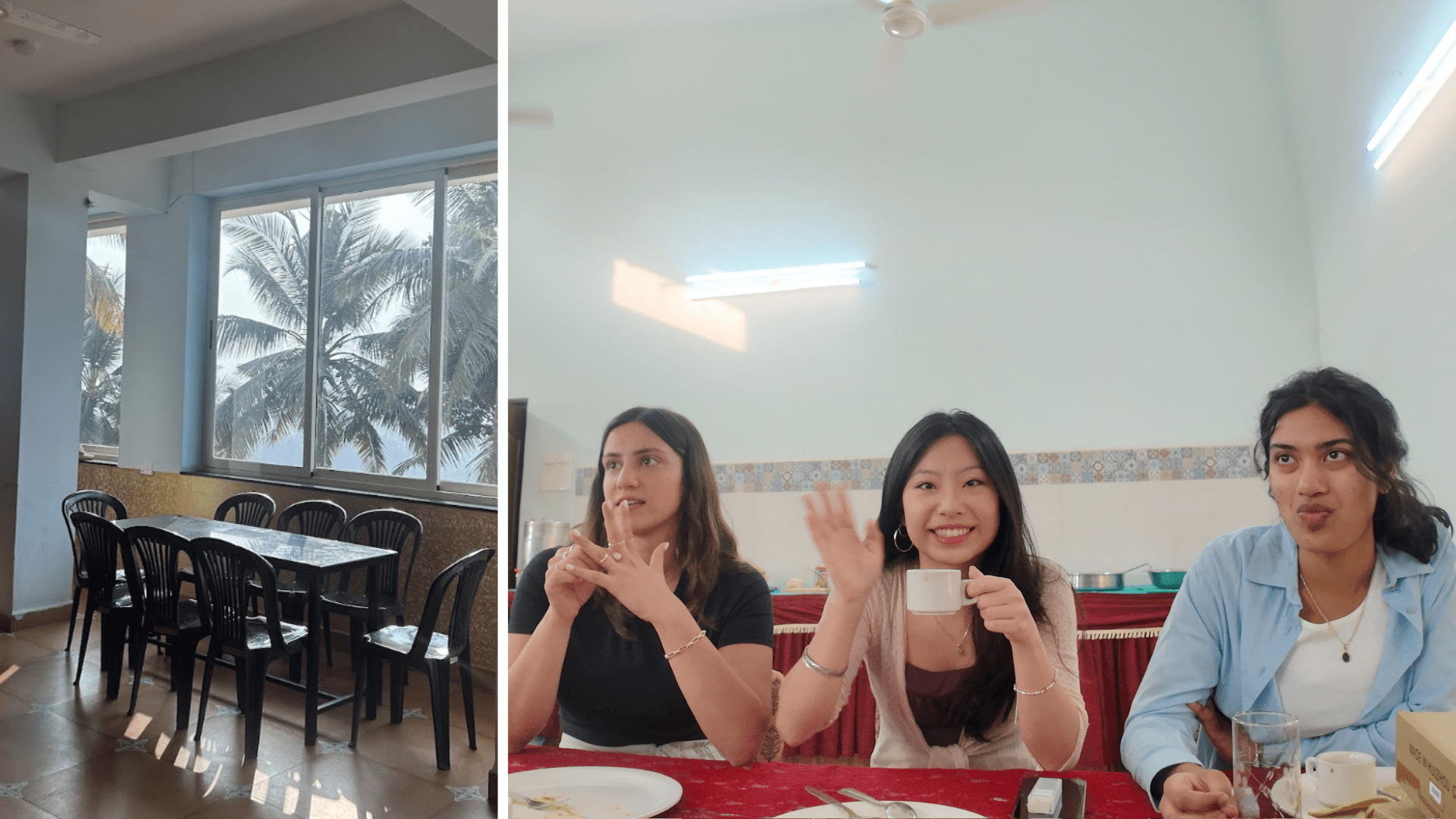
Left: The view in the morning from the cafeteria. Right: Liz drinking chai with her co-instractors, Kat Ravichandran and Megha Khemka.
On the first day, I taught a workshop called The Power of Public Art. I had prepared slides and I had talking points all nicely numbered in my notes. I spoke about how art had shaped my own identity and about how vulnerable it is to make something honest and put it in front of other people. In a meta way, it also felt extremely visible and vulnerable. And while I was teaching about a mural of a fisherwoman in Goa, a student raised his hand partway through and offered a Konkani saying: Lozen pot bharana. It was translated for me: “Shame won’t fill your stomach.” Students told me about Goa’s fishwomen who labored under the unforgiving sun in work too often overlooked. In one sentence, he gave me something I hadn’t even thought to include in my slides: a lesson about dignity and survival in artwork. I wrote it down in my notes that night and circled it.
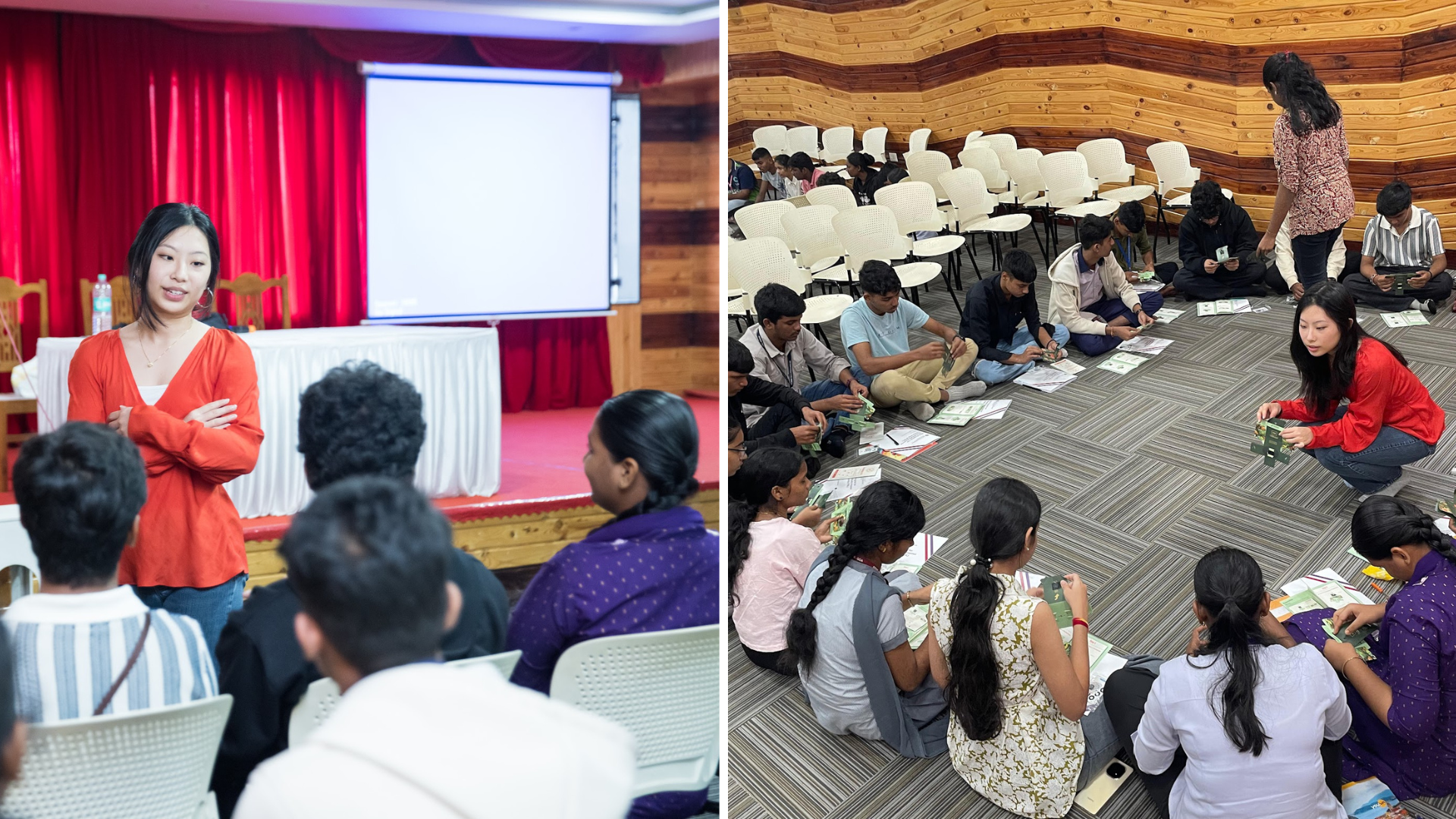
Liz teaching her section.
At first, the classroom was visibly divided. Girls on one side, boys on the other, careful distances between them and hands that twitched in laps when questions were asked. But day by day, I watched them emerge from their silent cocoons. Hands started rising with conviction; voices that had started as whispers became jokes, then stories (then sometimes even friendly arguments) then ideas that spilled past the end of class.
One of our first extracurricular exercises was making zines, which were small handmade booklets where I gave the prompt to simply express who they were, what they loved, and what was important to them. My students wrote about their families, ambitions, favorite foods, and even, surprisingly, private fears and futures they were only beginning to imagine. I was struck by how seriously they took the invitation to create, and how much they trusted me with pieces of their inner lives. I was so proud of them.
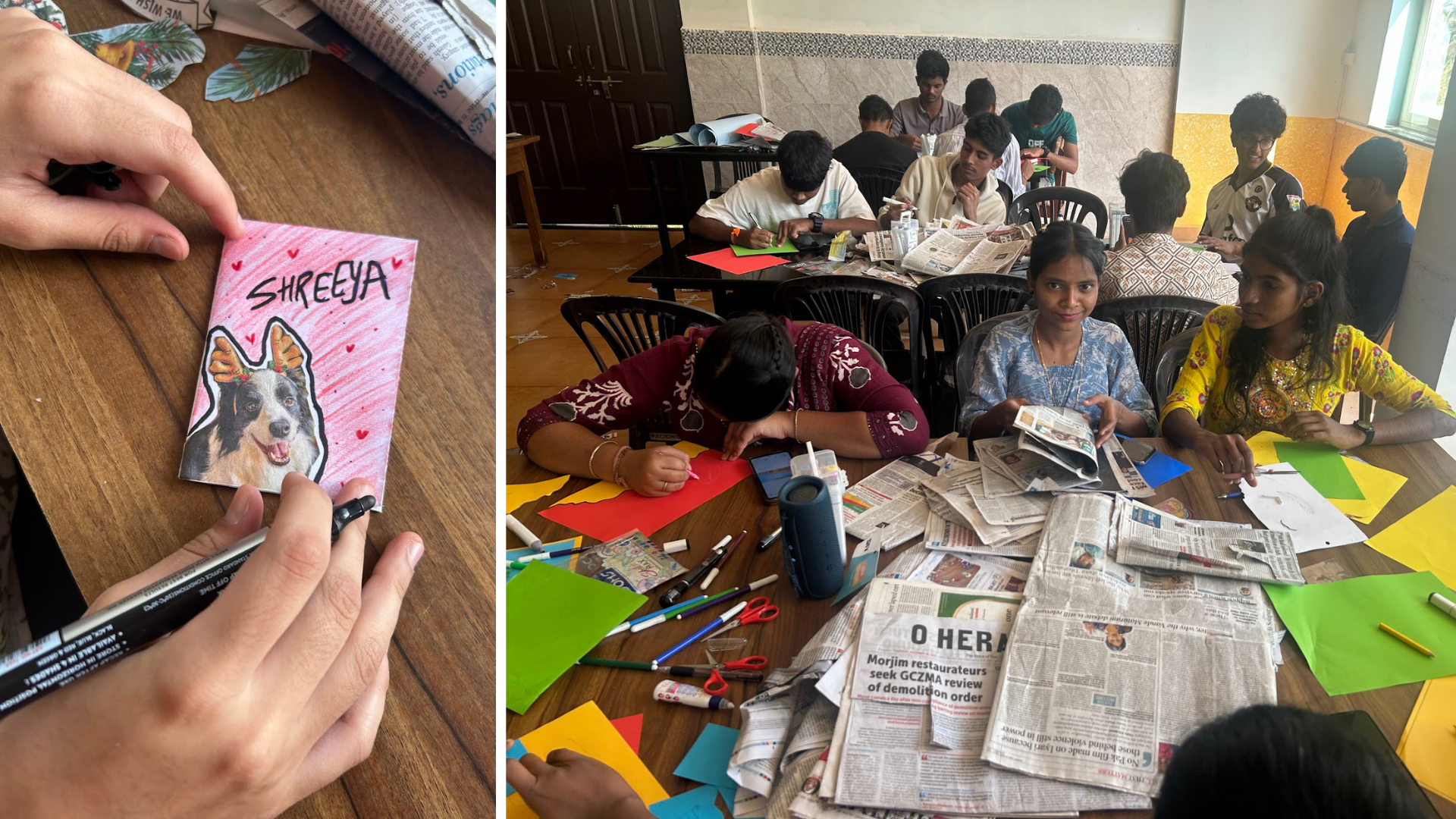
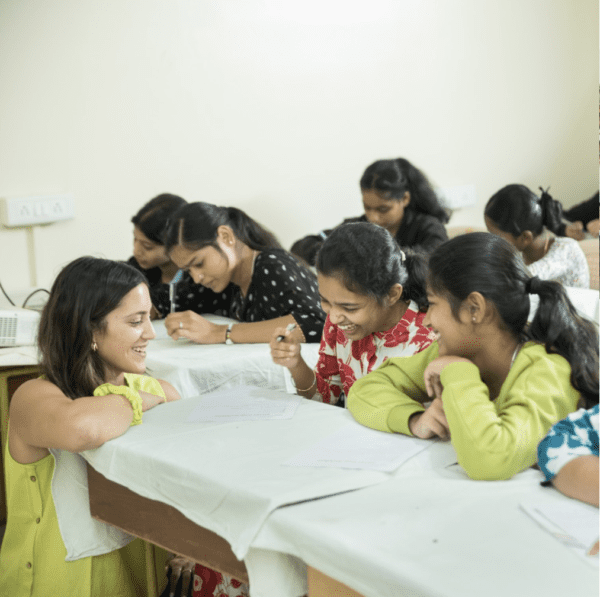
Left: The cover of Shreeya’s zine. Right: Students working.
My office hours always ran over. Students stayed to talk long after the time was up, sometimes because they had things they wanted to discuss, and sometimes, just to listen.
At the end of one night, Abukabar told MaryAnn (my wonderful co-instructor from Goa) and I: “Thank you, for making me feel so heard. This is the first time I’ve had a one-to-one conversation with a teacher. I feel so much more confident.” I was so moved, and he said it so matter-of-factly, that I sat there stunned for a moment. I think about that sentence all the time. I realized how, sometimes, beautifully, growth is not dramatic or loud.
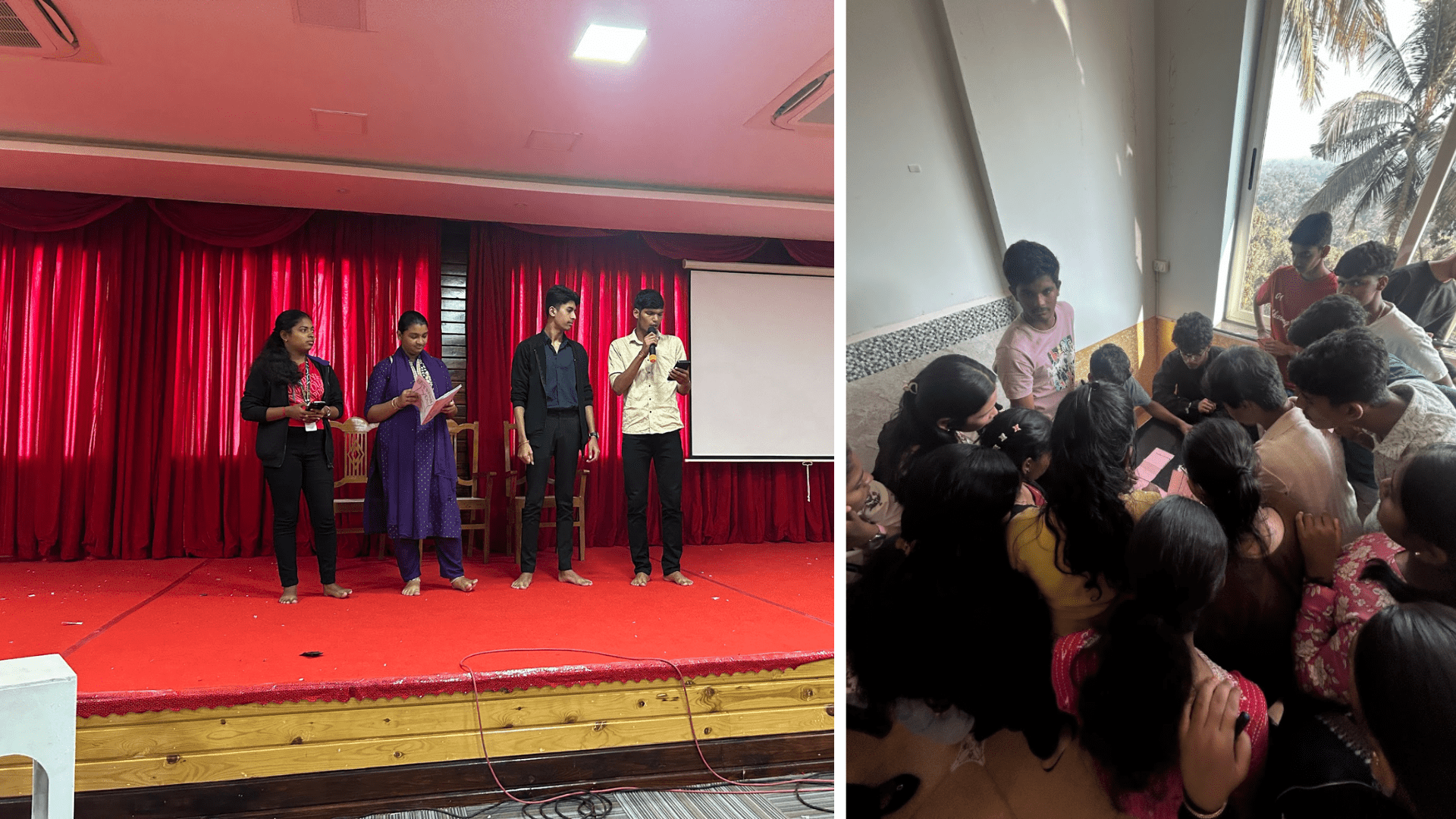
Students working on extracurriculars.
This didn’t mean my students’ ambitions weren’t expansive: I had future cybersecurity officers, pilots, teachers, comedians, and artists amongst me. One student told me during office hours that he wanted to become a stand-up comedian because he had always been made fun of, and humor felt like a way to reclaim himself. MaryAnn and I looked at each other across the table and then back at him, and we told him what we saw: someone already extraordinary, far beyond the pain that had shaped that particular dream. Shine gave a presentation on the tensions within Indian politics and spoke with such composure that I forgot for a moment I was the one who was supposed to be the instructor. Shivam showed me artwork he had made inspired by our extracurriculars and talked excitedly about making things for other people. Lester beamed when he told me how many friends he’d made after we all went out to play soccer.
During break we played ring, which was a fast, competitive game my students did not let me win… not even close. Our teaching team ate dosas at their favorite cafes in the late afternoon. We stayed up late preparing speeches for the final day. We all crowded into Simon’s room and sang “Riptide” while Kat played guitar—tired, sweaty, laughing, entirely present. Those were the moments when we became something I don’t have a better word for than family. At PSIL, some of the most important moments happened when we weren’t teaching at all.
Professionally, PSIL changed the way I understand what education is actually for. I learned that teaching is not a performance but a relationship. It is less about delivering information and more about making room for possibility. In our seven days together, I saw clearly that confidence is not something you tell someone to have and then assign as homework. It grows through trust, slowly, in the specific warmth and comfort of feeling genuinely seen. Curiosity can’t be forced, but it can be invited. My students didn’t need me to be a perfect instructor. They needed someone willing to listen, willing to push back, and most importantly, unequivocally willing to believe in them.
Personally, the program undid things I didn’t know I was carrying. Growing up in the United States, I had absorbed without noticing a set of quiet assumptions: that certain systems were the standard, that certain ways of knowing were universal, and that progress moved in one direction. In Goa, I felt those assumptions come loose, one by one. I watched how culture and religion and gender and family and history intertwined together in ways that could not be untangled or easily judged. I became slower to assume. I became quicker—eager—to listen.
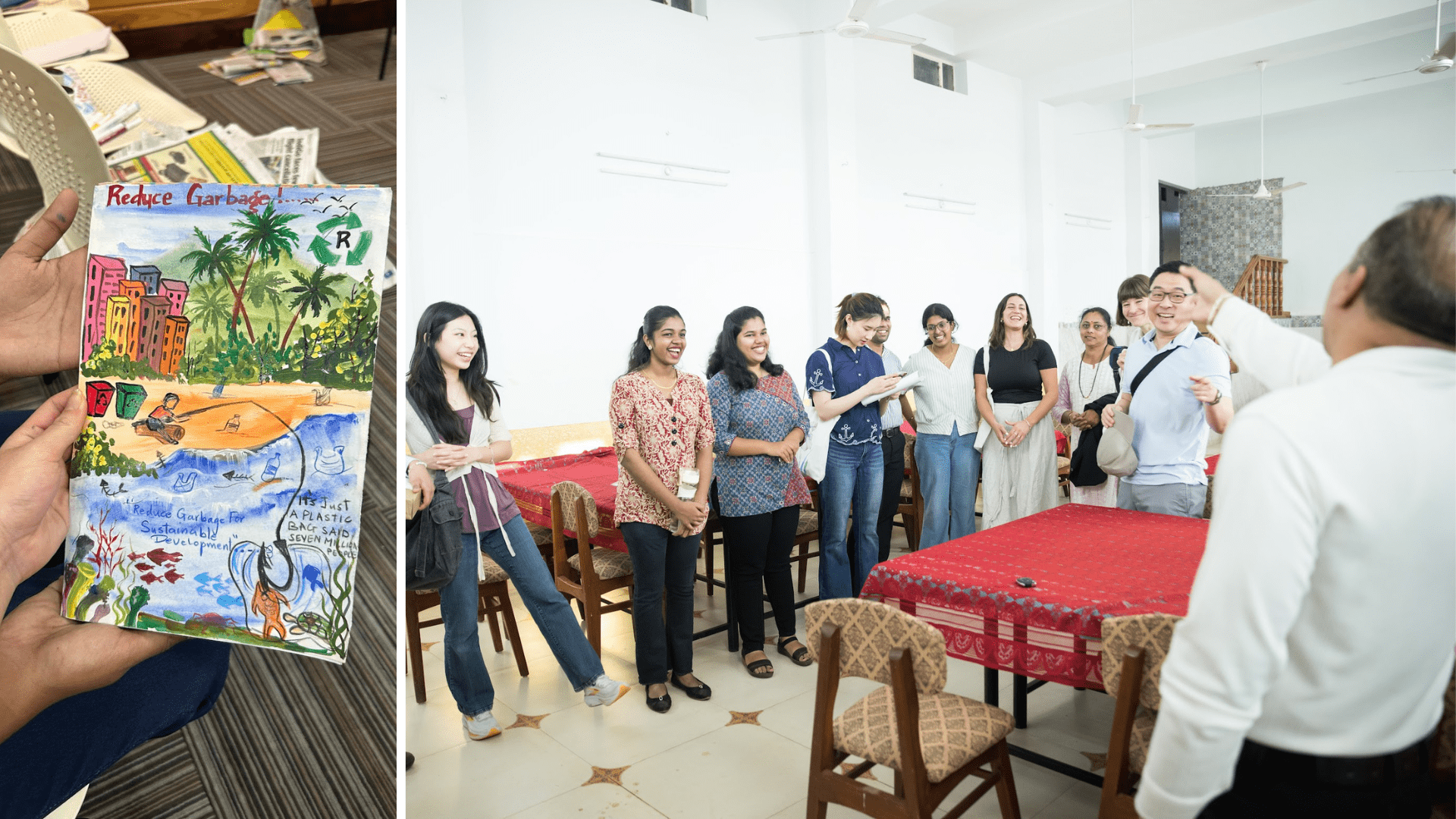
Left: Student’s final project to create a larger zine addressing an issue in their communities. Right: A group meeting.
When it was time to leave, I wrote cards to the Goa team telling them what I meant: that each of them carried their own particular light, that they would always have a home wherever I was. I was the last person from the Harvard team to go. I squeezed into the back of a taxi, ended up on Nandini’s lap, and watched the streets I had grown used to blur past the window with a sadness I couldn’t quite name.
It was strange to feel nostalgic for a future that hadn’t happened yet. For a home that wasn’t mine.
I return to Goa often, in memory. I have not found chai that matches its milky softness. I no longer hear Konkani—all its different dialects—threading through the air around me. I do not see my people across the world. But the experience remains vivid in the way that the best education always is: not because it gave me answers, but because it changed the questions I knew to ask.
PSIL has made me so much hungrier to learn, more willing to step beyond comfort, more committed to teaching, and more open to the extraordinary intimacy of simply knowing another person’s story.
Goa felt magical, yes, but more than that, it felt so deeply real.
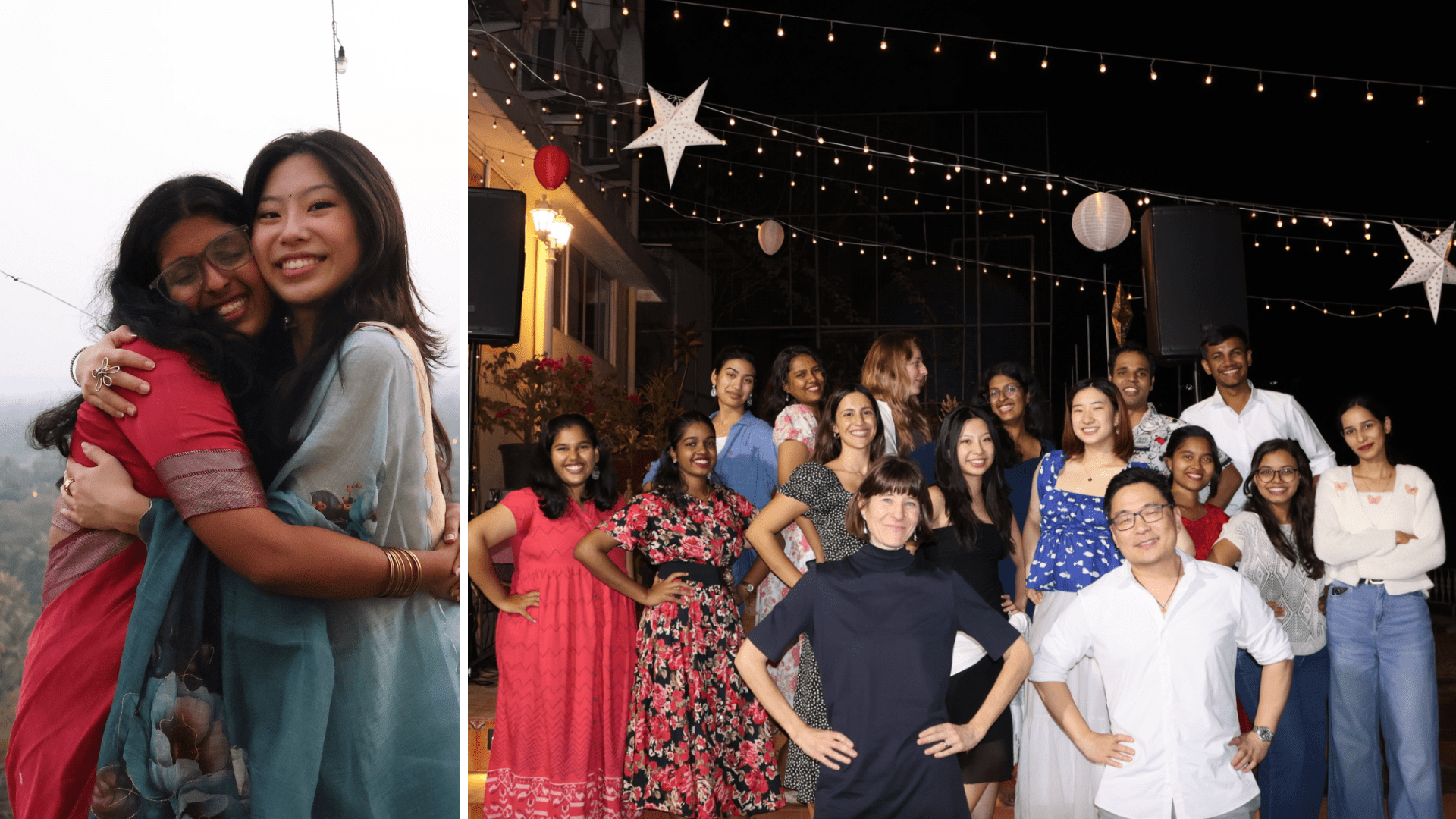
Family.
By Kat Ravichandran
When I first got the acceptance letter into PSIL, I was so excited to meet the future teachers and high school students from Goa, India. India! While my dad was born and raised in Tamil Nadu, I had never even been to Asia. The over 30-hour journey was a novel experience. But when Sarah and Simon welcomed us at the airport at 3 am, the country suddenly became familiar. Despite the hour, they were laughing and insisting we try their specialty nimbooz drink.
After a quick nap, the G-Team insisted on a proper Goan weekend, which included everything from local eats to saree shopping to kayaking along the beaches. As we finalized lesson preparations, I found it hard to believe students were still to come, given how much I had already learned.
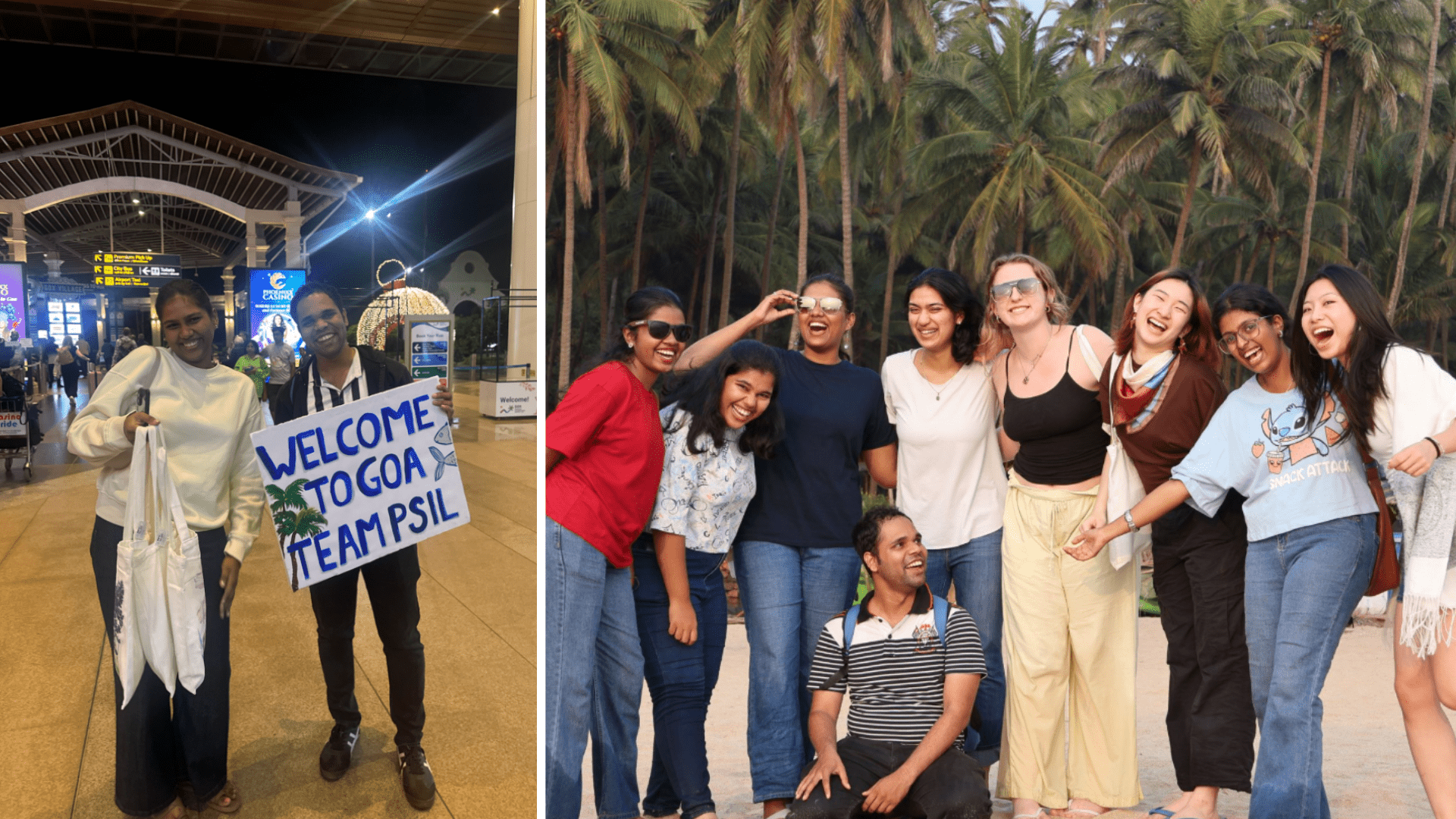
Left: A warm welcome. Right: Kat and other teaching instructors.
Luckily, the first meeting with the students settled me right in. Our lab taught the students to make paper microscopes – an already impressive task – yet the true thinking began after they were built. What should we investigate? What are we under a microscope? A piece of hair! A flower! They took turns exploring the program’s Pilar Pilgrimage Center for subjects. As they headed to lunch, some were debating the ethics of putting bugs into the microscopes. We breathed a sigh of relief knowing that the students were eager to learn.
It was that first afternoon when we realized we would also be learning. Liz, a fellow H-Team member, was presenting on the Power of Public Art and how expression, all around the world, can be used as a mode of communication. She presented a Goan artwork of women working to catch fish, and asked the students what this image might be about. A brave student raised his hand and began, “While women who catch fish might be looked down upon, we have a saying in Konkani, ‘Lozen pot bharana.’” The Goan students nodded in affirmation. He and the G-Team members translated, “Shame won’t fill your stomach.” You cannot care too much about what others think, he said, because then you will be left without food in your belly.
 I was constantly learning from the students. As they practiced throwing an American football during my extracurricular, I learned the popular Goan songs they put on aux, including the ones they deemed “brainrot” (oftentimes my favorite, I must admit). I learned from how they openly asked for help when they didn’t understand how to hold the ball; how they laughed when it dropped instead of pointing blame; and how they cheered when they all could throw a solid spiral.
But the most impactful moments with the students came in Office Hours. There, I saw high school students in one of the most transformative experiences of their lives thus far. I felt almost like I was meeting a first-year student at Harvard, living away from home for the first time, and so excited to be around inspiring peers. They found friends who they could learn from and laugh with. In Office Hours, sipping Chao, the students would ask the questions they were beginning to ask, questions I still remember, three months later: “How do I live a happy life?” “What next steps should I take to become an engineer?” “How do I always keep learning?” My Goan co-instructor, studying teaching, and I, studying philosophy, braved the questions alongside the students.
One student had been very quiet in class – aside from a few in-class jokes – yet the art he was producing in lab showed his engagement with the course. My co-instructor, Shaurya, suggested we bring him in for that day’s Office Hours. There, he confessed that he had hurt people with his words in the past and decided it would be best to keep his mouth shut out of fear of causing harm or seeming to “care too much.” I was struck by both awe at his honesty and gratitude for our positions as mentors whom the students could ask for advice. Shaurya and I prompted him, “What if the words you said could help others, and you harm them by not speaking?” In answer, the student began not only to participate more in class, but he also took the initiative to encourage others as well; at the final talent show, he performed his poem on the importance of others.
While I departed from Goa only 10 days after I landed, a lot had changed. I had learned ten new ways to build with index cards and half a dozen Konkani sayings. I had also, from the Goan student teachers, learned how to become a better teacher: that acceptance is a wonderful form of welcome; that encouraging the good proves much more effective than suppressing the bad.
I am in awe of PSIL’s ability to create a universally transformative program for Goan high school students and teachers, for Goan student teachers, for Harvard professors, and for – with my utmost gratitude – Harvard students.
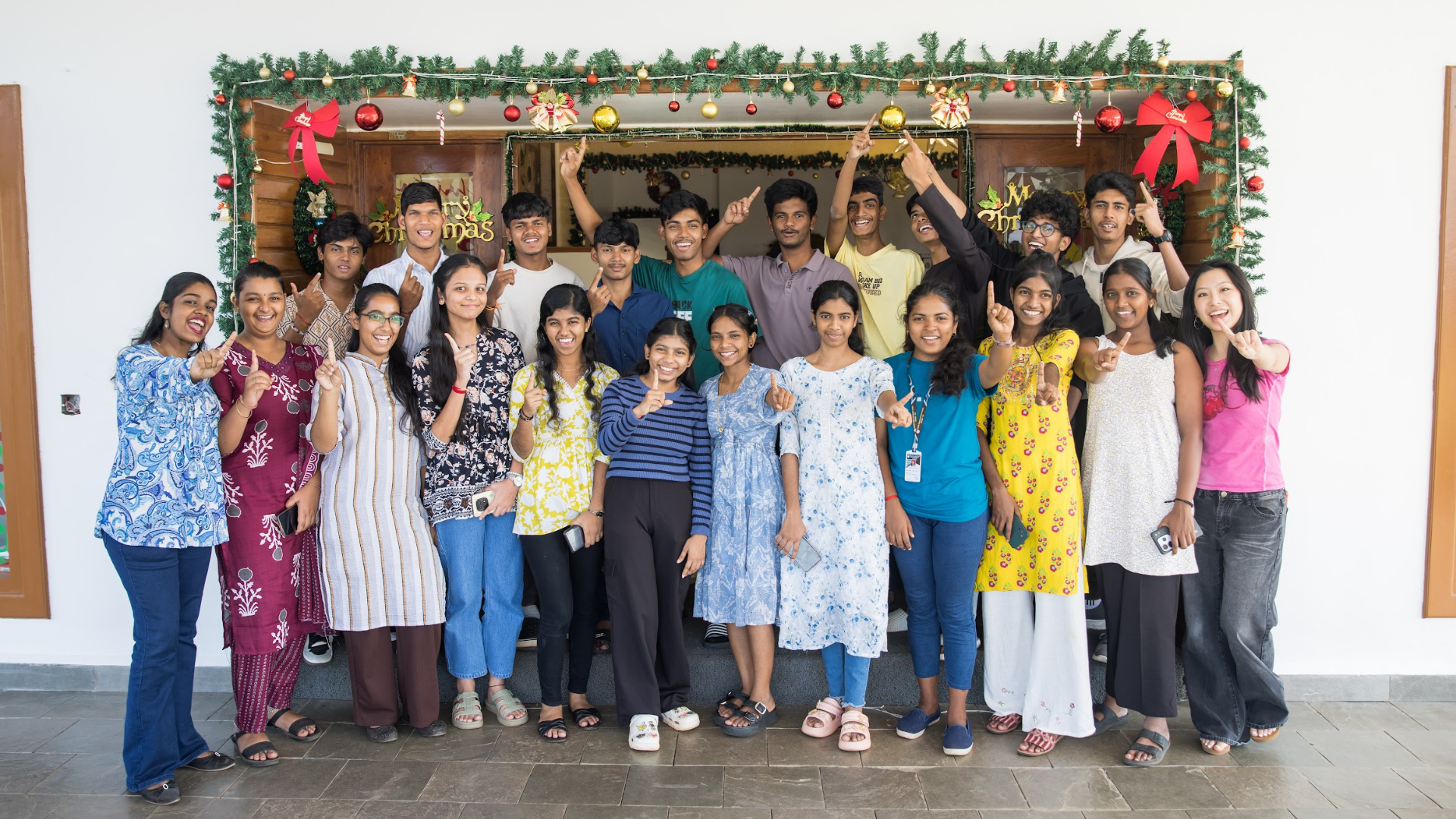
PSIL students and instructors.
By Brooke Decho
Something that stood out to me, as someone who studies environmental science and engineering, was the environmental consciousness the students presented in their final project. It was some that I had read about the trash and pollution output in India, that is emphasized, however, many of the students’ final projects revolved around trash clean up and pollution control. It was amazing to see the work of young advocates, and I cannot wait to see what they do in the future to work on the problems they identified.
The connection between the students and the teachers was one that made the experience truly memorable. While the program is only a week long, the students were truly bought in to getting to know the instructions and what PSIL is about.
☆ The views represented herein are those of the interview subjects and do not necessarily reflect the views of the Mittal Institute, its staff, or its steering committee.