As a Mittal Institute student grant recipient, Tara Hein, a PhD student at Harvard, spent summer 2026 in Kerala, India, conducting research for her project, “Seeing like a Citizen: Fragmented Citizenship in Santiago, Chile and Kerala, India.” Her research explores how people’s experiences with the state—particularly when government services and institutions are highly visible but unevenly delivered—shape how they understand and engage with citizenship. Building on interviews conducted in Santiago, Chile, she traveled to Kochi and Thiruvananthapuram to further develop her research through interviews with residents in Kerala. She shares more about her summer in her grant report.
Mittal Institute: What were your goals with your student grant, and why did you pursue this project in India?
Tara Hein: My primary aim was to extend and test my theory of fragmented citizenship: the idea that in places where the state is widely visible but its performance is heterogeneous across domains of service provision, programs, and public goods, citizens’ relationship with the state is characterized by asymmetry. In such settings, individuals may experience a responsive state in some domains (e.g., housing or education) and failure in others (e.g., security or waste management). Such contradictions, I posit, influence what citizens come to expect from the state and shape how they choose to exercise their citizenship in turn.
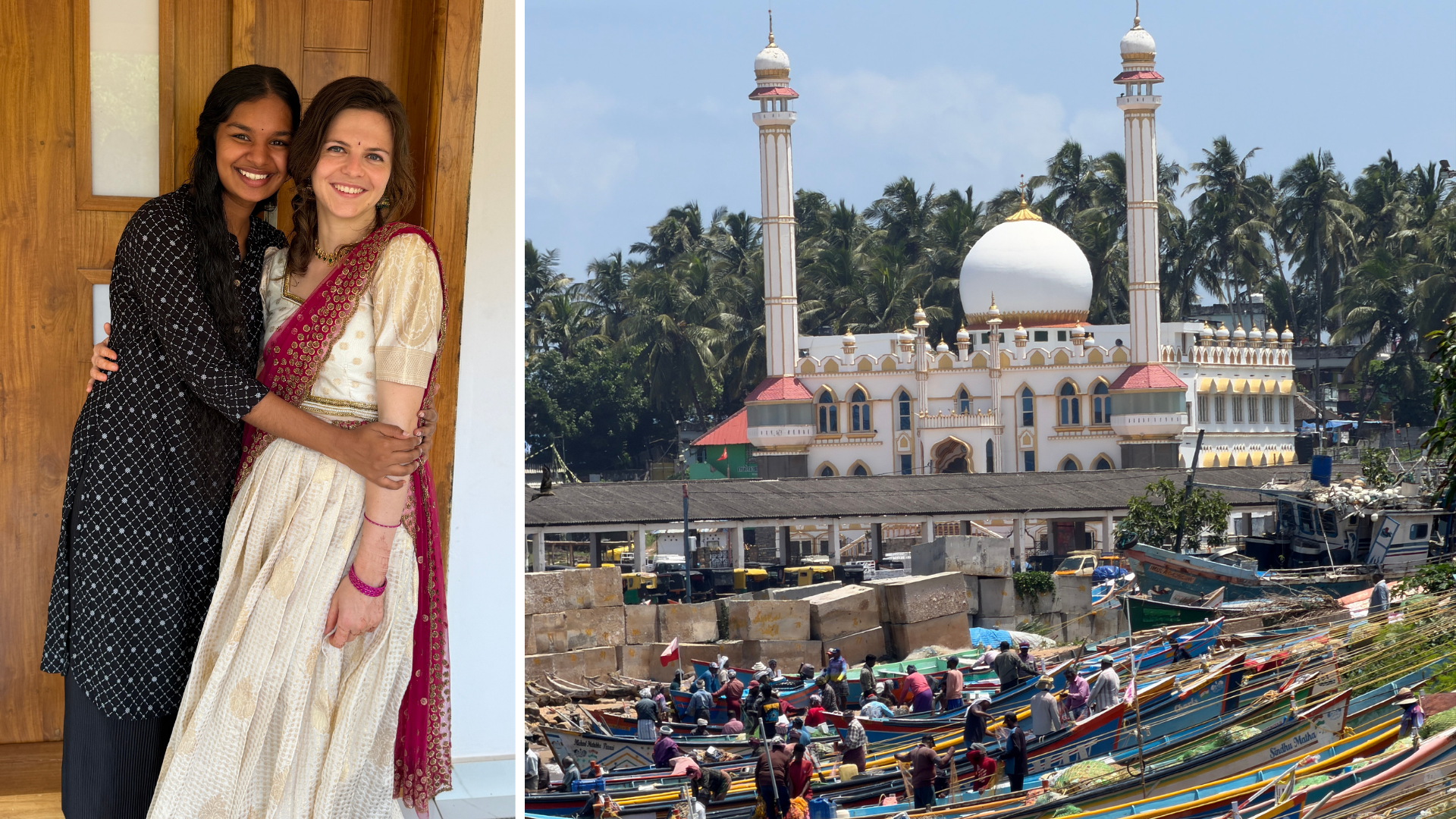
Left image: Tara with Bhavi, field assistant, at her home in Palakkad; Right: Fishing boats at Vizhinjam Port.
Mittal Institute: What was most impactful about this experience?
Tara Hein: This was my first time in India; indeed, it was my first time in Asia. Thus far, I have mainly studied Latin America. And, part of the reason for my travels was, specifically, to examine the similarities and differences across these contexts to better understand how to build theories of citizen-state relations that travel — or, alternatively, observe the ways in which they are limited to time and place. Broadly, what struck me most during this trip were the overlaps and divergences between the places that I know so well and this setting that was so new to me. In many ways, the residential areas we visited on the outskirts of the big cities reminded me of Costa Rica: the abundance of food, of coconuts, mangos, bananas, papayas; the pace of life; the friendliness and tranquility of the folks living there. But there were also some aspects of life here that contrasted sharply with what I am accustomed to in Latin America. Among these, for example, the fact that on the same street you could find people who were markedly below the poverty line and significantly above it. Latin American metropolises are infamous for the sharp spatial inequality across their geography, and this is also the case in other parts of India. But in Kerala, it was nearly absent. My field assistant could not understand why I was so fascinated by its absence: “this is normal for us!”, she’d say. Details like this one are what impacted me the most, and which I am looking forward to considering further as I analyze my data and continue working on my project.
Mittal Institute: Bring us into your daily life during your grant? What was it like? Who were you meeting? What institutions were you visiting?
Tara Hein: Most days started with a hot glass of chai (I would ask for “no sugar,” and this was always somewhat disconcerting for the person taking my order) and a masala dosa, before my field assistant and I ventured to that day’s selected residential area, where we would spend the day talking to people. We would start on one end of a street, knock on a door, and let our random walks take us through the coconut-lined alleyways of Kochi and Thiruvananthapuram. We’d introduce ourselves and the project, and were more often than not welcomed into a home or waved onto a porch, where we would spend the next one to two hours hearing from the respondent (sometimes joined by one or two members of their family) about what life was like here. We asked about public services—about experiences with infrastructure, waste management, healthcare, local government, and so forth—as well as general satisfaction with life in Kerala, political views, and anything else the respondent might find pertinent to share with us or someone reading this research in the future. After the first set of interviews, we’d find a local restaurant to have our “meals” from—this typical lunch included rice and a whole host of coconut-based veggie side dishes, like avail, and always accompanied by the lentil curry “sambar”. Sometimes the monsoons would try to interrupt our day, but we just pulled out our umbrellas and kept walking down evermore narrow alleys between houses. After about the fifth interview, nightfall would be proximate, and we would head home for the day, before doing it all again tomorrow.
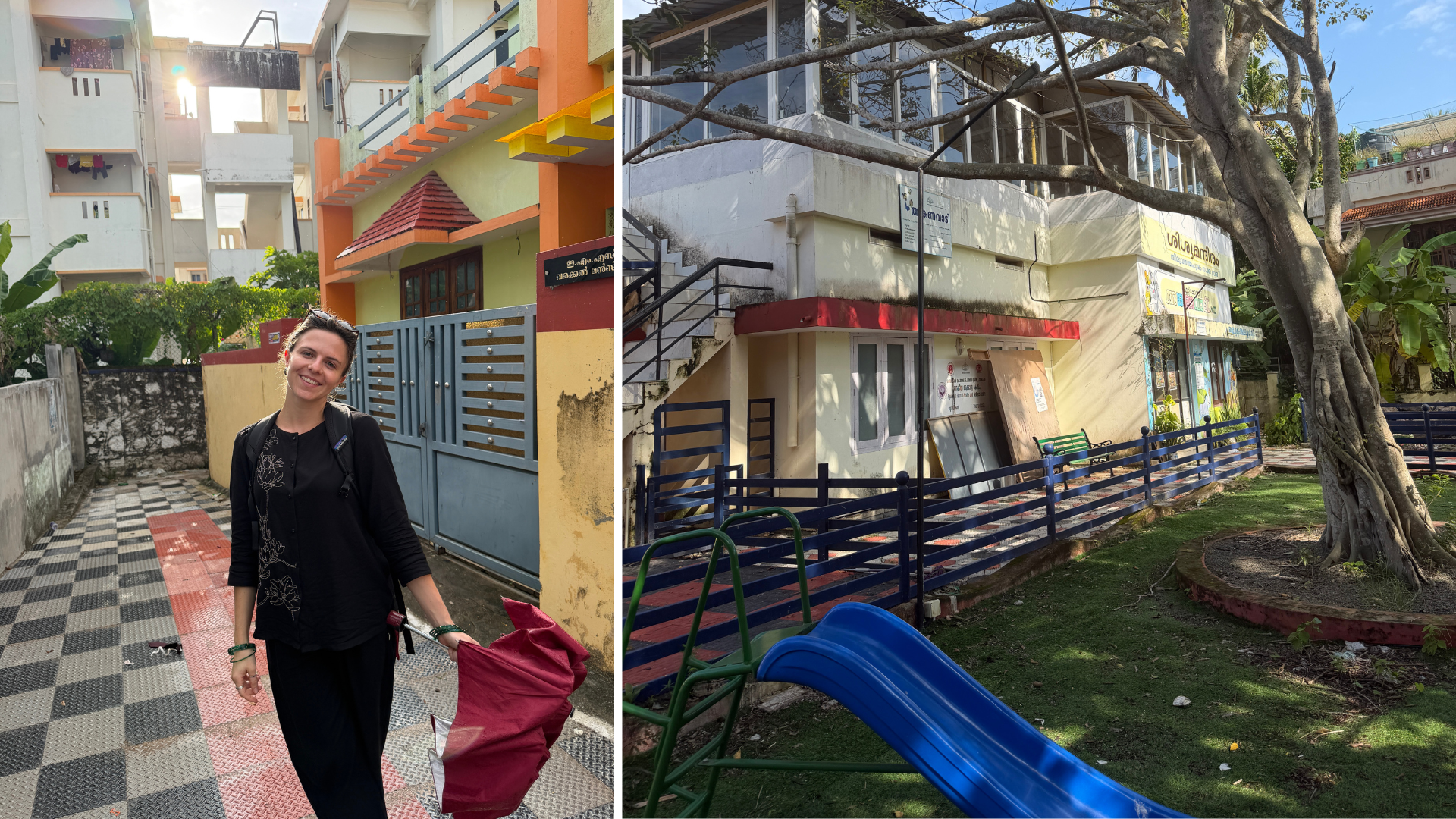
Left: Tara in a neighborhood where she conducted interviews; Right: An anganwadi—a government-supported center for early childhood education, nutrition, and basic health services—in a residential neighborhood; an example of state presence.
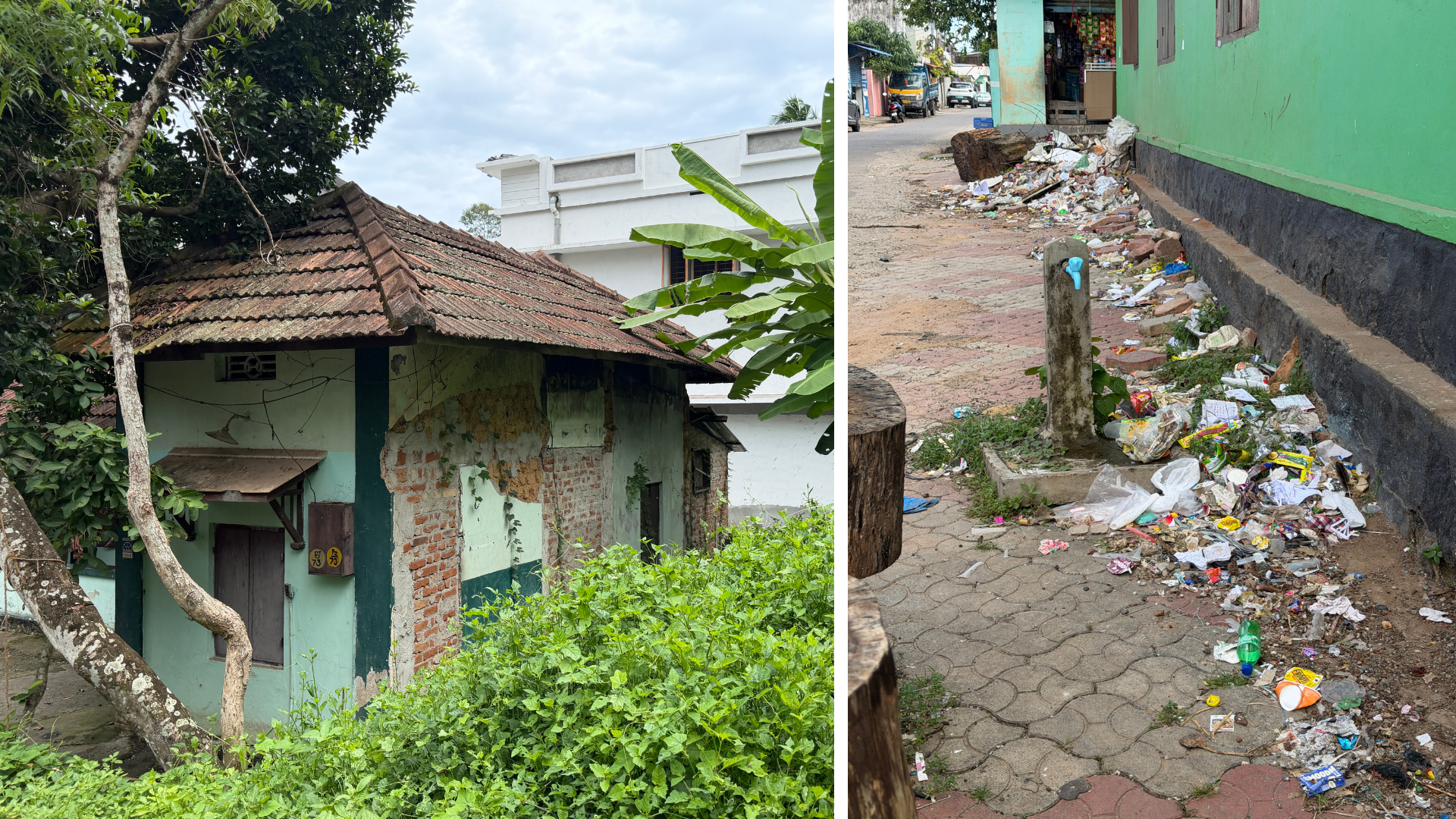
Left: Modest and affluent homes in close proximity, illustrating Kerala’s relative little spatial socioeconomic segregation; Right: Roadside waste accumulation, which Tara says is “very common and demonstrative of the absence of proper waste management.”
Mittal Institute: How will this experience help you to reach your academic goals?
Tara Hein: My fieldwork resulted in over one hundred conversations with residents across both cities. I spoke to people from a wide variety of socioeconomic backgrounds, religious affiliations, political ideologies, and so forth. The wealth of experiences that I came into contact with provided me a rich corpus of data that I am still analyzing. Beyond contributing to this specific project, my time in Kerala has offered me with an invaluable comparative perspective that I am sure will influence the remainder of the work upon which I will embark in graduate school, and beyond. It has reinforced my conviction that personally knowing different places is an indispensable part of being able to produce strong comparative work in political science.
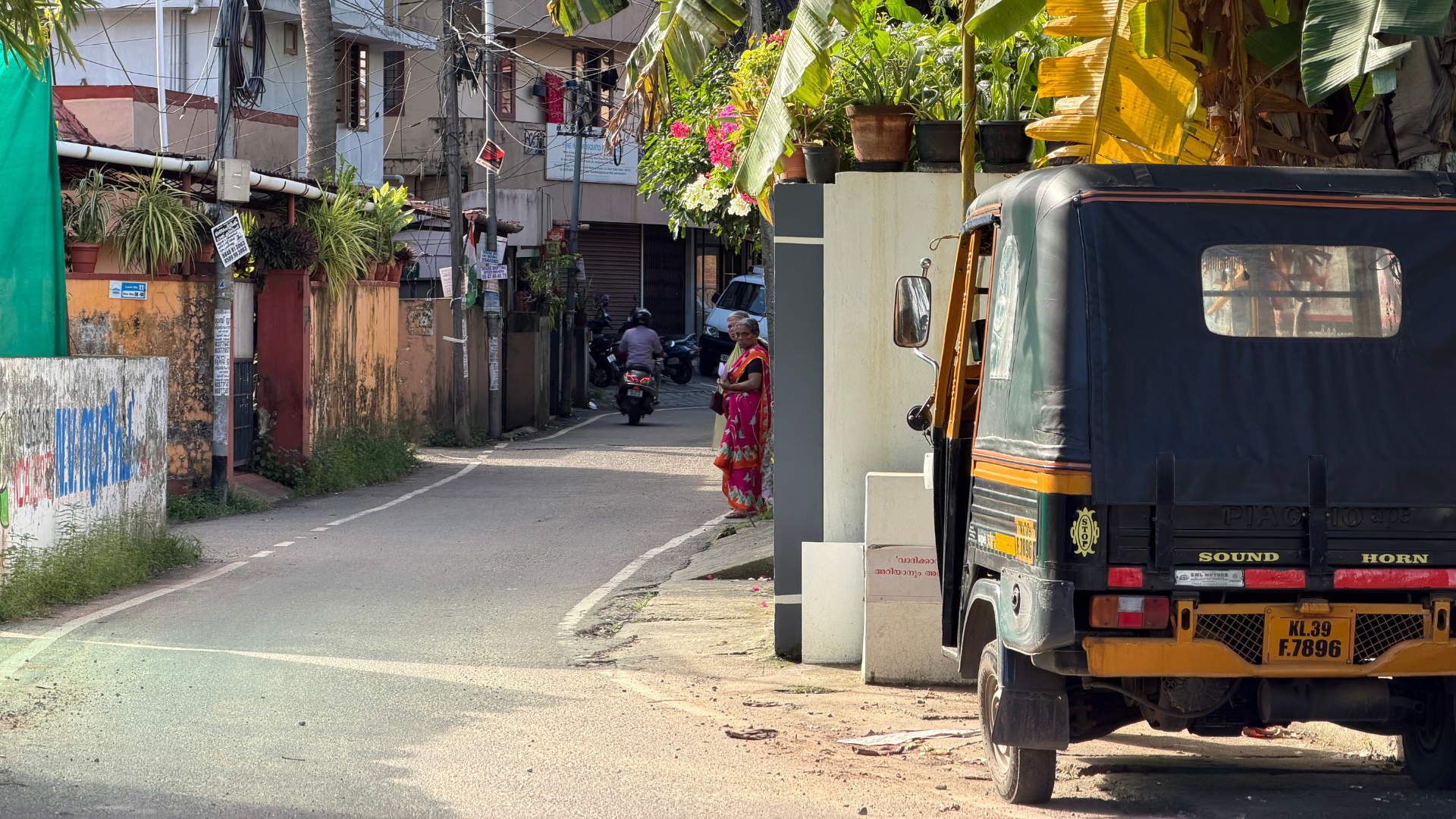
Residents (not interviewed) speaking in a neighborhood where Tara conducted interviews.
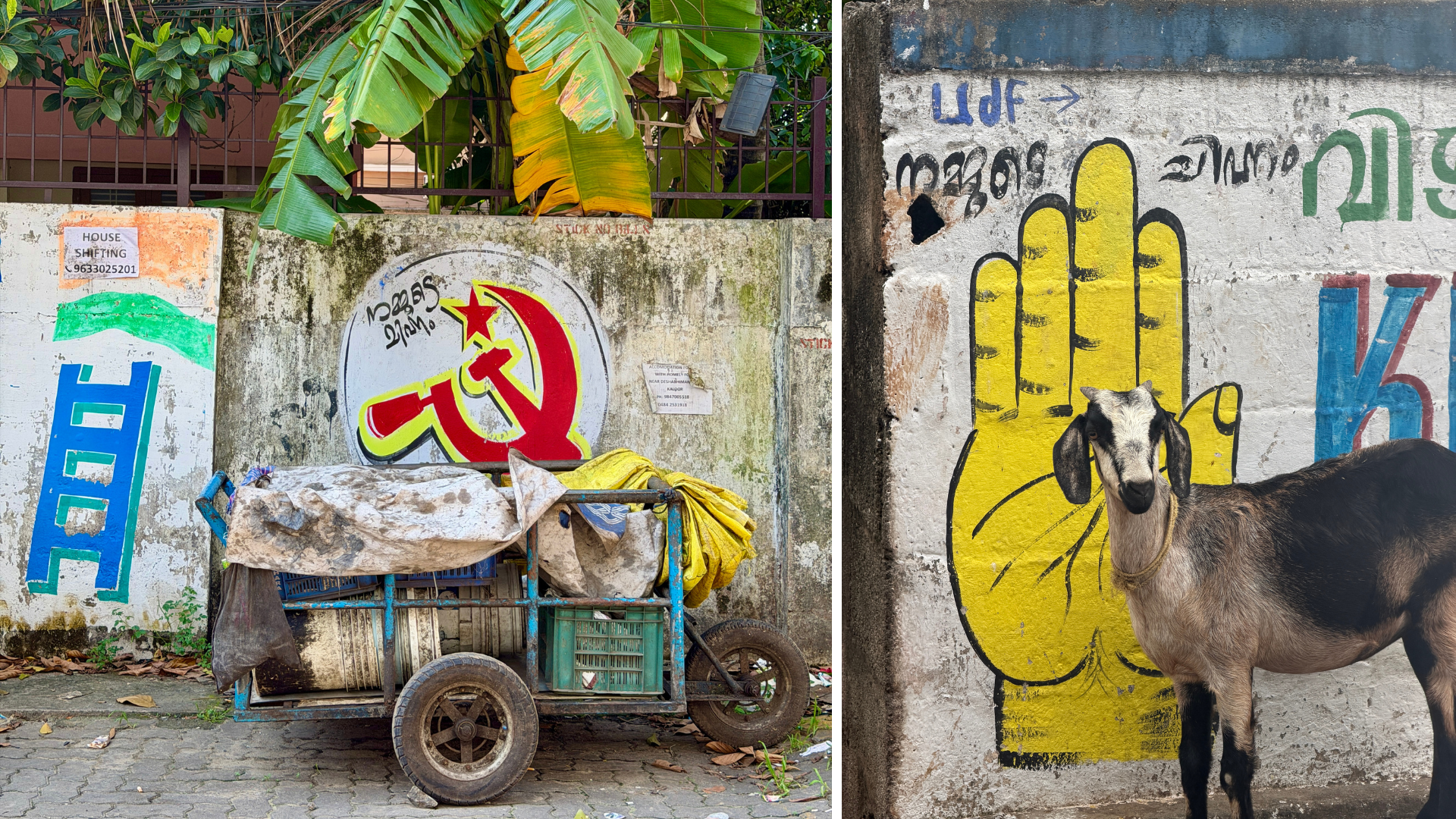
Left: An LDF campaign mural along the roadside, one of many remaining after the recent elections; Right: A goat standing in front of a UDF campaign mural left after the recent elections.
Mittal Institute: What’s the most memorable moment from your time on the student grant?
Tara Hein: Over the course of my time in Kerala, Bhavi, the woman who started out as my field assistant, became a friend. Bhavi’s incredible energy made fieldwork what it was from day one, and about halfway through my time there, she invited me to her home to meet her family and celebrate her little brother’s seventh birthday. It is this open heartedness and hospitality that I hold most dear.
☆ The views represented herein are those of the interview subject and do not necessarily reflect the views of the Mittal Institute, its staff, or its steering committee.