
As Bangladesh confronts the growing challenges of climate change, questions about how communities adapt, build resilience, and navigate government policies are becoming increasingly urgent. Drawing on years of research and professional experience in climate adaptation and governance in Bangladesh, Dr. Md Mafizur Rahman, Mittal Family Climate Fellow, 2026-27, shares his perspective on the challenges facing vulnerable communities and the policies and practices that could help shape a more resilient future.

Dr. Md Mafizur Rahman
By Dr. Md Mafizur Rahman, Mittal Family Climate Fellow, 2026-27
In coastal Bangladesh, salinity intrusion limits access to safe drinking water, while the northern part of the country faces extreme heat, floods, and riverbank erosion. These contrasting realities highlight the need for locally responsive climate adaptation. Since independence, under the leadership of Bangabandhu Sheikh Mujibur Rahman, the Father of the Nation, Bangladesh has developed its environmental protection and disaster management agenda. Over the past two decades, successive Awami League-led governments advanced the country’s climate governance agenda through policy initiatives, including the Bangladesh Delta Plan 2100, the Mujib Climate Prosperity Plan 2022–2041, and the National Adaptation Plan (NAP) 2023–2050. The renaming of the Ministry of Environment and Forests as the Ministry of Environment, Forest and Climate Change in 2018 further reflected the growing importance of climate change in national governance. Yet translating national commitments into local action remains challenging. The NAP recognizes Local Adaptation Plans of Action (LAPAs), with guidelines published in 2024. The Local Government Initiative on Climate Change (LoGIC), a multi-donor initiative involving the Government of Bangladesh, the EU, Sweden, and Denmark, with support from UNCDF and UNDP, developed these guidelines. CARE Bangladesh, the International Rescue Committee (IRC), Concern Worldwide, and Practical Action have also supported local adaptation initiatives.
I have had the opportunity to contribute to LAPA development through initiatives implemented by the Center for Natural Resource Studies (CNRS), a leading environmental NGO in Bangladesh. These included initiatives associated with IRC and Concern Worldwide, as well as a LAPA developed under the Biodiversity for Resilient Livelihoods (B4RL) project, funded by the Embassy of Sweden and implemented by CNRS. Through these initiatives, I have gained experience translating local climate vulnerabilities and community priorities into locally relevant adaptation plans. This process involves participatory planning across eight sectors, ranging from water resources and agriculture to disaster preparedness, ecosystems, governance, and capacity development. Through approaches including PAPD and FGDs, community members identify problems, examine their causes, propose solutions, and prioritize interventions. Their participation brings local knowledge into adaptation planning and helps ensure that responses reflect the challenges people face.
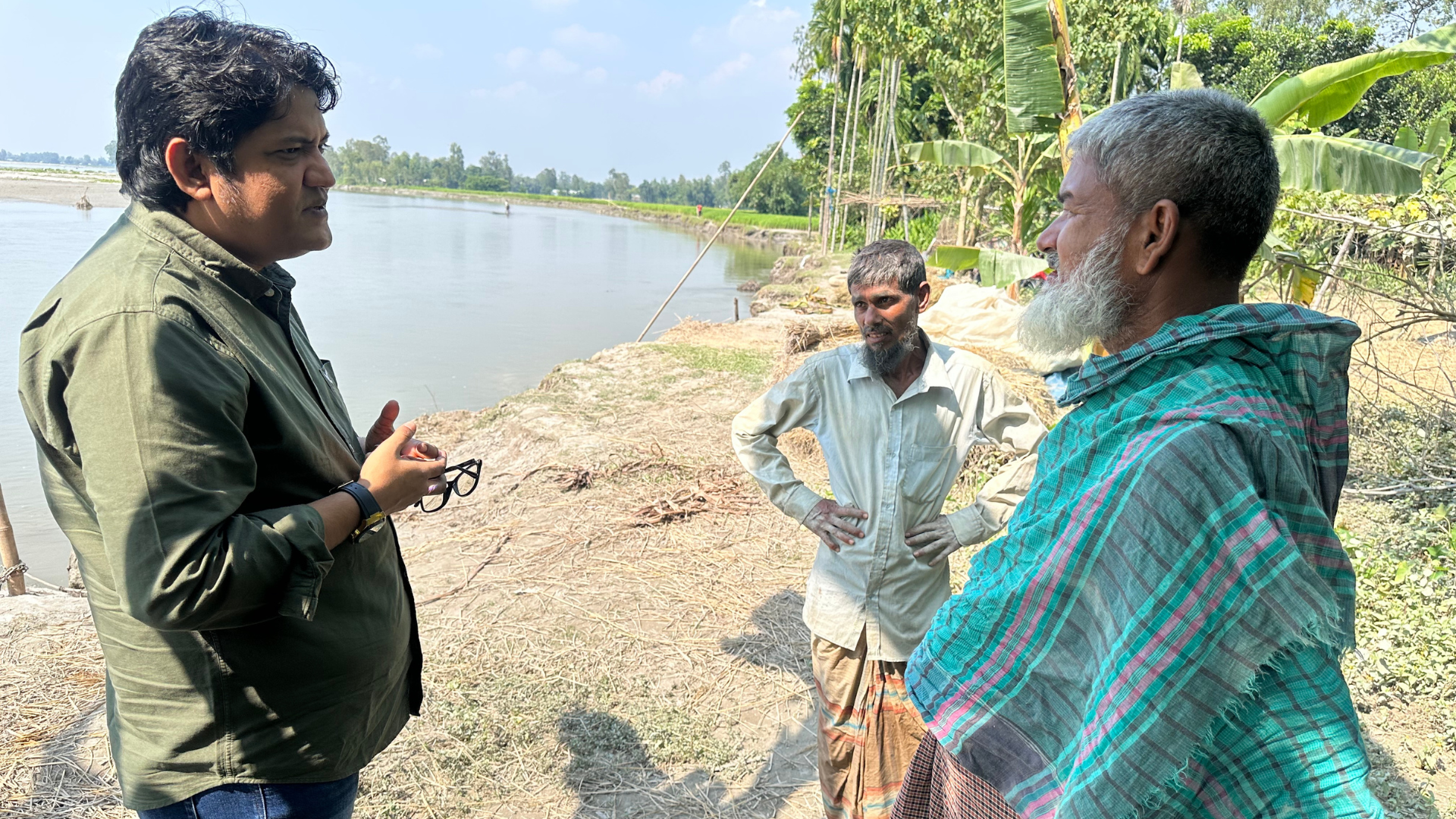
Dr. Rahman consults with local communities.
This approach is reflected in the LAPA developed for Hatibandha Upazila in Lalmonirhat District, in the Teesta River basin. Developed by Concern Worldwide and CNRS, with local partner Gana Unnayan Kendra (GUK), the plan addresses recurring floods, riverbank erosion, and waterlogging that threaten agriculture, infrastructure, and livelihoods. The area has historically experienced Monga, a seasonal livelihood crisis associated with food insecurity and limited employment opportunities. The plan’s priorities include safer water and sanitation, improved flood early-warning systems, resilient infrastructure, climate-adapted agriculture, solar-powered irrigation, and better water storage. These interventions connect immediate disaster risks with longer-term concerns about agriculture, water management, and livelihoods.
Along the southern coast, adaptation priorities reflect different environmental challenges. In Kalapara and Rangabali in Patuakhali District, and Shyamnagar and Assasuni in Satkhira District, LAPA development commissioned by IRC and undertaken with CNRS and local partners Jago Nari and Uttaran identified challenges specific to coastal communities. In Patuakhali, communities prioritized safe drinking water, tube-well installation and repair, rainwater harvesting, and pond and canal restoration amid salinity and dry-season freshwater scarcity. Communities in Satkhira faced similar freshwater challenges, alongside waterlogging and inadequate drainage. These experiences demonstrate why adaptation must respond to local environmental conditions rather than rely on a standard set of interventions.
Adaptation must respond to local environmental conditions rather than rely on a standard set of interventions.
However, environmental differences are only part of the picture. The LAPA developed for Shyamnagar, Satkhira District, under the B4RL project also included the Munda indigenous community and highlighted climate-related pressures on their traditional livelihoods linked to agriculture and Sundarbans resources, including fishing and crab harvesting. Social marginalization further restricts their access to public services, cyclone shelters, and local decision-making, compounding their environmental vulnerability. The LAPA identified priorities for the Munda community beyond physical infrastructure, including freshwater access, culturally sensitive disaster preparedness, livelihood diversification, representation in local governance, and cultural heritage preservation. A cyclone shelter cannot provide equal protection if marginalized groups face barriers to accessing or using it. Adaptation planning must therefore consider not only what infrastructure communities need, but also whether different groups can access its benefits and participate in decisions affecting their futures.

Dr. Rahman in a session with a local community./span>
These experiences have shaped my understanding of climate adaptation as both an environmental and a governance challenge. LAPAs represent an important step toward locally led adaptation, enabling communities to identify vulnerabilities, prioritize needs, and shape responses suited to local realities. To realize this potential, community participation must go beyond consultation. Local priorities must influence public decisions and be supported by budgets, effective coordination, capable institutions, and accountability. Bangladesh’s national climate policies provide an important foundation, but their lasting impact depends on how effectively they address local realities and inequalities. For me, local adaptation planning is not simply about preparing communities for a changing climate; it is about ensuring that their knowledge, priorities, and voices help shape decisions about their lives and futures.
☆ The views represented herein are those of the interview subject and do not necessarily reflect the views of the Mittal Institute, its staff, or its steering committee.