
Dr. Guglielmo Zappalà, a Harvard University Environmental Fellow, is investigating how climate change is reshaping agricultural livelihoods in Pakistan. Building on a 2024 survey of more than 2,000 farmers in Punjab, his latest research —which earned a 2026 Mittal Institute faculty climate research grant—examines how the devastating 2025 floods have influenced farmers’ perceptions of risk, their interest in crop insurance, and the decisions they make to adapt to a changing climate. We asked him about the project, what he hopes to learn, and how the findings could inform future climate adaptation policies.

Guglielmo Zappalà
Mittal Institute: This project builds on your 2024 survey that explored why crop insurance uptake remains low among Punjab farmers. What first drew you to this research, and why is Pakistan an important place to study climate adaptation?
Guglielmo Zappalà: Few places make the stakes of climate adaptation as visible as Pakistan. The country contributes less than one percent of global greenhouse gas emissions, yet it consistently ranks among the most climate-vulnerable in the world. The 2022 monsoon floods affected 33 million people and caused an estimated 30 billion dollars in damage and losses. And agriculture, which accounts for roughly a quarter of national income and more than a third of employment, absorbs much of the blow when the water rises: what is lost is not just a harvest but the main engine of rural livelihoods.
This project is joint with Patrick Baylis and Talha Naeem at the University of British Columbia, and it began with a context Talha knows intimately. He is from Pakistan. During a field visit in Punjab, he learned about Pakistan’s first crop insurance program, the Punjab Crop Insurance Program, which offered heavily subsidized crop insurance to farmers but had almost no uptake unless provided for free. That was the puzzle that drew us in: why would farmers facing repeated climate shocks turn down heavily subsidized insurance? Was it driven by liquidity constraints, preferences, lack of information or beliefs, or is this a result of a poorly designed contract that either does not reflect the true underlying risk or introduces additional risk that farmers are unwilling to pay for? This is a first-order question for developing countries as they redesign insurance and social protection programs in a changing environment. Patrick’s existing work on insurance to natural disasters, my work on the adaptation in developing countries and on the role of beliefs in shaping farmers’ decisions, and Talha’s experience working in Pakistan put us in a good position to tackle this puzzle.
In 2024, we surveyed more than 2,000 farmers across a hundred villages of Punjab. We provided a random group of them with information about how temperature and rainfall in their own area had changed in recent years, and we measured how much they would be willing to pay for an area-yield index insurance, a product that pays out when conditions in an area cross a threshold and implicitly covers all perils that may affect yields in an area. In particular, we tested whether farmers were put off by what economists call basis risk: the possibility that your own field suffers a loss but the index the insurance is written on does not register it, so no payout arrives.
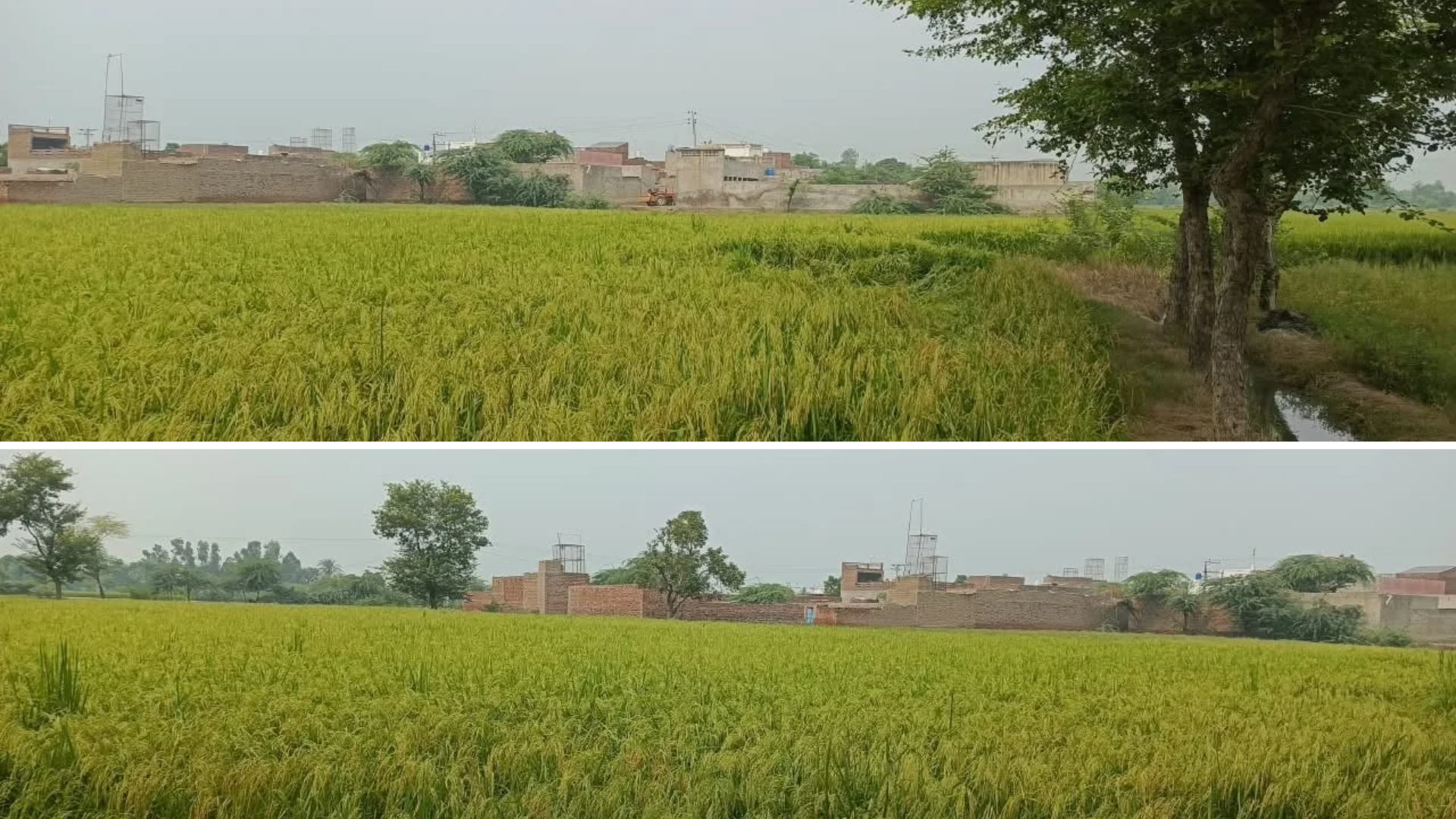
View of farmland in Punjab.
Mittal Institute: Did any of the findings from your 2024 survey surprise you?
Guglielmo Zappalà: Two main findings stood out. Given the emphasis in both theoretical and empirical work on index insurance literature, we expected basis risk to be of first-order importance, but we found that it mattered less. The same farmer would not pay meaningfully more for an index measured close to their own fields than for one measured across their whole district, even though the local index is far less likely to miss their loss. Part of the reason is that farmers expected all three contracts we offered to trigger at the same rate, even though the objective likelihood of payout was decreasing as the level of index increased.
The second finding was information. Farmers who received simple information about historical temperature and rainfall in their area were willing to pay somewhat more for insurance, and the effect was concentrated among those who believed average temperatures were lower than the weather records show. For them, the information brought perceptions closer to the data, and their demand responded. But the effect was modest, and it did not close the gap: even with accurate information, demand stayed low. If neither price nor information accounts for farmers’ reluctance, the binding constraints could be somewhere economists do not usually look. That conclusion is what set the direction for the new project.
Mittal Institute: The 2025 floods in Punjab were among the worst in recent history. How did that event shape the direction of this new project?
Guglielmo Zappalà: When the floods came in August 2025, farmers across the districts where we work were living through exactly a scenario where insurance against natural disasters could have helped cope with losses. Two things became impossible to ignore. The first is that insurance is only one of the ways households can respond to climate risk: they can also invest in protecting their fields, diversify their income, or, in the extreme, move. The second is that even after devastating floods, very few households seriously consider leaving. We wanted to understand how different forms of adaptation fit together, and why the mobility margin stays so firmly shut.
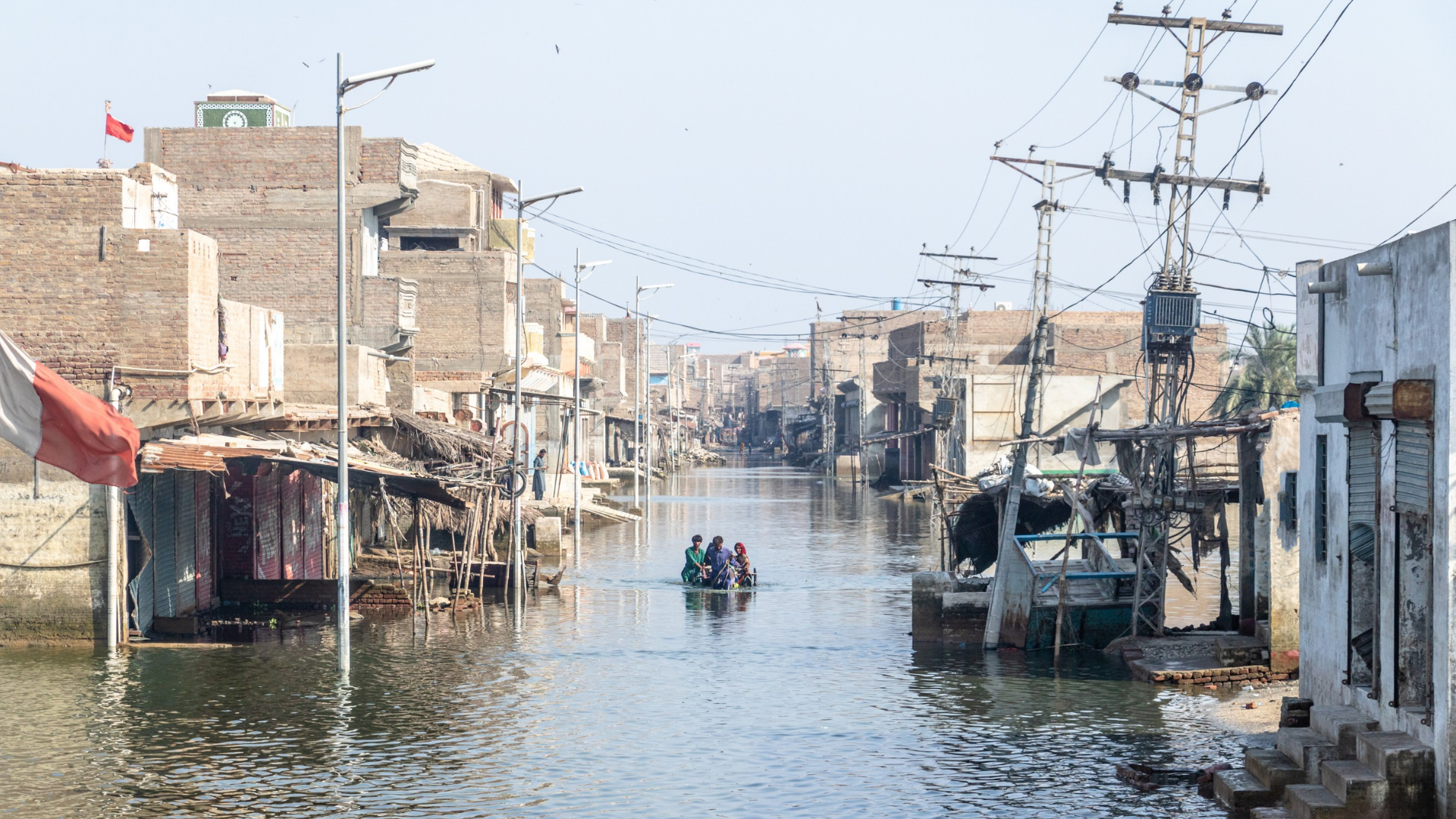
Flooding in Pakistan | Adobe.
In our early conversations with farmers, the answers were rarely about money alone. They were about family and community, about the village itself, and about specific plots of land that a household has farmed for generations. That is what pushed us to put attachment at the center of the new project: attachment to people, to places, and to plots. These ties are real costs of moving, but they are not traded in any market, so no compensation scheme or cost-benefit calculation counts them. A flood can take a harvest in a day, but the ties that bind a family to its village are built over generations, and farmers do not give them up lightly. The new survey is designed to measure each of these three attachments separately and to ask how they shape the adaptation choices farmers are willing to make.
Mittal Institute: For this project you expanded the survey’s geographic scope to reach farmers living with very different levels of flood exposure. What do you hope to learn by comparing them?
Guglielmo Zappalà: We are launching the survey this month: 1,440 farming households across 120 villages of Punjab, chosen so that they span very different histories of flooding, from villages hit hard in 2025 to villages that have largely been spared. The comparison is the point. If we only spoke to farmers in the hardest-hit villages, we could never tell which decisions reflect the flood and which reflect the farmer.
Comparing across exposure levels lets us ask questions a single setting cannot answer. Do beliefs about flood risk track the risk farmers actually face, or do they lag behind it? Is the willingness to consider moving different where floods are frequent rather than rare, and do the social norms around staying, the sense that a family belongs to its village, soften or harden with repeated shocks? Does demand for insurance rise with exposure, or does living through a flood change what farmers want from a contract altogether? The answers matter for policy, because a program that works in a district that floods every few years may fail entirely in one where the risk is growing but has not yet arrived.
Mittal Institute: Your project combines interviews with satellite imagery. What does that combination allow you to see that you couldn’t with surveys alone?
Guglielmo Zappalà: Surveys tell us what farmers believe; satellites tell us how climate actually behaved. The distance between those two pictures is where much of this project lives. We use satellite-based flood records to build an objective measure of exposure for every community: how much of the surrounding area was under water at the peak of the 2025 floods, and in earlier flood years. That record does two jobs. It lets us choose villages across the whole spectrum of exposure rather than only where the damage made the news, and it gives us a benchmark against which to compare the recollections and beliefs we elicit in the survey, so we can see whose picture of their own risk is accurate and whose is not. We also check the satellite record against the government’s own flood maps, which are often closer to what households actually see and hear about.
Surveys tell us what farmers believe; satellites tell us how climate actually behaved. The distance between those two pictures is where much of this project lives.
Looking forward, we combine the satellite record with model-based projections of flood risk over the next ten years, which lets us ask additional questions: do farmers understand that the frequency and severity of flooding are changing, or do they expect the future to look like the past? Whether people believe they live in a stationary climate or a changing one may be one of the most consequential beliefs in adaptation.
Mittal Institute: How could your findings help shape crop insurance programs in Pakistan? And are there lessons that could apply to other countries facing more frequent climate extremes?
Guglielmo Zappalà: Insurance is where we started, but it is one instrument among several. Governments facing rising climate risk are deciding, often implicitly, how to divide resources between insurance and social protection, support for households that move, and extension and training that make farms more resilient where they are. Our survey speaks to that allocation, because it measures how farmers value each of those margins rather than only what they will pay for a contract.
On insurance itself, the most direct lessons are about design. Index insurance can be written on different underlying measures, rainfall or average yields, and calculated at different geographic levels, from the village up to the district. Rather than give farmers a fixed menu, our survey asks them to design their preferred contract, and it asks those who decline precisely why, whether that is distrust of providers, religious concerns, expecting relief from the government instead, or simply not feeling at risk. That tells us which features farmers value and, just as important, which ones they trust.
We are also testing something simpler and, if it works, very cheap: the way a program is described. Every farmer in our survey is offered the same contract, but for some it is described as protecting income, for others as enabling investment in the farm, and for others as helping families stay where they are, with their people, places, and plots. If demand responds to the description, the lesson is not confined to insurance. A resettlement package, a cash transfer, or a training program is also presented to farmers in some way, and the presentation may be worth as much as the terms.
The attachment measures answer a different question: which instruments can work at all. Where ties to people, village, and land are strong, programs that ask households to relocate will struggle even when the compensation looks generous, and the same budget does more through flood protection, social protection that pays out quickly, and training that supports diversification on the farm. Where those ties bind less, or where the risk becomes severe enough to override them, the constraint is more likely to be liquidity or information, and support for mobility becomes a serious option. Knowing which case a village is in is exactly what these estimates are for.
These lessons travel. A large and growing number of governments run subsidized crop insurance programs, index-based products are increasingly the instrument of choice for agricultural risk, and most of these programs struggle with the same low uptake we study. But the wider point is that adaptation policy everywhere is a portfolio choice across insurance, protection in place, and mobility. What generalizes from our work is not a particular contract but the diagnostic: is the barrier information, is it program design, or is it something deeper about how farming families weigh risk against the lives they have built?
Mittal Institute: Has this research changed the way you think about how people adapt to climate change?
Guglielmo Zappalà: It has. As economists, we usually explain low adaptation through constraints that markets and budgets impose: technologies are costly, credit is short, information is missing, insurance and credit markets fail. Those constraints are real, and much of this project is about measuring them. But this research has pushed us to take seriously a set of barriers that operate through preferences and social norms and not only through markets. Some of the most binding constraints on adaptation may be ones economists rarely write down: the value of the people, the village, and the land that make up a life.
That has consequences for policy. Social ties determine who can borrow from whom after a flood, who takes in a family whose house is gone, and whose fields get replanted first, so they also determine how much risk is left over for a program to cover. And support that arrives in a village rarely stays with the household it was addressed to. It moves along the lines that were already there. A program designed without those lines in view will misjudge both the demand for what it offers and the reach of what it delivers.
Taking attachment seriously does not mean treating farmers who stay as irrational. It means recognizing that moving away from risk has costs that no market prices, and that a policy which ignores those costs will keep being puzzled by the choices people make. If we can measure what staying is worth to households, and which ties bind most, we can begin to answer a question climate adaptation policy will face everywhere: whether to compensate people for the ties they would have to sever, to design programs that make those ties portable, or to help people stay safely where they are.
☆ The views represented herein are those of the interview subject and do not necessarily reflect the views of the Mittal Institute, its staff, or its steering committee.