
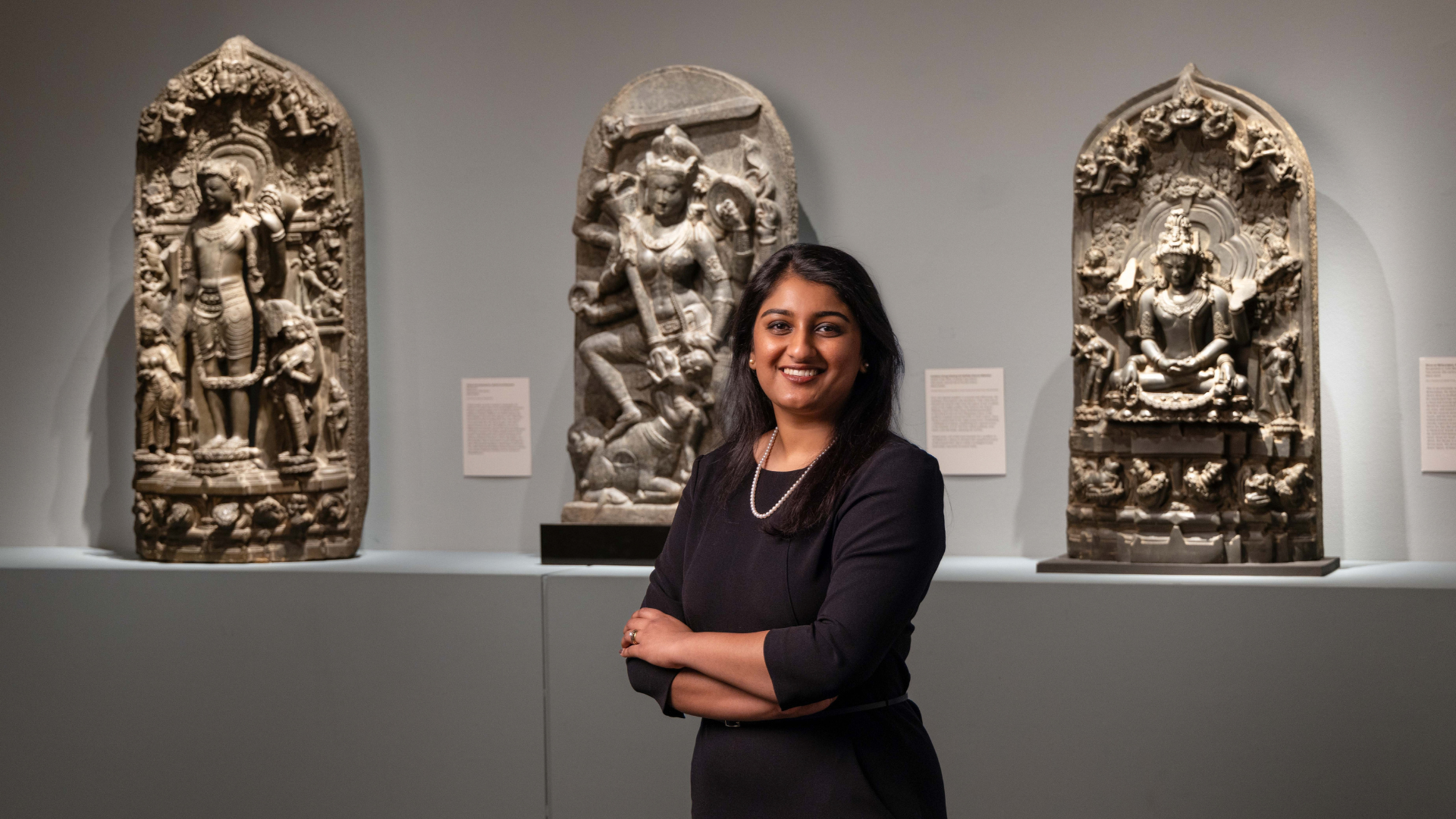
Vaishnavi Patil. Photo Credit: Eileen Travell, The Met.
Vaishnavi Patil, an alumna of the Mittal Institute’s Graduate Student Associate program, earned her Ph.D. from Harvard’s Department of History of Art and Architecture in February 2026. Her doctoral research examined female deities—particularly mother goddesses—and how religious production, patronage, and institutional development shaped their evolution across South and Southeast Asia. She has since joined the Metropolitan Museum of Art in New York as Assistant Curator of South and Southeast Asian Art. We spoke with Vaishnavi about her new role and how her time at Harvard shaped her career trajectory.
Mittal Institute: Vaishnavi, congratulations on completing your Ph.D.! Before we discuss your new role, let’s start with the bigger picture. What first sparked your interest in South Asian art and visual culture?
Vaishnavi Patil: Thank you! Completing my Ph.D. at Harvard and starting a new role at The Met are deeply meaningful milestones for me, each rooted in my longstanding engagement with art history.
My interest in history began early, but a pivotal moment came during my undergraduate years at St. Xavier’s College, Mumbai, when I participated in a site seminar at the Ajanta Caves with the late Professor Walter Spink. Studying Ajanta with Professor Spink transformed my understanding of the relationship between art and history. Moving through the caves and encountering the sculptures, murals, and architecture in situ, I came to see that images do not merely illustrate belief; they help shape religious experience. That experience solidified my commitment to the direct study of objects and sites.
That commitment deepened years later through my work on the exhibition Tree & Serpent: Early Buddhist Art in India, 200 BCE–400 CE (2023), curated by John Guy, at The Metropolitan Museum of Art. As a Research Assistant on the project, I was introduced to curatorial practice and public scholarship in a new light. I came to value the process of translating research into museum spaces and carefully considering how visitors encounter objects and construct meaning from them. While working on the exhibition, I also became increasingly aware of gaps in scholarship on early goddesses and goddess worship. Questions arising from those gaps eventually became the foundation of my dissertation.
I came to see that images do not merely illustrate belief; they help shape religious experience. That experience solidified my commitment to the direct study of objects and sites.
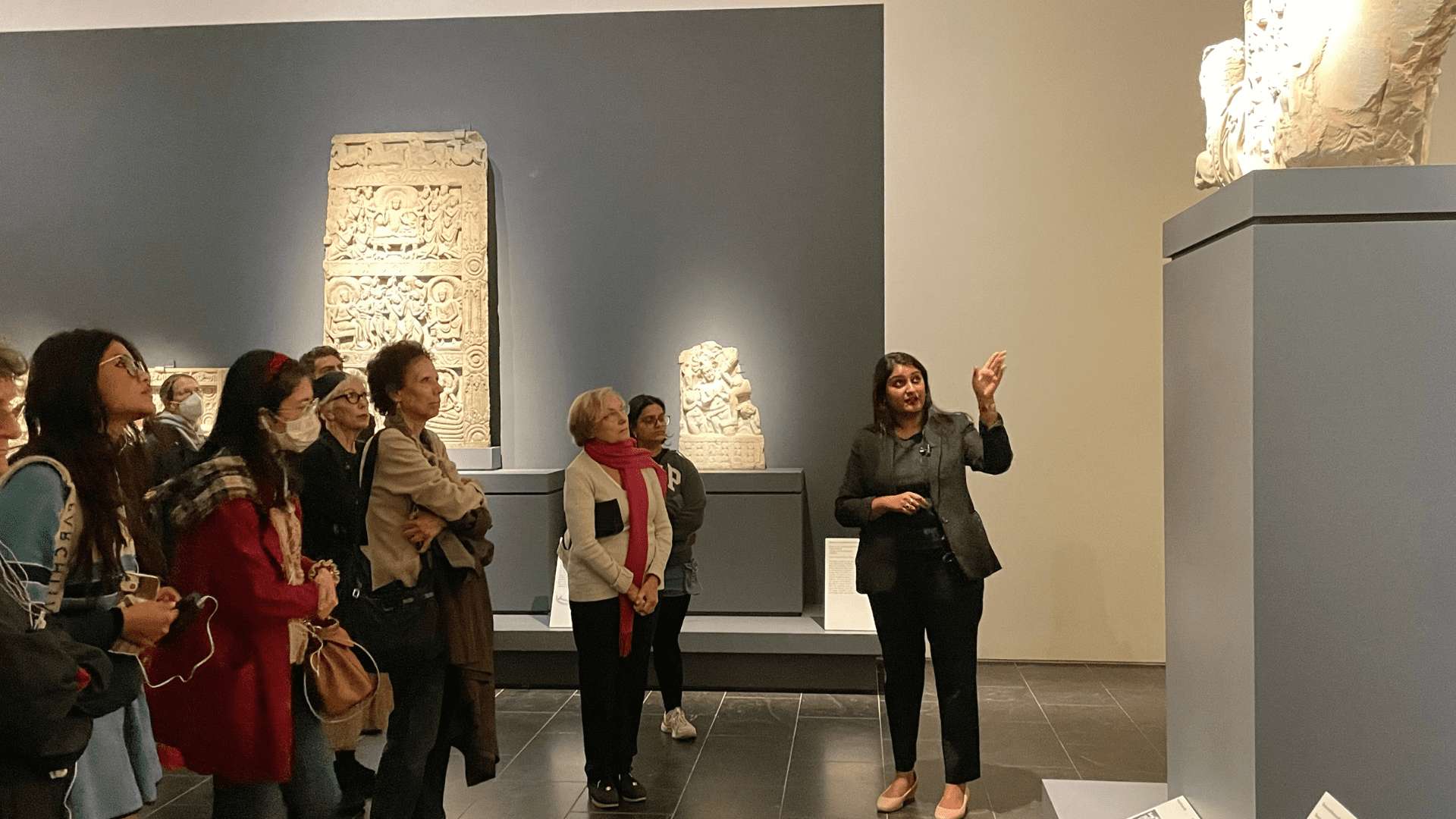
Leading a “Conversations with an Expert” tour for Tree & Serpent: Early Buddhist Art in India, 200 BCE–400 CE, The Metropolitan Museum of Art, September 28, 2023.
Mittal Institute: Your doctoral dissertation, Between Power and Protection: Maternal Imagery in the Religious Art of South Asia, 1st–7th Century CE, explores a rich and complex subject. What were the central questions that guided your research?
Vaishnavi Patil: My dissertation began with what seemed like a simple question: How did goddesses shape the religious traditions of South Asia? Who were these earliest divine female figures, and what significance did they hold for the communities that worshipped them?
While examining early goddess imagery, three figures stood out: Hārītī in Buddhism, the Saptamātṛkās in Brahmanical traditions, and Ambikā in Jainism. These goddesses share striking similarities in iconography, myth, and function, yet previous scholarship has often treated them within strict sectarian boundaries. Textual sources, meanwhile, offer surprisingly few details about their early histories. Through my dissertation, I sought to recover the feminine presence in South Asian histories while developing new methods for understanding premodern South Asia.
Using a longue durée approach, I examine their sculptural representations through the lenses of gender, trans-regionalism, and trans-sectarianism. Over time, it became clear to me that motherhood was not peripheral to early South Asian religious life; it was central to how the feminine, both divine and human, was imagined and made visible in the early centuries of the first millennium. Covering the first to seventh centuries CE, my dissertation shows how maternal imagery became a powerful source of both protection and authority for women and men alike.
Mittal Institute: How did Harvard’s resources — including the Mittal Institute — support your research and professional development?
Vaishnavi Patil: Fieldwork was essential to my dissertation. The project involved extensive research across India, as well as the study of sculptures now housed in museums in the United States and the United Kingdom. Generous support from the Mittal Institute, Harvard Griffin GSAS, and the Asia Center made multiple research trips possible, allowing me to examine archaeological sites and objects firsthand. Seeing works in person and studying their size, placement, surfaces, and signs of wear shaped my research in ways that photographs alone could not.
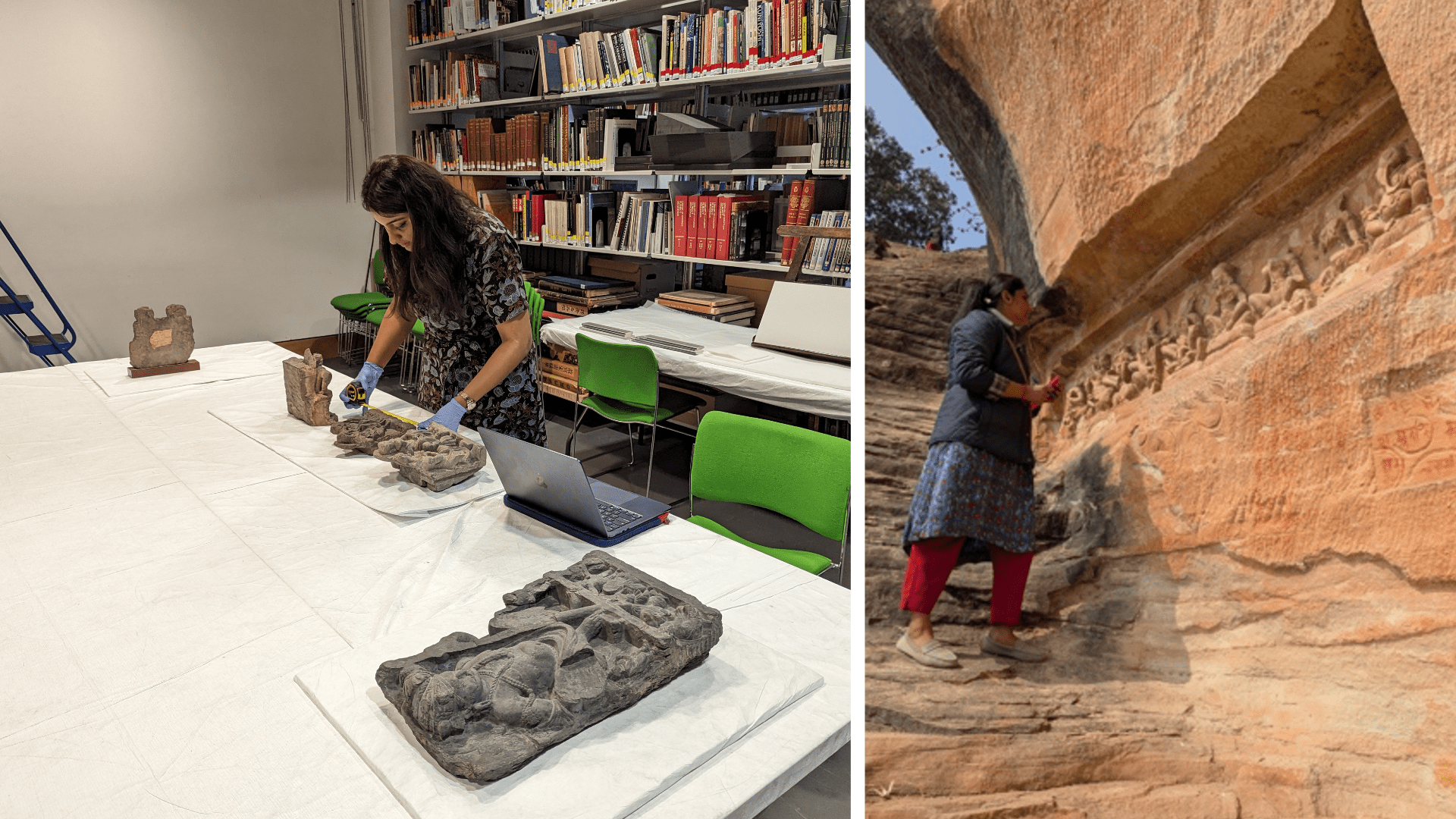
Left image: Conducting research at the British Museum in London through a joint summer research grant from the Mittal Institute and Asia Center. August 2023; Right image: Conducting research at Nahar Ghat, Deogarh, Uttar Pradesh, India, through a winter research grant from the Mittal Institute. January 2025.
Beyond my dissertation, I was actively involved in Mapping Color in History, a Digital Humanities project led by Professor Jinah Kim. The project allowed me to work closely with South Asian paintings alongside art historians, scientists, and conservators. Studying pigments and material techniques gave me a more interdisciplinary and collaborative view of art history. This work has also led to my ongoing research on the sixteenth-century manuscript known as the Dispersed Bhagavata Purana: through the project, we have digitally reunited dispersed folios, and in a recent journal article in npj Heritage Science, I analyzed the manuscript’s materiality in collaboration with scientists at the Harvard Art Museums. I hope to continue working on this manuscript and the broader group of sixteenth-century manuscripts in the future, as we still know so little about them!
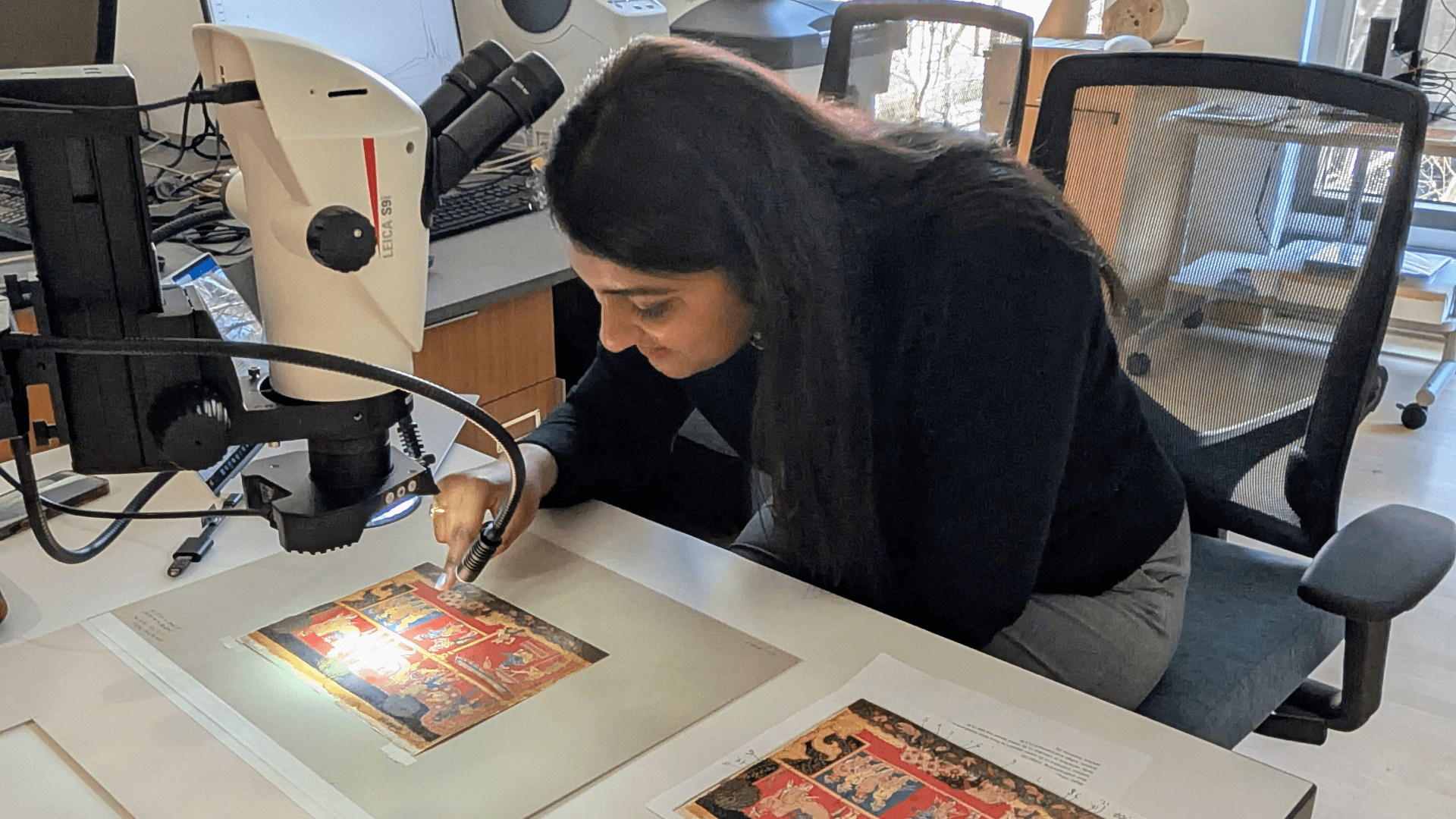
Studying the Dispersed Bhagavata Purana at the Museum of Fine Arts, Boston. March 2025.
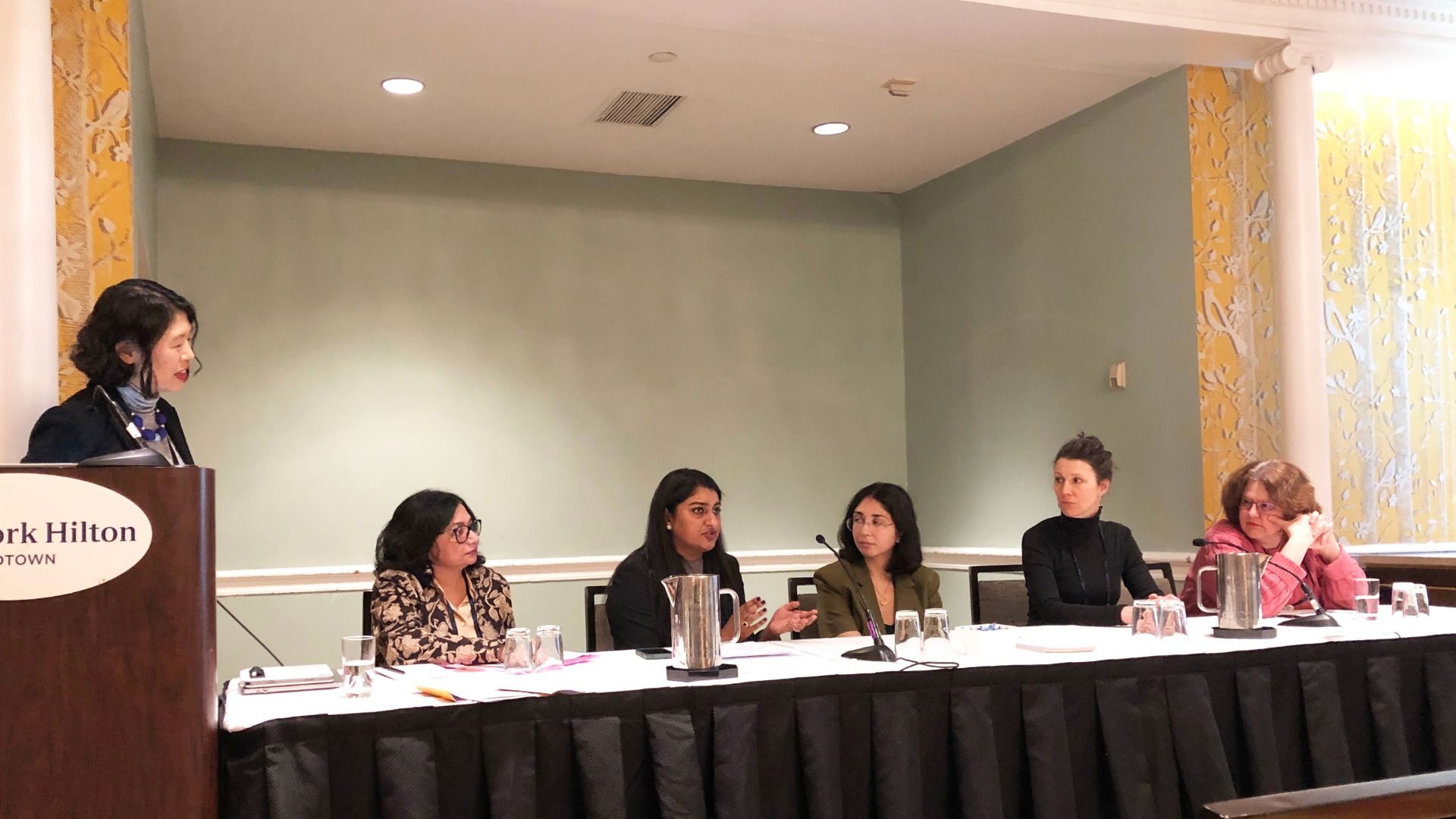
Presenting research on the Dispersed Bhagavata Purana at the College Art Association Conference 2025, alongside Mapping Color in History colleagues. February 2025.
I was also fortunate to be welcomed into the Harvard Art Museums community. Curators Sarah Laursen and Ayşin Yoltar-Yıldırım gave me opportunities to work closely with the collections and contribute to ongoing projects focused on Gandharan sculpture, Indian paintings, and Southeast Asian Art. Their mentorship was invaluable, especially given my strong interest in curatorial practice.
Mittal Institute: Your work at The Metropolitan Museum of Art bridges academic research and museum practice. Having returned to The Met as Research Associate for South and Southeast Asian Art and now appointed as Assistant Curator of South and Southeast Asian Art, can you tell us about your position and what excites you most about your current role?
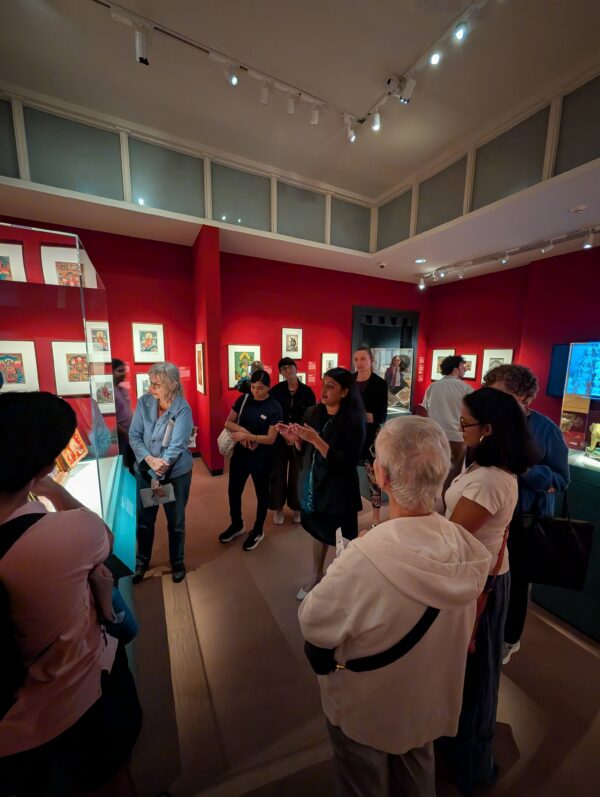
Leading a public tour of Household Gods: Hindu Devotional Prints, 1860–1930, The Metropolitan Museum of Art, May 5, 2026.
Vaishnavi Patil: Having previously worked with Curator John Guy on Tree & Serpent, I was delighted to return to The Met in September 2025 as a Research Associate for South and Southeast Asian Art.
One project that has been especially meaningful to me is Household Gods: Hindu Devotional Prints, 1860–1930, curated by John Guy. It has been deeply rewarding to see visitors engage with images that were once part of intimate domestic spaces and are now reinterpreted in the museum. I contributed a short essay on prints of the goddess Kali, inspired by conversations with visitors. Experiences like this have reaffirmed for me the power of museums as spaces where rigorous scholarship and public engagement meet. With two rotations still forthcoming, I encourage readers to visit the exhibition and experience the prints firsthand.
In July 2026, I began my new position as Assistant Curator of South and Southeast Asian Art. This role brings together the central strands of my journey: object-based research, fieldwork, writing, teaching, and curatorial practice, all of which are both scholarly and public-facing.
As Assistant Curator, I am honored to help steward The Met’s extraordinary collection, built over many decades through sustained curatorial vision, scholarship, and philanthropy. I am especially excited to work with the Indian paintings and Himalayan art collections, which offer rich opportunities for research, exhibitions, acquisitions, and object-based teaching. Through my work, I hope to create meaningful encounters between objects and audiences.
Mittal Institute: You were part of the Mittal Institute’s Graduate Student Associate program during your time at Harvard. How did that experience shape your academic journey and professional development?
Vaishnavi Patil: The Graduate Student Associate program was one of the most meaningful ways I connected with scholars, artists, and practitioners beyond my home department who shared a commitment to South Asia. It created a rare intellectual community—one that spanned disciplines, methods, and institutions—and that expansiveness mattered a great deal to me.
One of my most cherished memories was leading a tour of the South Asian collections at the Harvard Art Museums for Mittal affiliates. Sharing those objects with a community deeply invested in South Asia and thinking together about what they hold, obscure, and reveal captured something essential about what I value in both scholarship and curatorial practice: the possibility of creating spaces for sustained looking, conversation, and collective reflection.
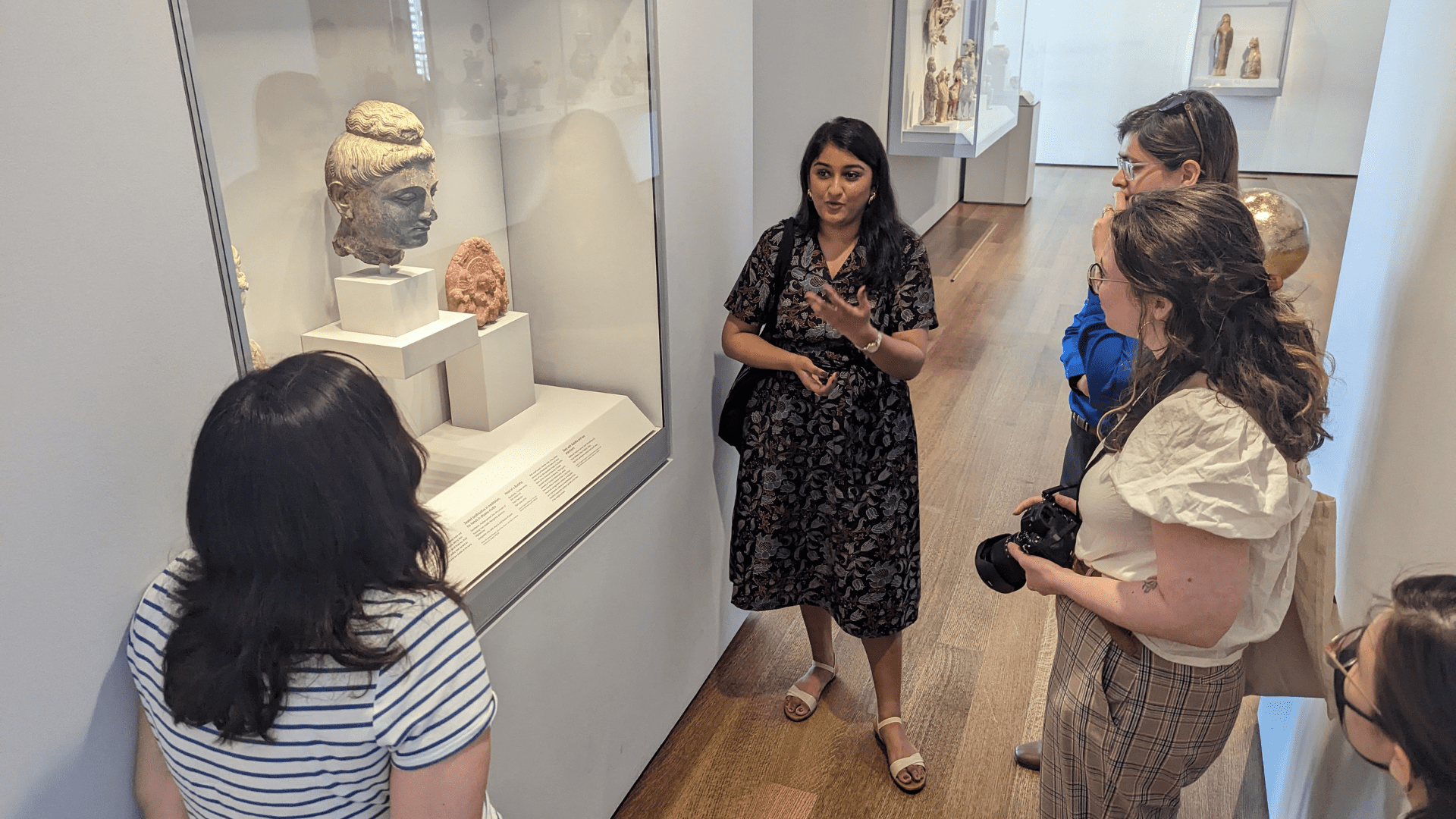
Leading a tour of the Harvard Art Museums’ South Asia Collections for Mittal affiliates, May 2023.
I have also valued the opportunity to meet South Asian artists through the Mittal Institute, which has deepened my understanding of artistic practice. For instance, I met the artist Manjot Kaur during her tenure as a Visiting Artist Fellow. Our conversations have continued well beyond her time at Harvard and have shaped how I think about materiality, memory, and feminist approaches in both artistic and scholarly work. I have also had the privilege of writing about her work and learning from her insights into artistic practice.
More broadly, Mittal Institute fostered a sense of intellectual community that extended beyond formal academic boundaries. That sense of connection has been invaluable to my growth as both a scholar and a museum professional.
☆ The views represented herein are those of the interview subjects and do not necessarily reflect the views of the Mittal Institute, its staff, or its steering committee.