
During his 2025-26 year as a Mittal Family Climate Postdoctoral Fellow, Sachin Kumar explored how artificial intelligence can strengthen climate action and accountability, with a particular focus on the needs and perspectives of the Global South. In this reflection, he considers how conversations with Harvard faculty, researchers, and practitioners reshaped his approach to the intersection of AI, climate, policy, and governance. From the classroom to seminars and conversations across the University, his time at Harvard expanded both the questions he is asking and the scope of his research. Here, he reflects on what he arrived with, what changed, and the ideas he will carry forward.
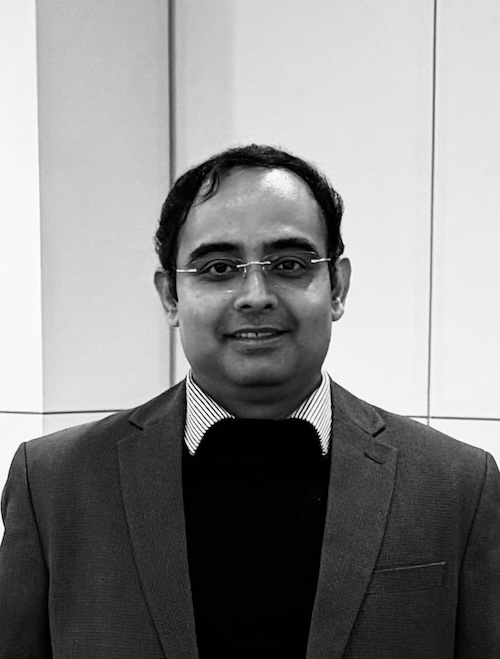
Sachin Kumar, 2025-26 Mittal Family Climate Postdoctoral Fellow
WHAT I ARRIVED WITH
As a Mittal Family Climate Fellow, I arrived at the Mittal Institute already convinced of two things: first, that the world’s climate accountability infrastructure was broken in ways that AI and machine learning were uniquely positioned to fix, and second, that the Global South — India in particular — had a distinct and underrepresented stake in fixing it. A year on, those two convictions still stand. But some of the most generous professors, researchers, and practitioners I have been privileged to learn from have quietly rebuilt the architecture of how I think about the problem. This is a reflection on what changed, and what I am carrying forward.
Before arriving at Harvard, my research program had begun to coalesce around a single conviction: that one of the most important areas of work for AI in the next decade is not in commerce alone, but service – applying it to the social, public, and planetary problems that markets are structurally not prioritizing. Climate change and sustainability had become my primary terrain within that broader commitment to AI for social good. I had questions about how to address climate change using AI, particularly from a climate action accountability perspective, as IPCC reports make plain that we are off track to achieve our climate targets and face persistent challenges in measurement, reporting, and assessment.
THE CONVERSATIONS THAT RE-ARCHITECTED THE WORK
Within weeks of my arrival, my supervisor, Prof. Patrick Vinck – whose work on data, society, and accountability mechanisms for vulnerable populations sits at the intersection of human rights and computational methods – suggested I treat accountability not primarily as a technical problem but also as a policy and impact problem. The framing he helped me develop is this: accountability is a relational claim before it is a measurement. It is one thing to detect a gap between a country’s pledged and actual emissions trajectories. It is another to ask who that gap is owed to, who can act on the information, whose voice the accountability infrastructure makes audible, and how it can impact policy decisions that improve people’s lives. That early redirection led to the research I undertook, including the conceptual scaffolding of what I now call Climate Accountability and, in a broader sense, compliance challenges.
A second shift came from Prof. S.V. Subramanian at the Harvard T.H. Chan School of Public Health, whose path-breaking work on measuring human development raised a question I had not been asking with sufficient seriousness: what does it mean to measure climate compliance across different scales? This gave me a whole new perspective: we need to develop macro- and micro-level measurement and accountability systems to mitigate climate change and adaptation strategies. Our conversations enriched my thinking on AI and its implications on the wider social spectrum.
Apart from the research work, I audited several courses that proved formative. “Digital Governance and Leadership,” taught by Prof. Anil Arora at the Harvard Kennedy School brought together public servants, technologists, and policy students, and forced me to articulate my work in language a finance ministry official could act on, not just language a peer reviewer would approve. Professor Mousavi’s course on AI for Earth and Planetary Sciences deepened my understanding of climate dynamics, carbon cycles, and Earth system feedbacks, and sharpened my ability to connect quantitative model outputs to real-world climate policy challenges.
EVENTS THAT WIDENED THE LENS
The Harvard calendar offered, outside the office and classroom, a kind of weekly intellectual recalibration. At the Salata Institute for Climate and Sustainability lectures, lectures, economists, atmospheric scientists, and policy practitioners convened in ways that reframed climate governance for me. The Mittal Institute’s own research seminars, and South Asia-focused programming kept my work grounded in the regional realities that matter most to me. Discussions related to the Berkman Klein Center on the governance of frontier AI systems provided me with a vocabulary for thinking about the moral and political architecture within which my technical work operates.
One particularly illuminating moment was when I was invited to give a postdoc seminar in the Mittal Institute’s lecture series on Artificial Intelligence for Climate Action Accountability. Preparing for that talk forced me to summarize a year’s worth of disorganized thought into a coherent three-tier architecture—measurement, attribution, and adjudication—that now organizes much of my future research agenda.
HOW THE WORK HAS EXTENDED
What I take away from Harvard is not a single paper but a vastly expanded research program. Research work at the intersection of AI and Climate Action Accountability and Sustainable approaches, including the NDC compliance framework and related work, has matured into a manuscript now under review at a reputable journal, with a headline finding of a significant empirical compliance gap for India and a methodology designed to be scaled across other countries in the Global South facing data infrastructure challenges.
“What I take away from Harvard is not a single paper but a vastly expanded research program.”
Another strand of my work has begun to confront what I consider the most uncomfortable paradox in our field: the very AI systems we are trying to harness for climate accountability are themselves becoming a meaningful source of climate stress. The training of frontier models now consumes energy and natural resources at a scale that rivals small cities. Global data-center electricity demand is on a trajectory that the International Energy Agency projects could roughly double by 2026 and onwards, with AI workloads driving a disproportionate share of the growth. The water footprint of large-scale AI cooling, particularly in regions already living with chronic water stress, has only recently begun to attract the scrutiny it warrants. To work seriously on AI for climate is, increasingly, to work on the climate impact of AI itself.
I am immensely grateful to the Mittal Institute, Harvard Univeristy and Ecosystem, to the professors, researchers, scholars, and colleagues named and unnamed in this piece. I expect to be drawing on for the rest of my career for teaching me that — patiently, generously, and across an extraordinary range of disciplines.
Sachin Kumar is the Mittal Family Climate Postdoctoral Fellow at the Lakshmi Mittal and Family South Asia Institute, Harvard University. His research focuses on AI for Social good, particularly AI for climate change and sustainability, AI safety, equity, and governance, with particular attention to the Global South. He can be contacted on social media at @profsachinkumar.
☆ The views represented herein are those of the subject and do not necessarily reflect the views of the Mittal Institute, its staff, or its steering committee.