
Dr. Thiyagaraj Gurunathan is the Jamnalal Kaniram Bajaj Fellow for Fall 2026, working with Prof. David Jones, A. Bernard Ackerman Professor of the Culture of Medicine and Chair of the Department of the History of Science at Harvard University. An early-career researcher at the intersection of health humanities and cultural studies, his work examines the cultural meanings of contagion in South Asia, particularly in India, with a focus on caste, disease, and outbreak narratives. During his fellowship at Harvard, he is drawing on his background in literature and cultural studies to advance his research toward the history of medicine. We spoke with Dr. Gurunathan about his research and his hopes for his fellowship.
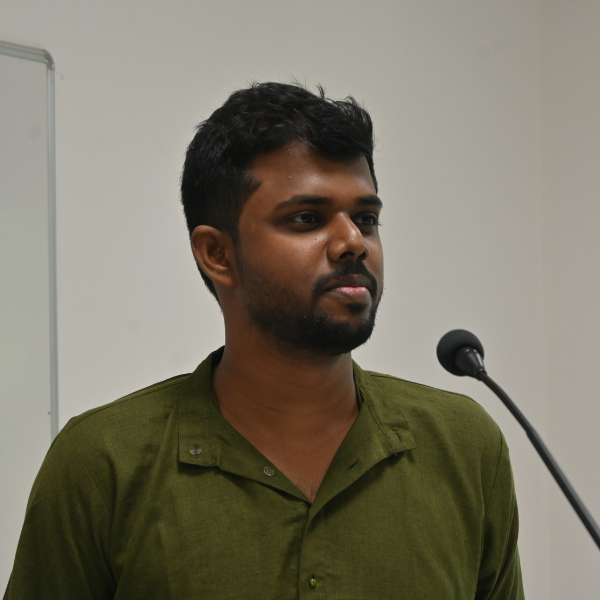
Thiyagaraj Gurunathan, Jamnalal Kaniram Bajaj Fellow, Fall 2026
Mittal Institute: Your work brings together literature, language, and cultural studies. What excites you most about working across those fields? What first sparked your interest in English and cultural studies?
Thiyagaraj Gurunathan: Thanks for asking. Although I am from a Tamil family, I had the privilege of living and moving to different parts of India during my childhood. Naturally, I became fluent in multiple languages, including English, Tamil, Hindi, and even Gujarati at one point. Interestingly, though, English became my language of thought and comfort through which I tried to understand the different cultures and people I encountered. Many thanks to all the inspiring professors (Straight Outta Dead Poets Society!) from my undergraduate days at Madras Christian College who taught me the value of literature and life at large. My post-graduation was a turning point in my career. I had two roads ahead: either I could have pursued a traditional MA in English Literature or chosen something different. I wanted to do more and get out of the box, and that’s how I joined the MA in English and Cultural Studies at Christ University, Bengaluru. The program offered so many interesting courses taught by very cool professors, of course. From doing cultural history to learning anthropology and visual arts to writing lives, those years shaped my critical thinking and made me the researcher that I am. Later, my PhD from the Department of Humanities and Social Sciences at IIT Roorkee gave me the opportunity and freedom to apply those insights to my research on the histories of public health in India—something I carry forward into my postdoctoral research.
Mittal Institute: What drew you to apply for this fellowship, and what are you hoping it will make possible for your research?
Thiyagaraj Gurunathan: My doctoral research is a literary historiography of disease outbreaks in colonial and early post-colonial India. In this matter, I work across a range of texts, including fiction and non-fiction, available in English translation from different languages and cultural geographies. The discourse I bring to the table, of course, transcends the contemporary boundaries of India per se. My interest in outbreak narratives spreads, just like an outbreak, to different parts of South Asia and even beyond. Hence, I found it necessary to gain that exposure by joining an intellectual community like LMSAI, where scholars from across South Asia and around the world come together. It is my hope that my research in the South Asia Institute at Harvard will open the door towards encouraging discussions and meaningful research. One of my significant plans is to work on my thesis-to-book project, Contagion and Community in India: Outbreak Narratives in Colonial and Postcolonial Literature.
I am also just getting started as a teacher. I have been teaching full-time for almost a year now. If my research were a means to achieve something, I strongly find its application in my classrooms. By being part of Harvard classrooms, where I plan to audit a course on Medical Ethics and History taught by Prof. David Jones, I will learn not only as a researcher but also as an evolving teacher. I sincerely look forward to bringing back many insights from the discussions and developing my own course plans that help me channel my years of research in health humanities and public health histories.
Mittal Institute: Looking across your research, are there particular questions or themes that you find yourself returning to?
Thiyagaraj Gurunathan: The one question that I always return to is, “What is contagion?” To answer this seemingly simple question and make sense of it, humanity has collectively engaged over thousands of years through words, signs, emotions, rituals, art, poetry, music, performance, games and even more.
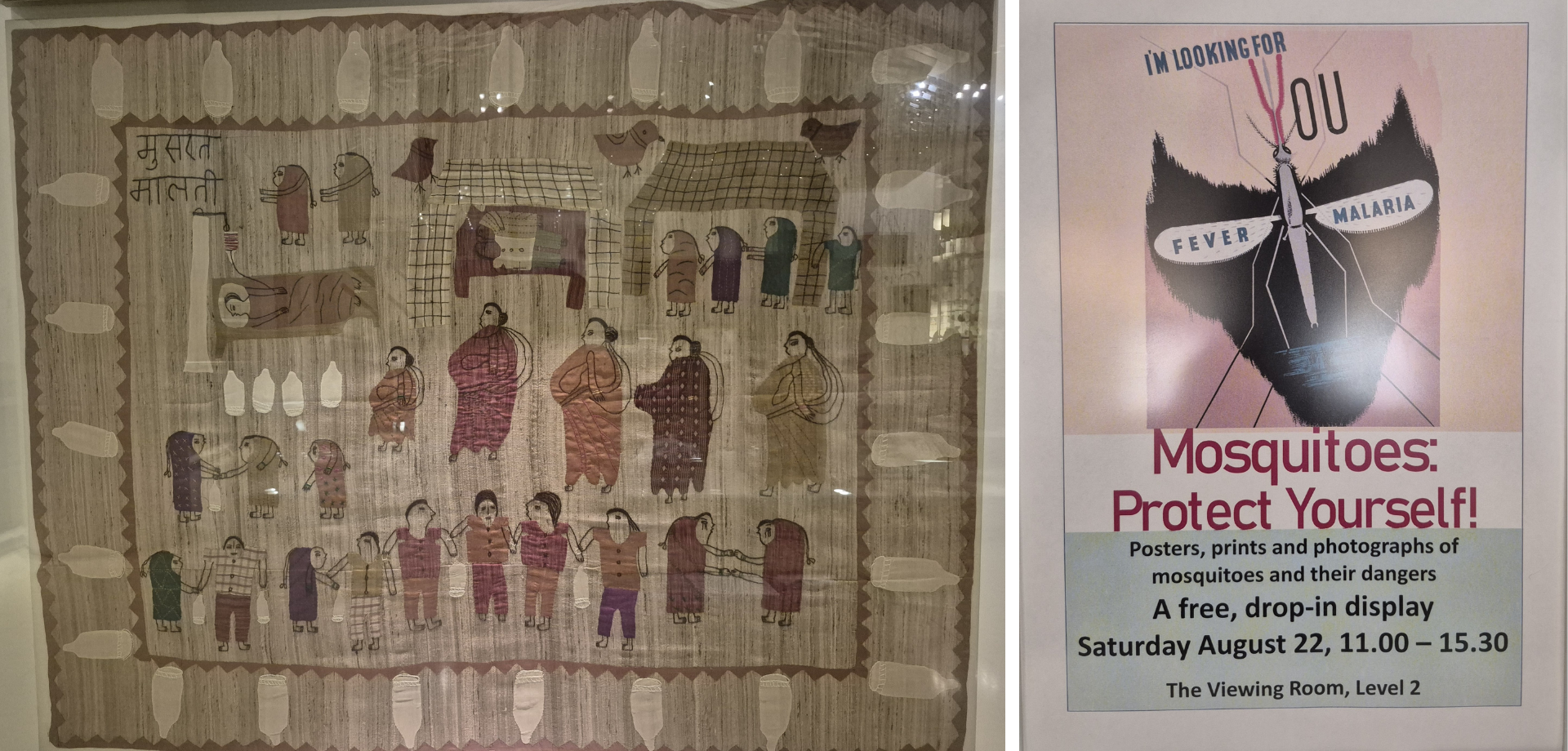
Left image: Silk wall-hanging (khatwa) on AIDS awareness made in Patna, Bihar, 2002. [Photo taken at the British Museum]; Right image: A call for posters and prints on mosquito-borne illnesses. [Photo taken at the Wellcome Library]
So far, medical history in colonial India has shed light on these contagious diseases in an aetiological sense. I mean, the historical discourse always interpreted contagion as something that shapes culture. Here, I beg to differ, stating that it is rather culture that actively shapes contagion. We make cartoon sketches and caricatures of it, anthropomorphize it, tell stories around it, make effigies and burn them, build idols and worship them—all in the name of contagion—from our own cultural prism. How beautiful is that a topic to work upon!
In a country like India, we have always lived together with contagion. Ancient manuscripts, including Ayurvedic and Vedic literature, refer to these microbes by various names, such as krimis, sukshumajeeva, and jeevanu. In a multicultural and stratified Indian society, the impact of contagion can be measured from different lenses of caste, religion, gender, class and even colonialism. So many actors have played their role in interpreting contagion and making the invisible visible. I trace these journeys of interpretation and meaning-making that unpack histories of public health experiences. Among these experiences, I always find myself returning to find the subaltern whose health has always been taken for granted, able bodies experimented on (often without informed consent) and later refused and discriminated against even upon death. My research on these lived health experiences speaks to and contributes further to the global discourse on the health humanities and medical ethics.
Mittal Institute: Is there a paper, book chapter, or creative work that feels especially meaningful to you? What makes it stand out?
Thiyagaraj Gurunathan: My first research article on “Spectres of Caste/Contagion: Death Anxiety and Caste-Anxiety in U.R. Ananthamurthy’s Samskara” still feels special to me since its publication in December 2022. I express my gratitude to my Prof. Gaana Jayagopalan, who introduced me to the Kannada short novel while I was hunting for a PhD research topic—that’s where it all started. During the COVID-19 pandemic, I was primarily interested in reading everything under the sun about epidemics and pandemics. I was very curious about the buzz terms and the history behind them. For instance, to think and challenge, if the ‘novel’ coronavirus was actually novel in itself? Or to question the newness associated with the ‘new-normal’?
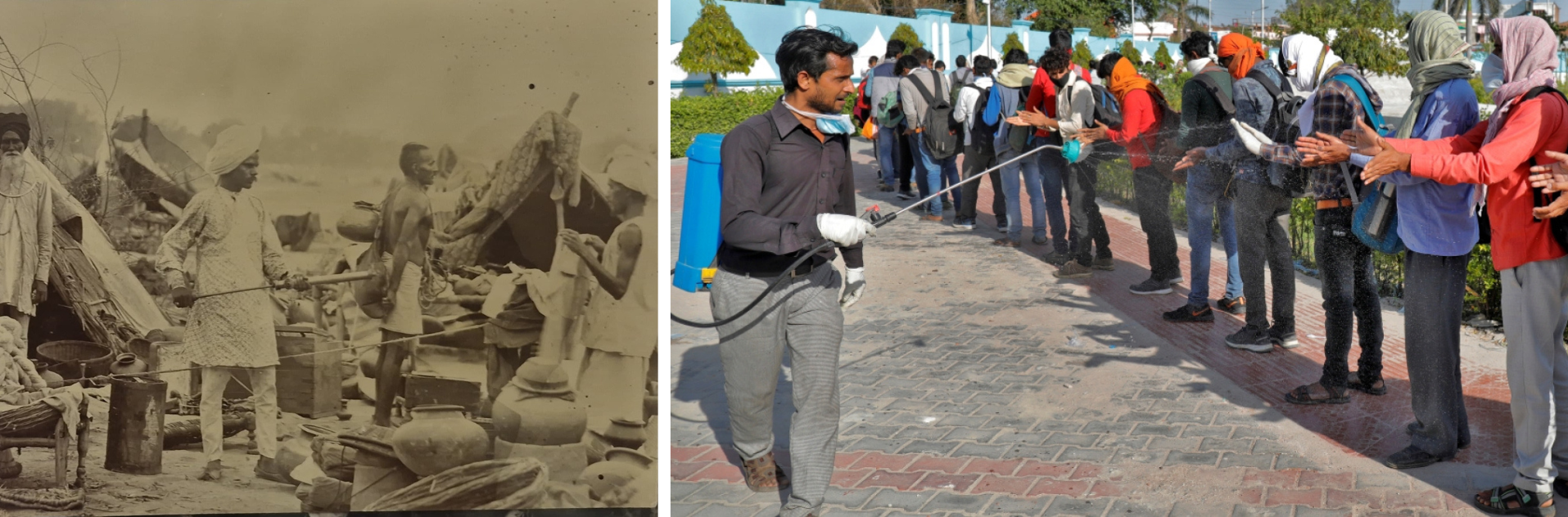
Left image: Photograph of Bombay Plague Observation Camp: Spraying Detainee (1896-97) by unknown [Source: Print Room, British Library Archives – Photo 311/1]; Right image: Migrants in India sprayed with disinfectant to fight coronavirus [Source: Al Jazeera].
In this regard, many chose to read Albert Camus’ The Plague and Gabriel García Márquez’s Love in the Time of Cholera at the time. However, my curiosity led me to trace those stories of Indian soil. And that’s when I stumbled upon Dr Saurav Rai’s article titled “Pandemics Through Indian Literary Lens,” which recommended very interesting regional texts dealing with the history of contagion in India. Later on, Dr Sathyaraj Venkatesan and Dr Nishi Pulugurtha’s edited volume on representations of pandemics and epidemics in literature thoroughly helped my search for more reading materials. One of the first revelations these outbreak narratives gave me was that early 20th-century Indian litterateurs were not really interested in the disease itself, but in something subtler and more implicit. They were more interested in unpacking the social ailments. Issues like patriarchy, religious bigotry, class inequality, caste untouchability, and similar issues that negatively affect the community’s well-being. Returning to Samskara, the novel ironically does not reveal the plague until its final pages. The plague works in the backdrop, unpacking an even more vile, rotten element of the Indian society—casteism. Interestingly, the narrative is similar to the way Camus worked in The Plague, using it as an allegory for fascism instead. Despite being short and condensed, Samskara as a novel has many layers and subtexts. It was an interesting first research project for me to consider how contagion acts as a ghostly specter that cautions society about its hubris, which also becomes its tragic flaw.
Mittal Institute: What research questions are you most excited to pursue during your time at Harvard and beyond?
Thiyagaraj Gurunathan: I am more interested in understanding the social determinants of health that shape public health decisions during disease outbreaks in Indian society. That is to answer, what are the culture-specific factors that influence the health of the body and the body politic in colonial and postcolonial India?
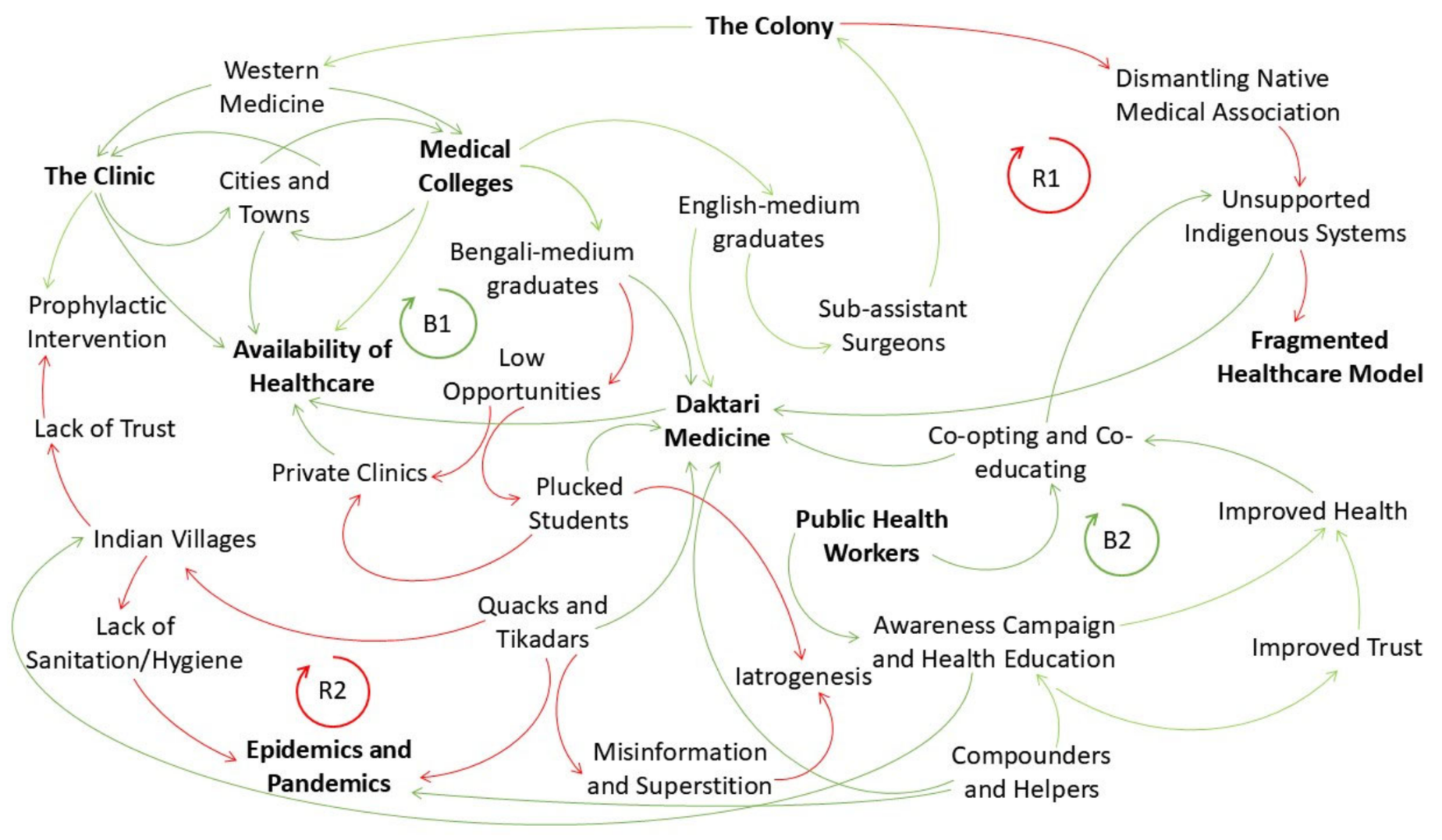
Causal-loop diagram of medical systems in colonial India. Figure created by Thiyagaraj Gurunathan [Source: The Birth of the “Indian” Clinic: Daktari Medicine in A Ballad of Remittent Fever. Humanities, 13(6), 169. https://doi.org/10.3390/h13060169].
My recent archival data collection, as part of the short-term research fellowship funded by the Charles Wallace India Trust and British Council, enabled me to examine this question from a colonial perspective. These questions have remained relevant for a long time and need to be considered whenever there is a public health emergency caused by a disease outbreak. More often than not, the decision-making process in medical bioethics fails to account for culture-specific intricacies, causing more harm than good. While public archives more often offer the State’s perspective, literary archives offer a counterfactual by providing insights into governmental failures, structural inequalities, and cultural idiosyncrasies. Dialogue between the archive and the literature is essential. My role as a Bajaj fellow is to bridge the gap between these sources and promote decolonial viewpoints by integrating the history of disease and the health humanities.
In this regard, most of my research has been significantly influenced by a defining question, erstwhile raised by Sally Swartz: Can the Clinical Subject Speak? And it is my own hope to come up with an answer, or at least strongly deliberate, on the construction of the colonial medical subject.
Mittal Institute: Looking ahead, if your research could change one conversation in your field, what would you want that change to be?
Thiyagaraj Gurunathan: The dual field of the history of medicine and the health humanities has long been interwoven. Roy Porter, in his pathbreaking article “The Patient’s View: Doing Medical History from Below,” recommends a bottom-up approach that incorporates personal and literary narratives to understand subjective health experiences of the patient. However, I believe that, over time, such a viewpoint became parallel and separated. Literature is primarily taken up as a source of evidence mainly by scholars of the health humanities, rather than historians of medicine. While the latter relies on facts and objectivity, the mainstream historical discourse often dismisses literary narratives as mere figment of imagination. This is all the more prevalent in India, where the field of health humanities is still finding its ground, unlike the UK and the US.
I would like my research to challenge the hegemony of historical archives by reading them both along and against the archival grain; while giving equal weight to Indian literary texts that narrate subjective experiences of disease outbreaks. My recent experience of convening a working group on “Contagion, Culture and the Global South” as part of the Philadelphia-based Consortium of History of Science, Technology and Medicine (CHSTM) is an attempt to bridge the gap between these contested disciplines as well.
☆ The views represented herein are those of the interview subject and do not necessarily reflect the views of the Mittal Institute, its staff, or its steering committee.