Professor E. Annamalai, who will present this year’s Sangam Tamil Lecture Series, is a distinguished scholar of Tamil and Dravidian linguistics whose career has spanned more than six decades. He has taught and conducted research at institutions including the Annamalai University, University of Chicago, and the Central Institute of Indian Languages, where he also served as Director and helped shape national programs and policies around language education and development in India. His work has focused on Tamil grammar, multilingualism, language policy and education, and the preservation of endangered languages, and he is the author of numerous books and papers on these subjects. He was a visiting fellow at institutions abroad that include Tokyo University of Foreign Studies, University of Melbourne, Leipzig University, Max Planck Institute of Psycholinguistics, Yale University among others.
We spoke with Dr. Annamalai ahead of his September 24 Sangnam Tamil lecture, “Classical Tamil Theories of Likeness to Convey Meaning,” in which he will talk about metaphor and metonymy as presented in the earliest grammar of the Tamil language, the Tolkappiyam.
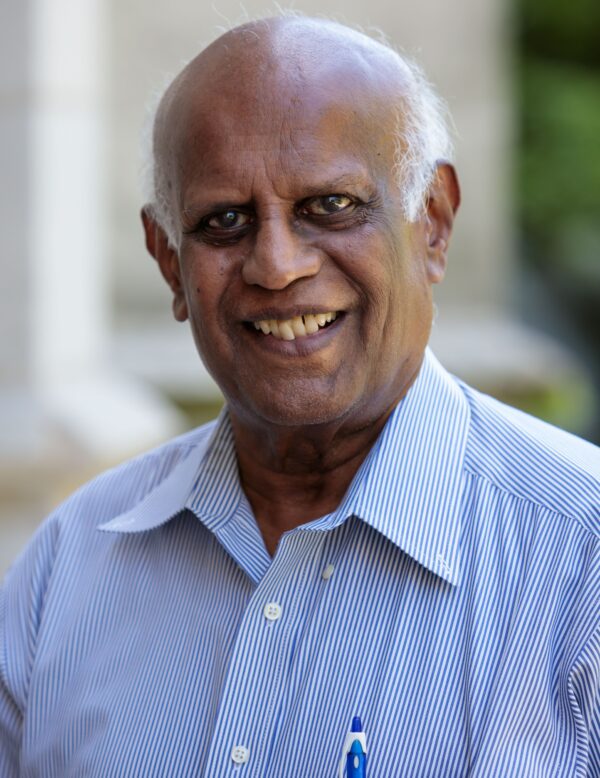
Professor E. Annamalai
Mittal Institute: Dr. Annamali, What first drew you to Tamil and to the study of linguistics?
E. Annamalai: It is a personal story. I was a student of Mathematics at The American College, Madurai and was a poor student of it. I was elected the student President of Thiruvalluvar Kazhagam, which organized lectures from public intellectuals on topics that included literature. It was in late 1950’s and language politics in Tamil Nadu was at its height after India became a Republic and the debate was going on what language would represent India a nation. No student was uninvolved in the debate intellectually or emotionally. I chose to pursue Tamil academically and went to Annamalai University to do graduate study in Tamil language and literature.
Mittal Institute: What is it about Tamil that makes it especially interesting to study from a linguistic perspective? What does Tamil reveal about language more generally?
E. Annamalai: The coexistence of antiquity and modernity as a language and as literature makes Tamil one of the handful of such languages in the world. Others are its power to unite the caste ridden society into one community bound by the language; its ability to stand distinct and integrated simultaneously with the wider stream of India, be it political, cultural or historical; its acceptance in the scholarly world as one of the two dimensions of classicalness of India: Sanskrit and Tamil is another attraction of it; and its rich literary and grammatical traditions that have remained unbroken while being innovated continuously for two millennia is a unique feature of it.
“The coexistence of antiquity and modernity as a language and as literature makes Tamil one of the handful of such languages in the world.”
Linguistically, Tamil belongs to the language family of Dravidian and to a structural typology of languages, which are verb final and left branching. This gives a fertile ground to test newly minted linguistic theories developed from European and Amerindian languages with a different set of data set. Tamil, like any language, reveals that its grammar is universal and individual at the same time. An interesting research question is to discover what is universal and what is individual of its grammar. Another interesting question is, Tamil, being a living language of more than 2,000 years, provides rich data to discover in what ways a language changes and what linguistic and social factors contribute to changes.
Mittal Institute: Tamil has an incredibly long literary history, but it’s also a living language that continues to change. How do you see the relationship between classical Tamil and the Tamil people speak today?
E. Annamalai: Some scholars think that classical Tamil and modern Tamil are two different languages. Classical Tamil is like a second language to the speakers of Tamil and will have to be learned in a formal setting outside home such as the school and the college. There is some truth to this. Because Tamil is a remarkable language in keeping unchanged its alphabetic system and the spelling of individual words, a literate Tamil speaker could ‘read’ a classical text such as Sangam poems though without comprehension. This is decoding the sounds of words but not their meanings; this is not true of Old English with a much shorter life span.
Nevertheless, there is feedback of classical Tamil to a modern Tamil person through school, print media, public speech and such. So, the classical Tamil is not totally alien to the modern Tamil, like Latin is for an unschooled modern American. The diglossic nature of Tamil with formal and functional dichotomy between speaking and writing and the written language’s nebulous link with the classical language make the intelligibility of classical Tamil not zero. And there is also some sharing of the cultural base between the classical and modern period. Moreover, there is convergence going on between the formal and informal varieties of Tamil in modern prose and poetry, though there is tension between the two varieties in teaching the language in schools. The exception to convergence is in morphology and phonology. Modern Tamil prose is closer to spoken Tamil in vocabulary (except in official policy that favors words of pure Tamil origin and manufactures technical terms in the new disciplines of knowledge for classical sources), in syntax and semantics. This is true of standard spoken Tamil also, which differentiates itself in the pronunciation (phonology) and composition (morphology) of words from classical Tamil. I believe that the standard modern writing and speaking will get closer. And classical Tamil will be its legacy.
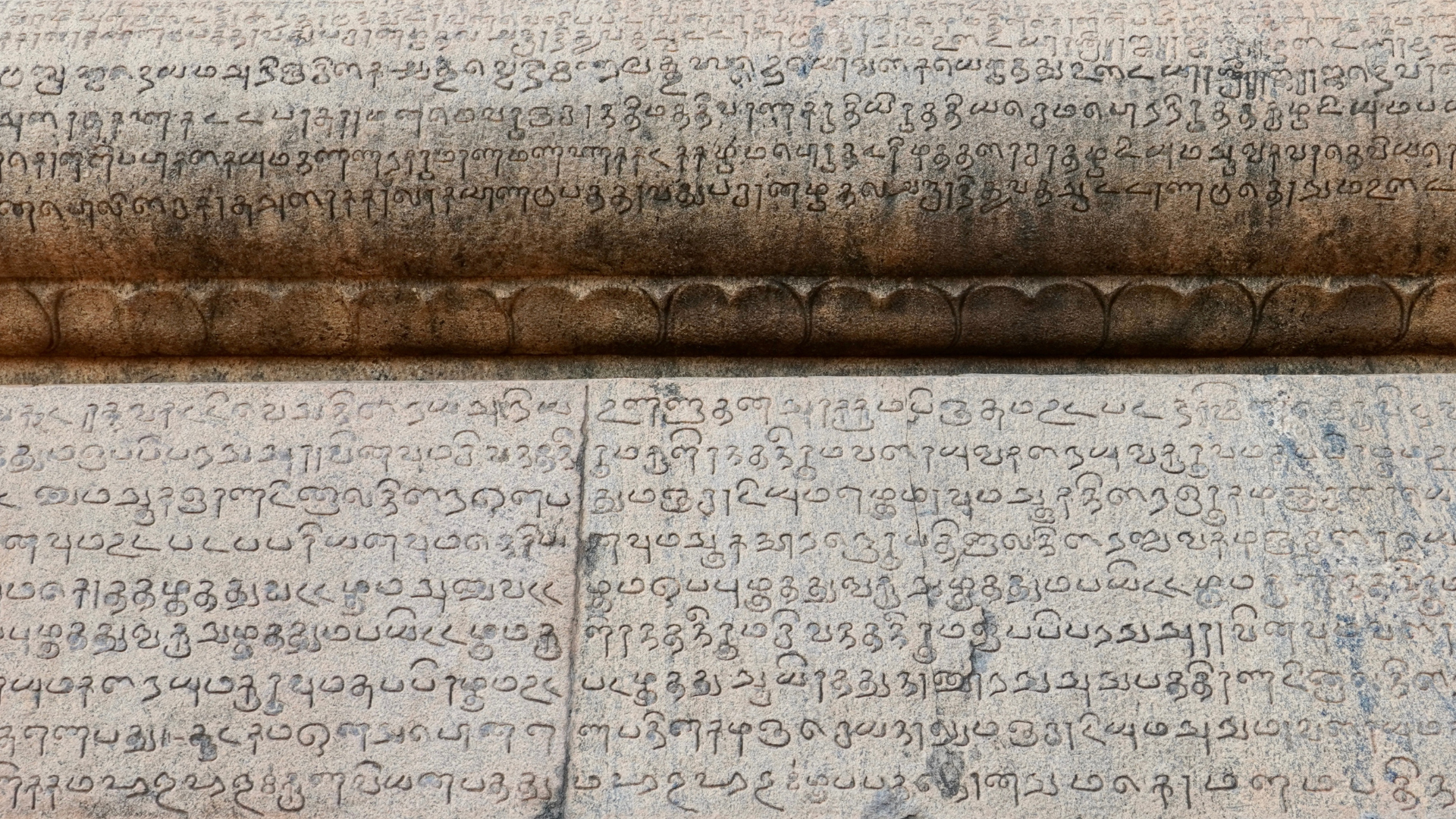
Inscriptions of Tamil language carved on the stone walls at Brihadeeswarar temple in Thanjavur, Tamilnadu, India. Adobe Photo.
Mittal Institute: Language and identity are closely connected in India. Why do you think language carries so much weight in how people understand their identity and community?
E. Annamalai: Human beings feel more secure in a group than being alone. Hence, they want to identify themselves with a larger formation than the self, be it caste, religion or nation. Language is attractive to be adopted to be a larger formation since it is natural immediate, sanguine, historical and importantly secular. Language comes in handy to mobilize people politically and to fight political battles. Whatever the real reasons are for political conflicts, language provides a cover to carry the fight in its name.
Mittal Institute: You’ve spent much of your career working with tribal and endangered languages. When a language disappears, what do we lose that can’t simply be captured by translating it into another language?
E. Annamalai: You lose a culture, i.e. a word view with unique features. And you lose a piece of knowledge that humanity collected over long years., like ideas about peaceful living, harmonious living with Mother Nature, healthy living, cooperative living etc. etc. It is also loss to the world like a garden of flowers that becomes a single flower garden or that a multi-cuisine restaurant becomes single item restaurant. It is also a moral failure when one destroys something that cannot be recreated.
Mittal Institute: Is there a Tamil word or expression that you particularly love or find fascinating? What makes it stand out to you?
E. Annamalai: panmai (பன்மை) ‘the quality of being plural or multiple’. Being among the many is a natural situation for human beings, as the desire for larger identity shows. Diversity is strength rather than unity, like the family with siblings. Tamil is one of the 7000 surviving languages, and it survives because it is fed by other languages materially and spiritually. And it feeds, and should feed, others through talks, seminars, personal interactions and translations of creative works.
☆ The views represented herein are those of the subject and do not necessarily reflect the views of the Mittal Institute, its staff, or its steering committee.