
As climate shocks increasingly affect agricultural livelihoods, crop insurance is becoming an important tool for helping farmers manage risk. At the webinar “Evaluating Crop Insurance as Climate Policy,” speakers examined India’s experience with crop insurance, the evolution of the Pradhan Mantri Fasal Bima Yojana (PMFBY), and new research from Odisha on what influences farmers’ decisions to enroll and benefit from crop insurance. The research was supported by the Mittal Institute through a Faculty Grant to Professor Emily Breza, facilitating the team’s work on climate resilience in Odisha.
Ritesh Chauhan, Senior IAS Officer, Mason Fellow at Harvard Kennedy School, and former CEO of PMFBY, opened with an overview of India’s long experience with crop insurance. He noted that the country has progressively moved from manual systems towards digital tools, remote sensing and technology-based yield estimation.
“India’s experience with crop insurance has been quite long, and we have been trying and iterating on providing this service,” Chauhan said.
He highlighted the scale and flexibility of PMFBY, which currently covers around 100 crops across 25 states. The scheme offers yield-loss and weather-index-based insurance, while states can choose the covers and add-ons based on their requirements. Chauhan also highlighted the role of technology in improving transparency and implementation, noting that the National Crop Insurance Portal “has become a very comprehensive digital platform to handle all PMFBY-related issues” and serves as the centralized source of information.
The discussion then turned to research examining why take-up remains limited in some vulnerable communities despite highly subsidized insurance.
Anchal Khandelwal, Research Manager at J-PAL South Asia, presented research conducted across 232 villages in Odisha’s Khordha, Puri and Cuttack districts. The study examines crop insurance take-up alongside the informal networks that rural households rely on to cope with climate shocks.
Khandelwal described how farmers may respond to repeated floods, droughts and delayed rains by borrowing from moneylenders, selling assets, reducing consumption or seeking support from people within their communities. Rhetorically, she asked, “how sustainable are these coping tools, really?”
The research team conducted an RCT using informational flyers, community meetings and free transportation to enrollment centers. The early findings showed a marked difference between simple information and community-based engagement. While the flyer intervention did not produce detectable changes in overall enrollment, the meetings increased applications by more than a quarter and increased the number of farmers insured by more than 25%.
“Just a little bit of a push, was enough to really increase take-up quite a bit,” said Emily Breza, Frederic E. Abbe Professor of Economics at Harvard University.
Breza, following in her presentation, showcased what happens when farmers experience the insurance system during an actual climate-related loss. Following extensive paddy damage in the study area, treated villages saw increases in claims and timely payouts. The research also points to a possible relationship between scale and the functioning of insurance systems: greater participation may encourage faster attention to claims.
The research also points to a possible relationship between scale and the functioning of insurance systems: greater participation may encourage faster attention to claims.
“If I can get more people filing a claim, the insurance company takes note, the insurance company sends somebody to come evaluate our losses. And then the payment can happen faster,” Breza said.
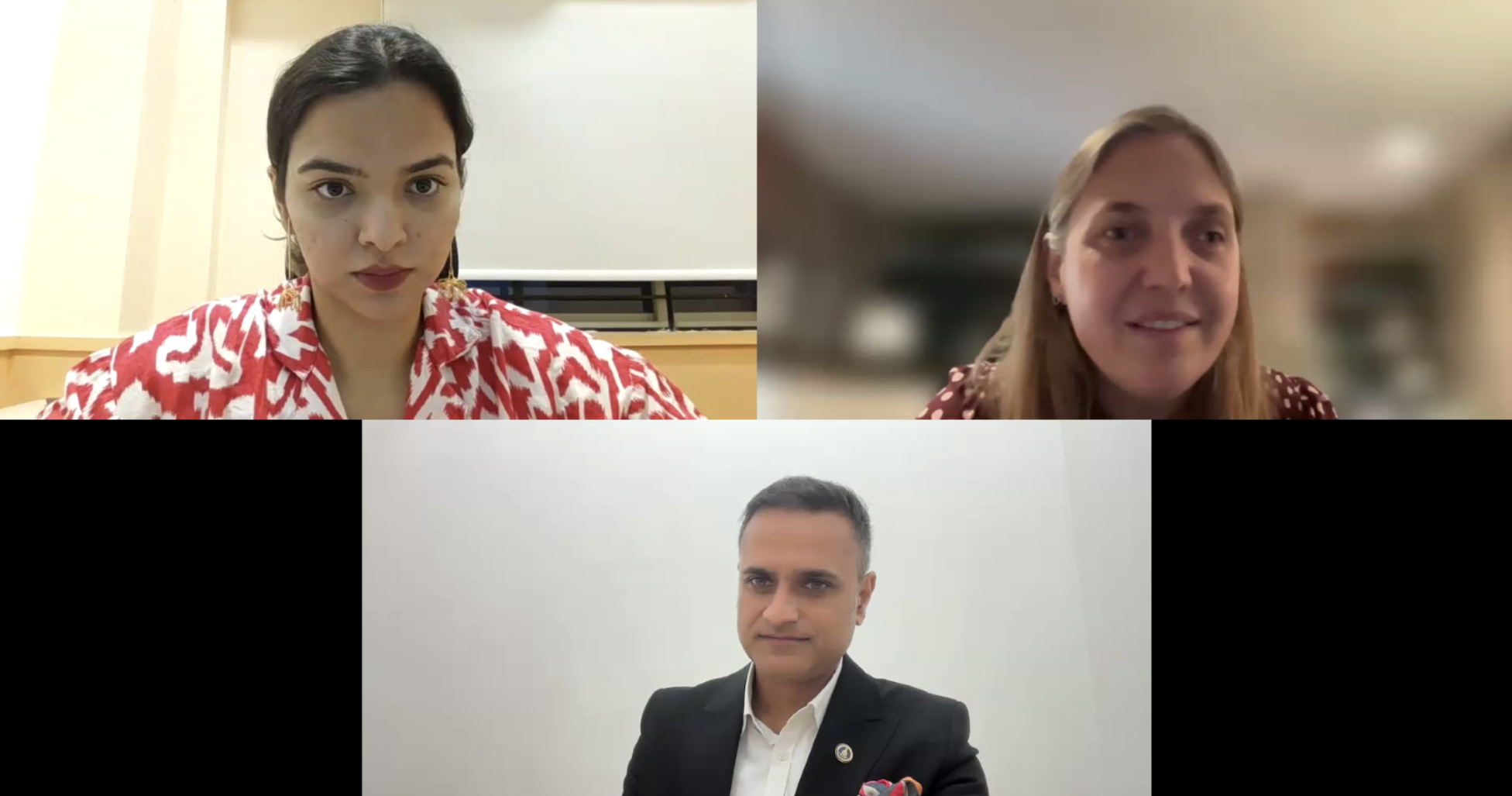
Speakers clockwise from top left: Anchal Khandelwal, Emily Breza, Ritesh Chauhan.
Another focus of the research is the interaction between formal insurance and informal social networks. Rural households often rely on friends and neighbours for information, informal loans and support during difficult periods. Rather than necessarily replacing these networks, the early findings suggest that formal insurance may strengthen them.
“It is interesting, it’s important when one is, you know, designing formal financial products, to not say that there’s just nothing going on in the background in a void, but to understand how the formal tools are, you know, either crowding in or crowding out those informal tools that were already there,” Breza said.
The discussion also highlighted the limits of insurance as a standalone climate-resilience tool. Breza noted that while the programme may work particularly well for landowners who can enroll, other groups remain exposed to climate shocks.
“I don’t think insurance can be the only piece of the toolkit,” she said.
The webinar concluded with discussion of future research on farmer distress, income diversification, labour markets, migration, informal credit and social resilience, underscoring the importance of understanding not only whether farmers enroll in insurance, but how insurance affects their wider ability to respond to climate shocks.
☆ The views represented herein are those of the interview subject and do not necessarily reflect the views of the Mittal Institute, its staff, or its steering committee.