
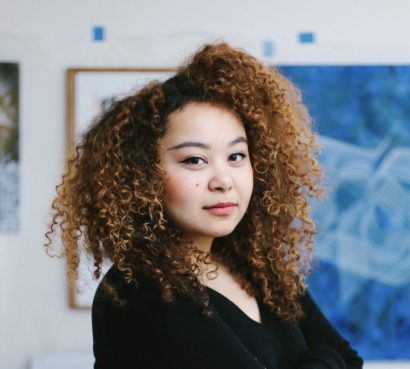
 Sneha Shrestha, known as IMAGINE, is a Nepali artist whose multidisciplinary practice spans painting, sculpture, and large-scale public installations. Drawing from Nepali script, ritual, and architecture, her practice explores language as form and atmosphere, cultural memory, and how living Himalayan cultures shape our sense of belonging. A recipient of the ICA/Boston’s 2025-26 Foster Prize, her work is held in the permanent collections of the Museum of Fine Arts, Boston, and the Harvard Art Museums. Sneha also serves as the Mittal Institute’s Arts Program Manager.
Since our last conversation with Sneha in 2024, her work has reached audiences from Kathmandu to Boston and beyond. Ahead of her upcoming October 29 artist talk at the Harvard Art Museums, where her sculpture Dwarpalika (Temple Guardian) is now in the collection, we caught up with her to discuss her evolving practice, cultural continuity, and the questions driving her work today.
Mittal Institute: When we last spoke in 2024, you had just opened your big solo show and your installation in New York at the Rubin Museum of Himalayan Art and you were thinking a lot about ritual, devotion, ancestry and what it means to create a sense of home. You had a large body of work at the ICA, Boston till April of this year. Have any of those ideas changed for you since then?
Sneha Shrestha: Those ideas are still at the center of my work and my understanding of home has expanded. I often approach home through my own experience of migration: the familiarity of Nepali letters, the discipline of repeating them, and the comfort of materials and gestures that connected me to Kathmandu. I’m increasingly interested in adding to it how home is made collectively, tradition, celebration, and gathering.
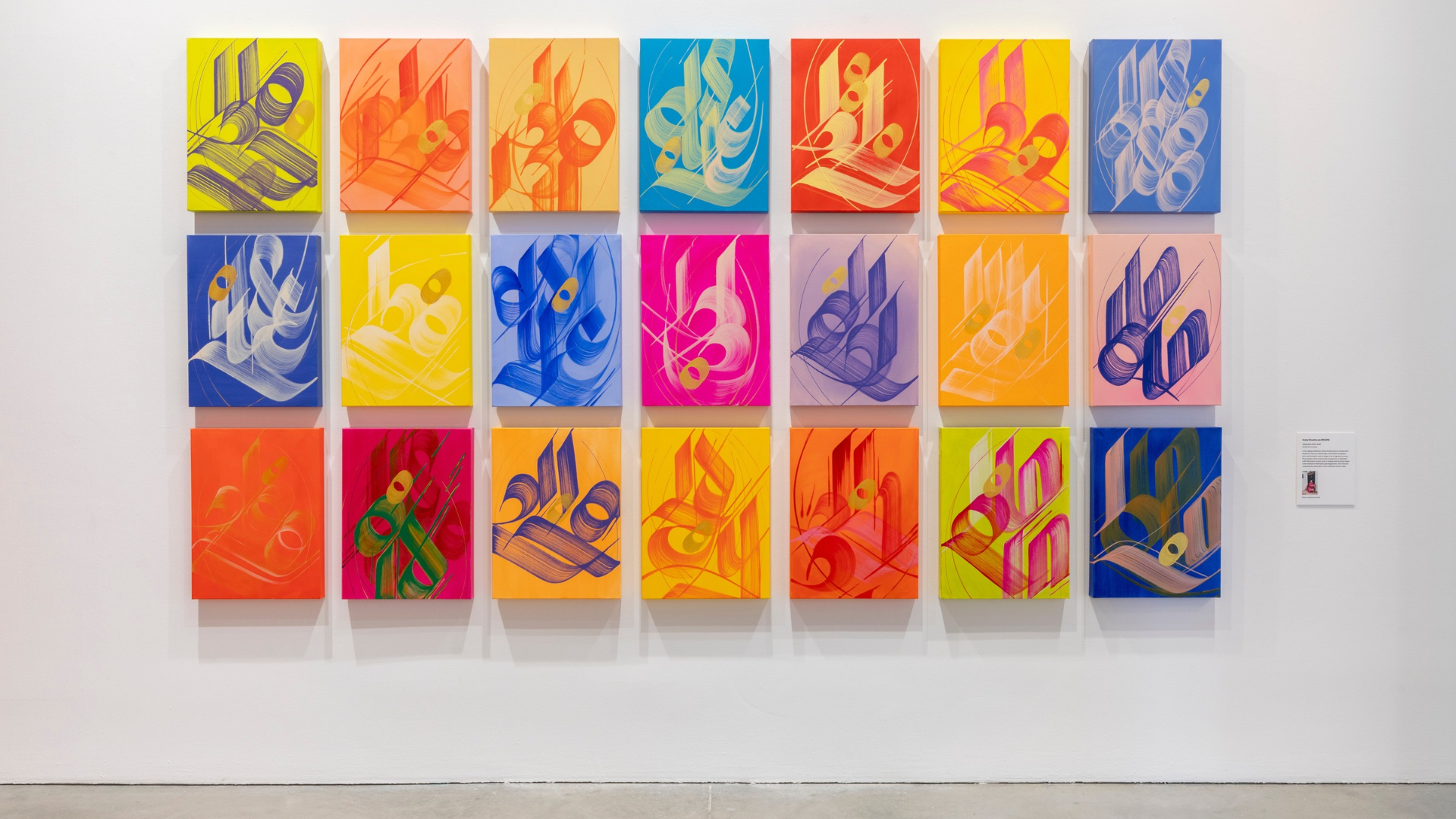
Installation view of Celebration series at ICA, Boston. Photo by Mel Taing.
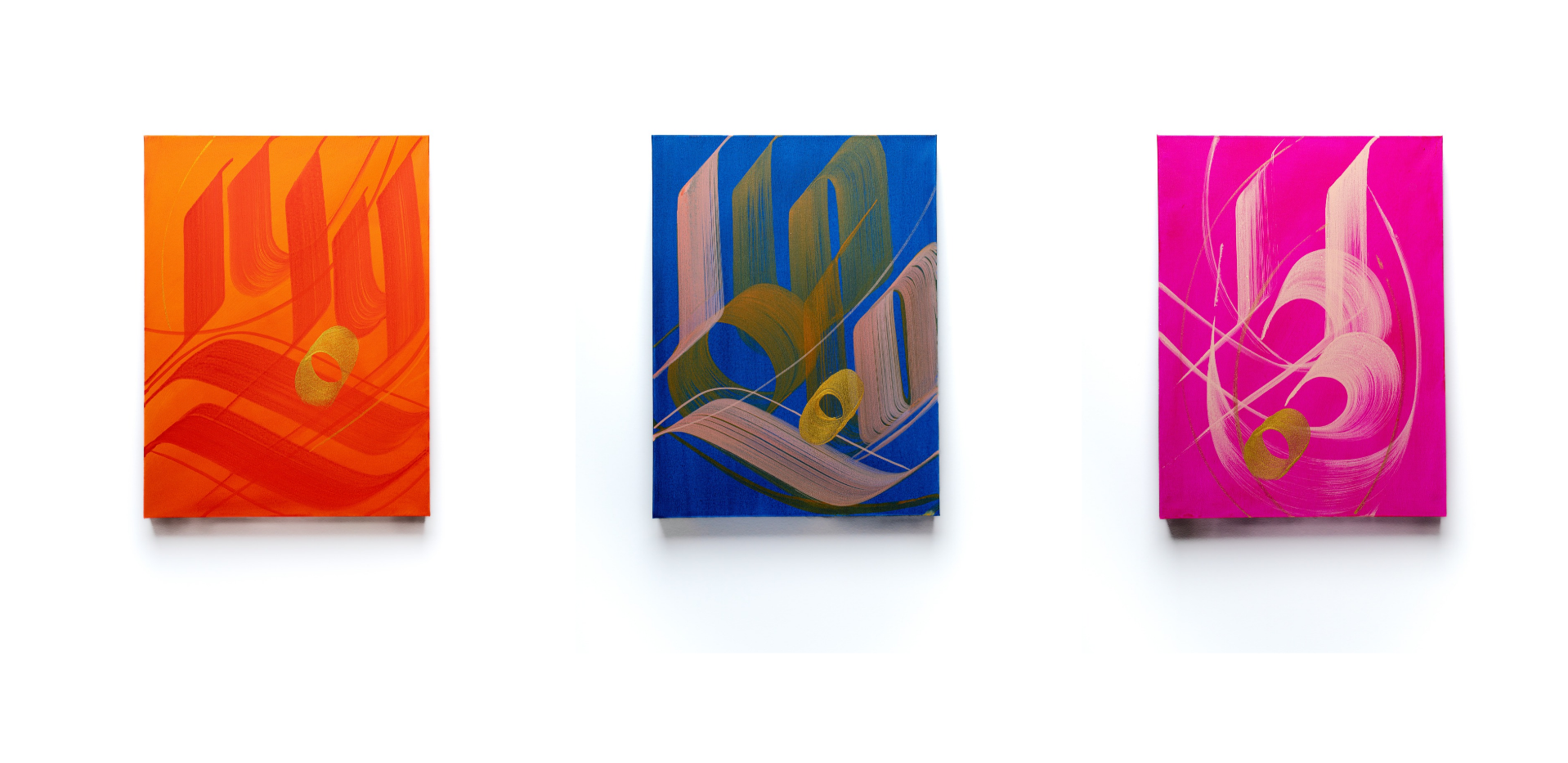
Detail View of Celebration series at ICA, Boston. Photos by Jane Louie Photography.
The Celebration series is an expanding series where this shows up most clearly for me. The series grew out of my immigration journey. I paint the names of immigration documents, layering language and color drawn from outfits my mother wore during celebrations I missed while being away from home. The forms carry the emotional weight of migration, but they also insist on joy, resilience, beauty, and the memories that make a life feel whole. The work gives space to experiences that official paperwork can never fully describe. Receiving the 2025 Foster Prize and exhibiting at the ICA/Boston gave me an opportunity to these ideas into a larger conversation.
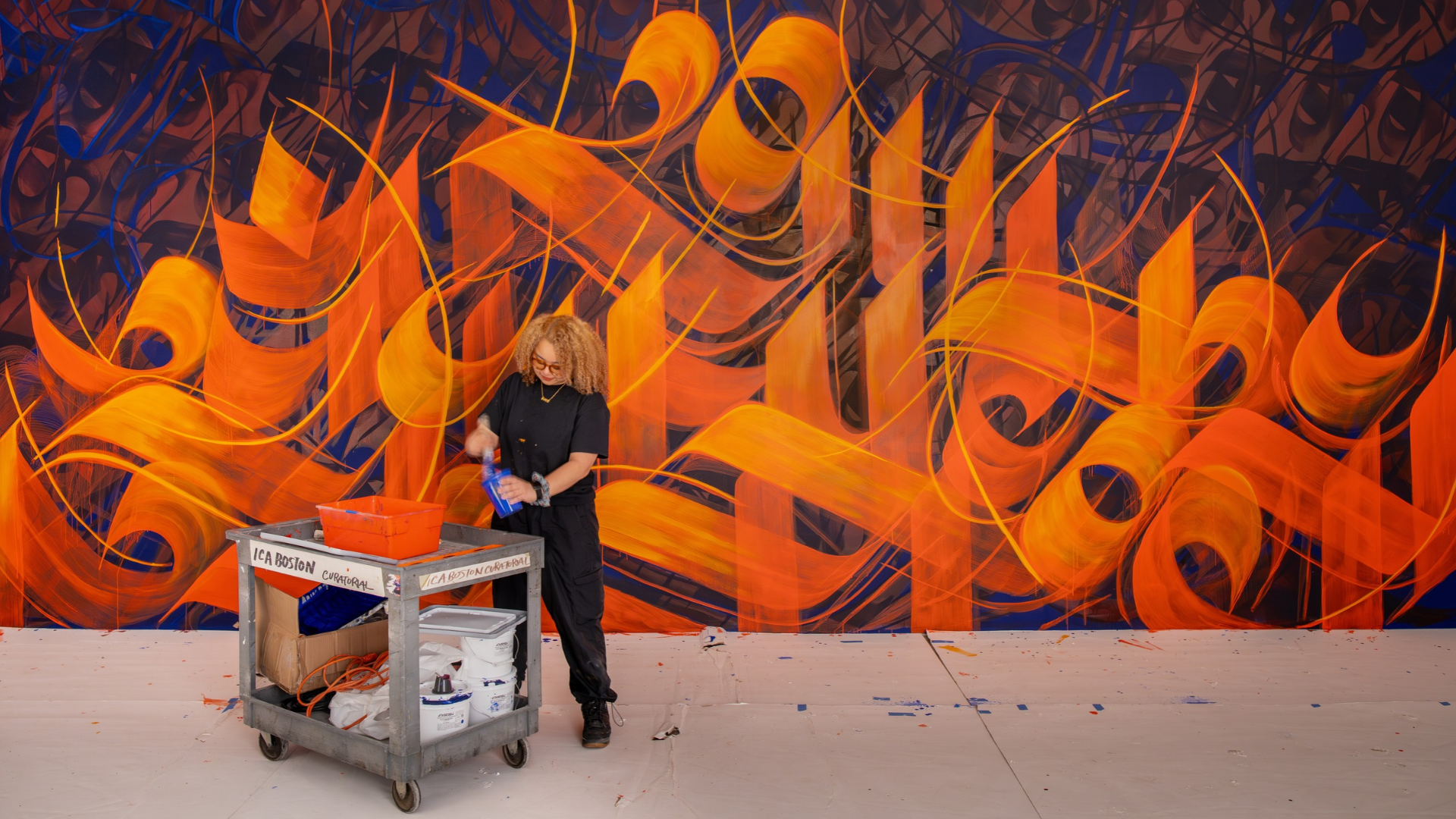
Sneha Shrestha (IMAGINE) at work on Worlds Apart at the ICA/Boston. Photo: Jane Louie.
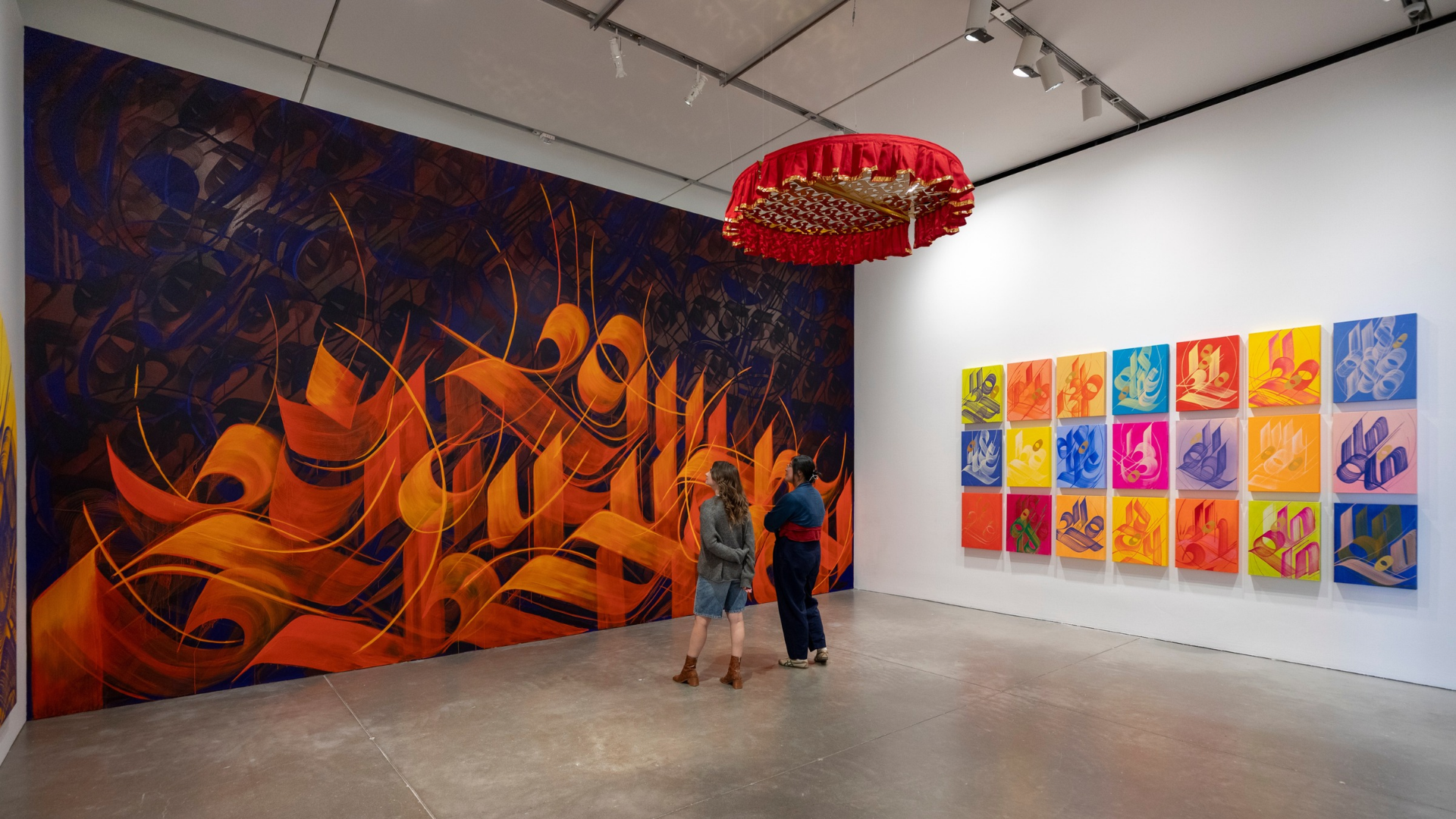
Installation view of Sneha Shrestha’s 2025 Foster Prize exhibition at the ICA/Boston. Photo: Mel Taing.
Mittal Institute: What are you most excited to share with the Harvard Art Museums audience, and what do you hope people take away from the conversation?
Sneha Shrestha: I’m excited to share about my sculpture, Dwarpalika (Temple Guardian), that was recently acquired by HAMs and how my past work and works in painting and mural has informed my sculptures. Dwarpalika (Temple Guardian) its arches and ankhi jhyal-inspired lattice patterns draw from the architectural vocabulary I grew up around in Kathmandu. I wanted to bring intimacy of written language into having an architectural and sculptural presence.
I also hope people come away curious about contemporary Himalayan art and the ways cultural knowledge lives in the present.
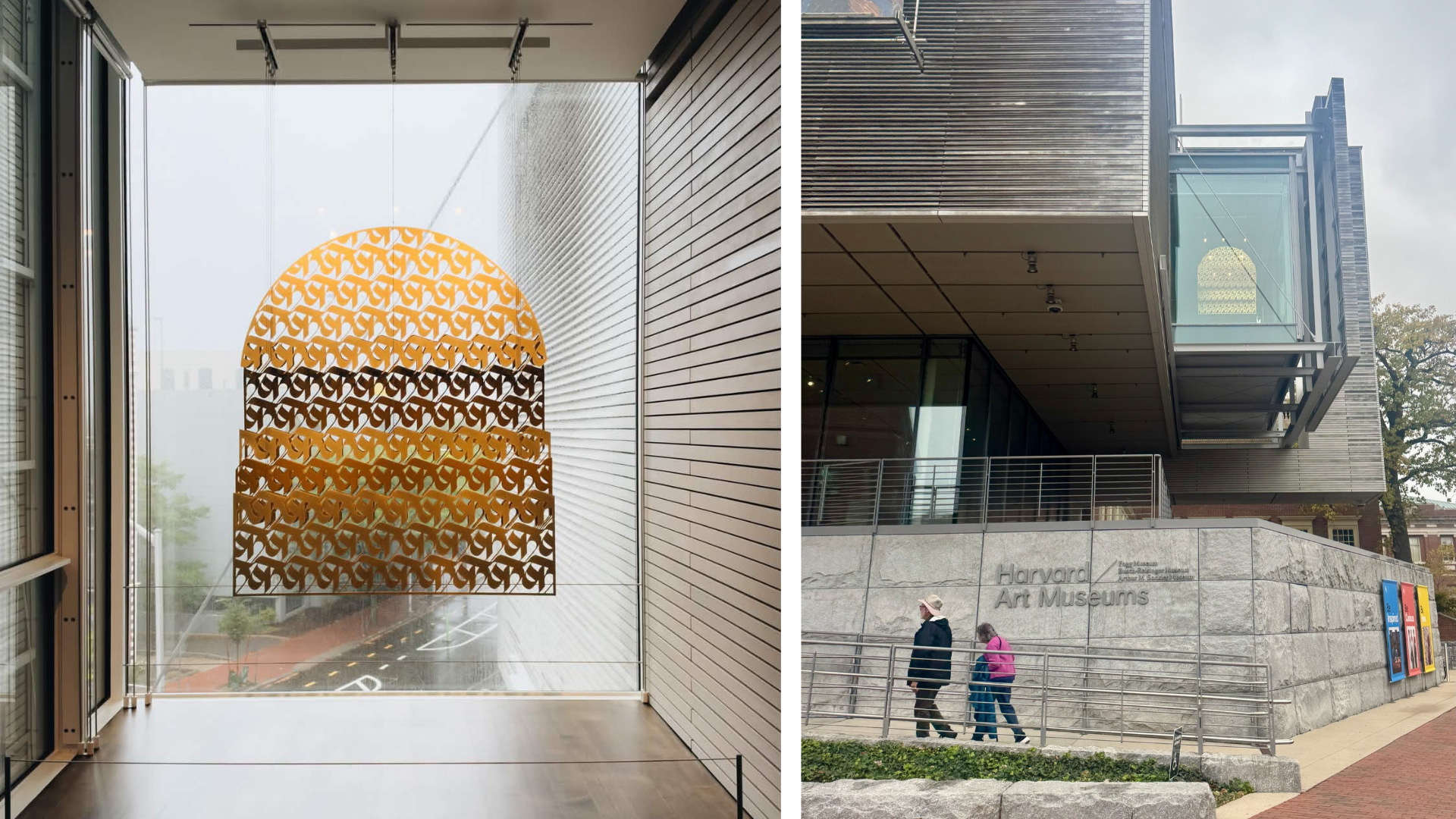
Left image: Interior installation view of Dwarpalika (Temple Guardian) at the Harvard Art Museums, Level 2, Room 2620. Photo: Brandon Shigeta; Right image: View of Dwarpalika (Temple Guardian) from outside the Harvard Art Museums, Level 2, Room 2620. Photo courtesy of the artist.
Mittal Institute: Your work has increasingly entered major museums and institutional spaces. Has working within those spaces changed how you think about your own art, and what are you most proud of with these collections?
Sneha Shrestha: When thinking of Home416 that made me the first contemporary Nepali artist in the permanent collection of the Museum of Fine Arts, Boston and I thinking of so many firsts as an artist of Himalayan culture, it gives me great honor to think that long after I’m gone, maybe a young person from the Himalayan diaspora can visit a museum and see objects from their culture represented beyond historical artifacts. I get an enormous sense of pride that I get to bring Himalayan culture to the forefront of the contemporary art world. Minority cultures are often held within museums yet rarely represented in American cultural conversations, and I want these collections to change that and share that Himalayan cultures are living cultures. I also feel responsible for opening doors for other South Asian artists, which is part of why my work at the Mittal Institute matters so much to me.
Mittal Institute: Speaking of living cultures, your first public art sculpture, About a Living Culture, was installed in the heart of a Himalayan community in Queens, New York. What did you want the work to communicate about living cultures, and how did seeing people interact with it shape your understanding of public art?
Sneha Shrestha: At the heart of my practice is the belief that cultures are not static, but resilient and constantly evolving, with roots in centuries-old traditions that continue to shape how we find community today. Himalayan culture is a living culture- It exists in our everyday lives, in our festivals, food, architecture, and the ways we gather and connect with one another.
At the heart of my practice is the belief that cultures are not static, but resilient and constantly evolving, with roots in centuries-old traditions that continue to shape how we find community today. Himalayan culture is a living culture.
About a Living Culture, is an homage to the Himalayan diaspora’s living traditions. Installed in Diversity Plaza in Jackson Heights, Queens, a gathering place for Himalayan communities, the sculpture creates a contemplative space through the interplay of light, form, and script. I wanted it to honor ancestral roots while embracing the diverse narratives of the neighborhood.
The sculpture is a roughly seven-foot golden arch made of repeated rows of “Ka,” the first consonant of the Nepali alphabet, and topped with red jhallar fabric, the decorative fringe seen on temple roofs and ceremonial umbrellas. I collaborated with talented maker friends in Boston to fabricate the end result you see and I commissioned a tailor in my Kathmandu neighborhood who makes textiles for temples to produce the fabric. It moves with the wind and will fade over time. I wanted this element of change to be part of the work itself, reflecting how cultural traditions continue to evolve through time and use.
Diversity Plaza is such a busy urban space, with people constantly moving through it. I wanted to create something intimate that would invite people to slow down, even for a moment. What was most meaningful was seeing people touch the sculpture, gather around it, and make it part of their everyday routines.
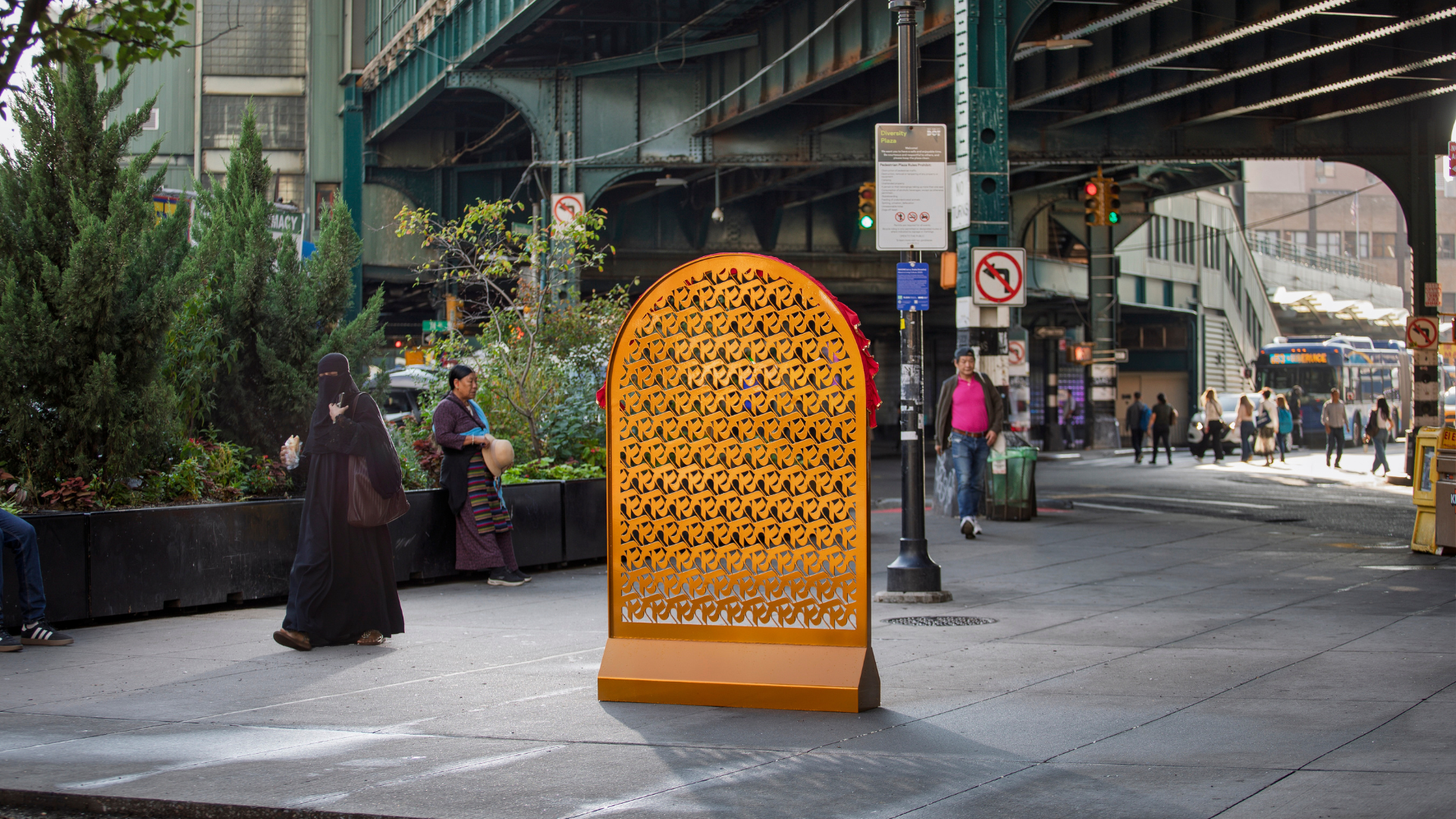
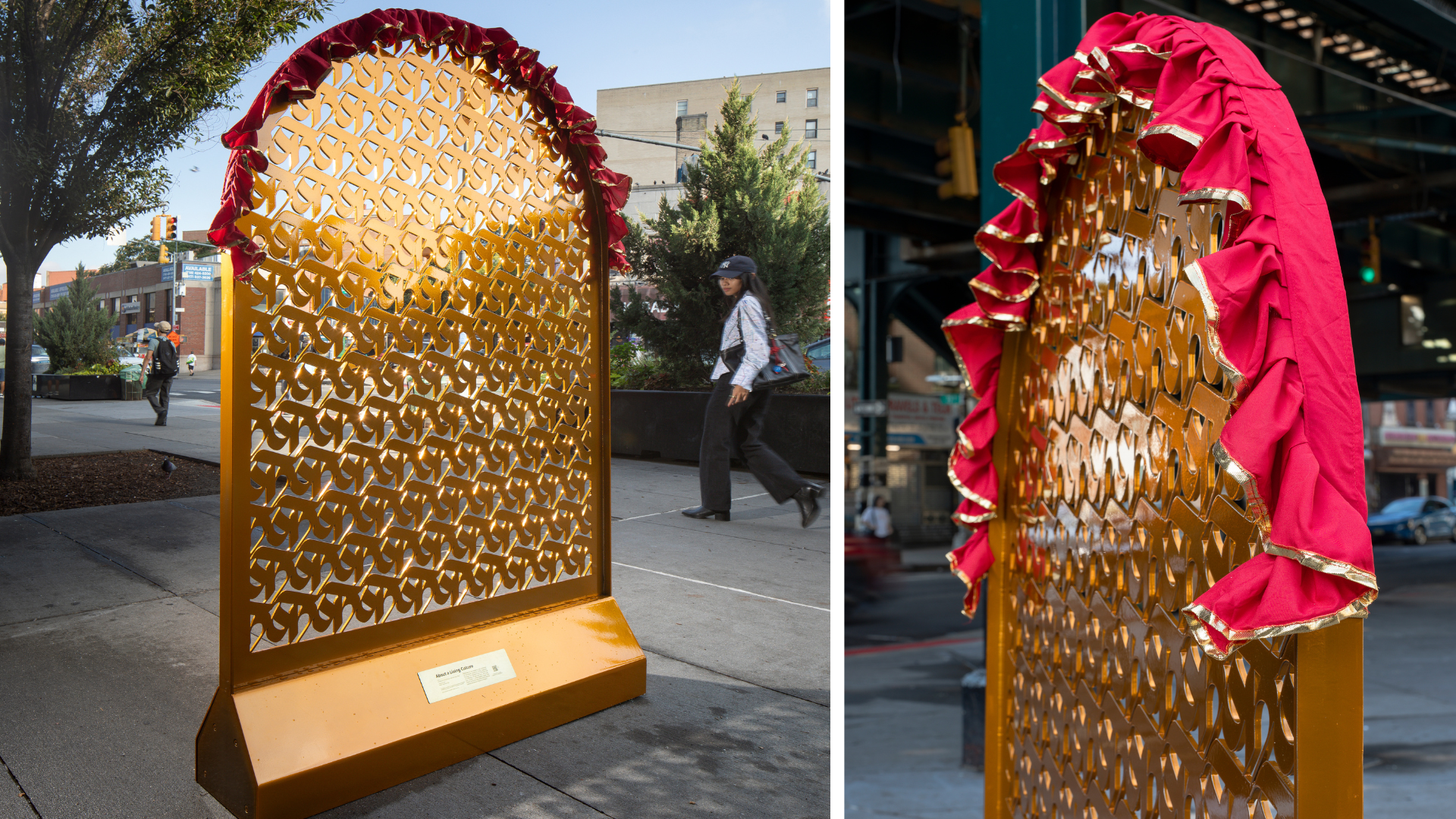
Installation view of About a Living Culture (2025) at Diversity Plaza, Jackson Heights, Queens, New York. Photo: Nicholas Knight. Courtesy of the Rubin Museum of Himalayan Art.
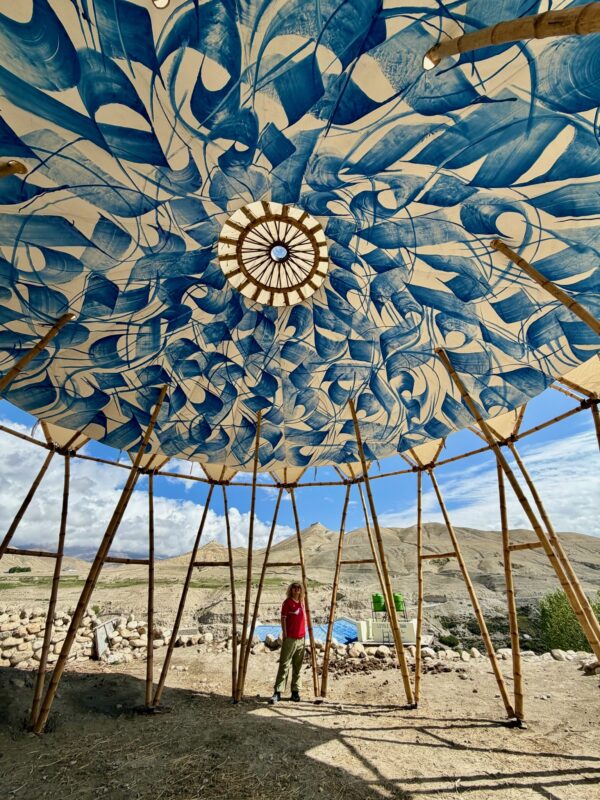
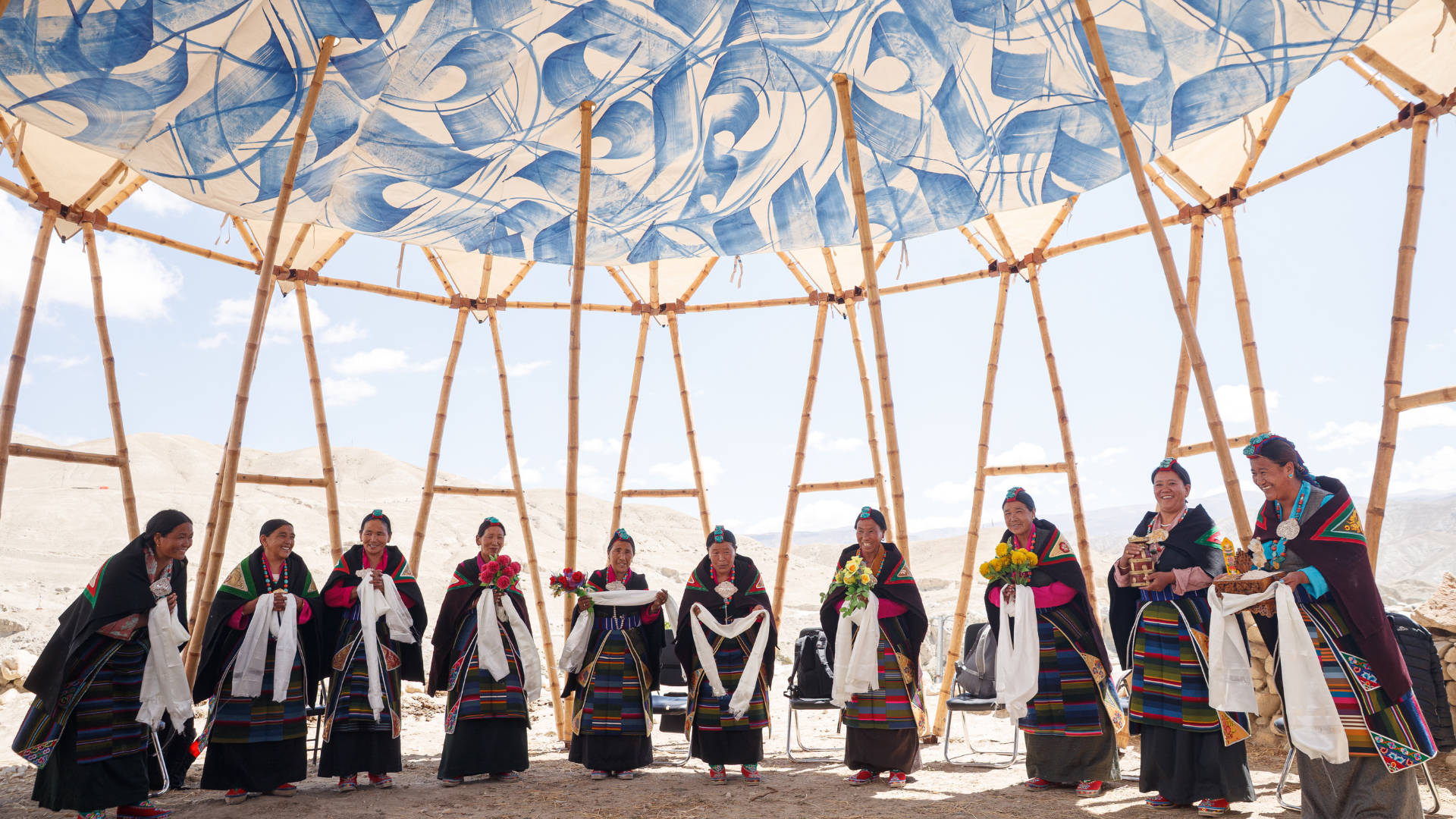
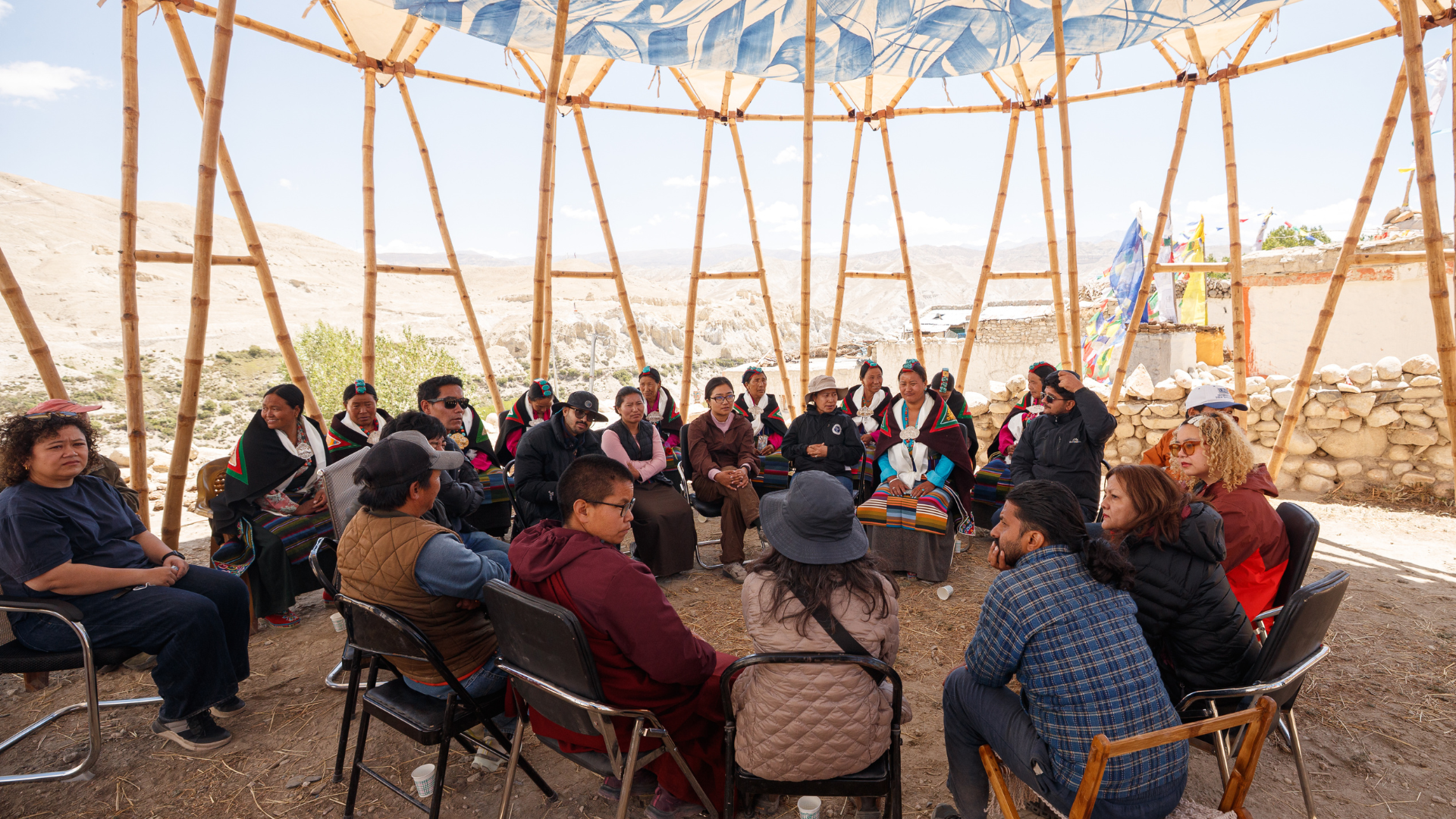
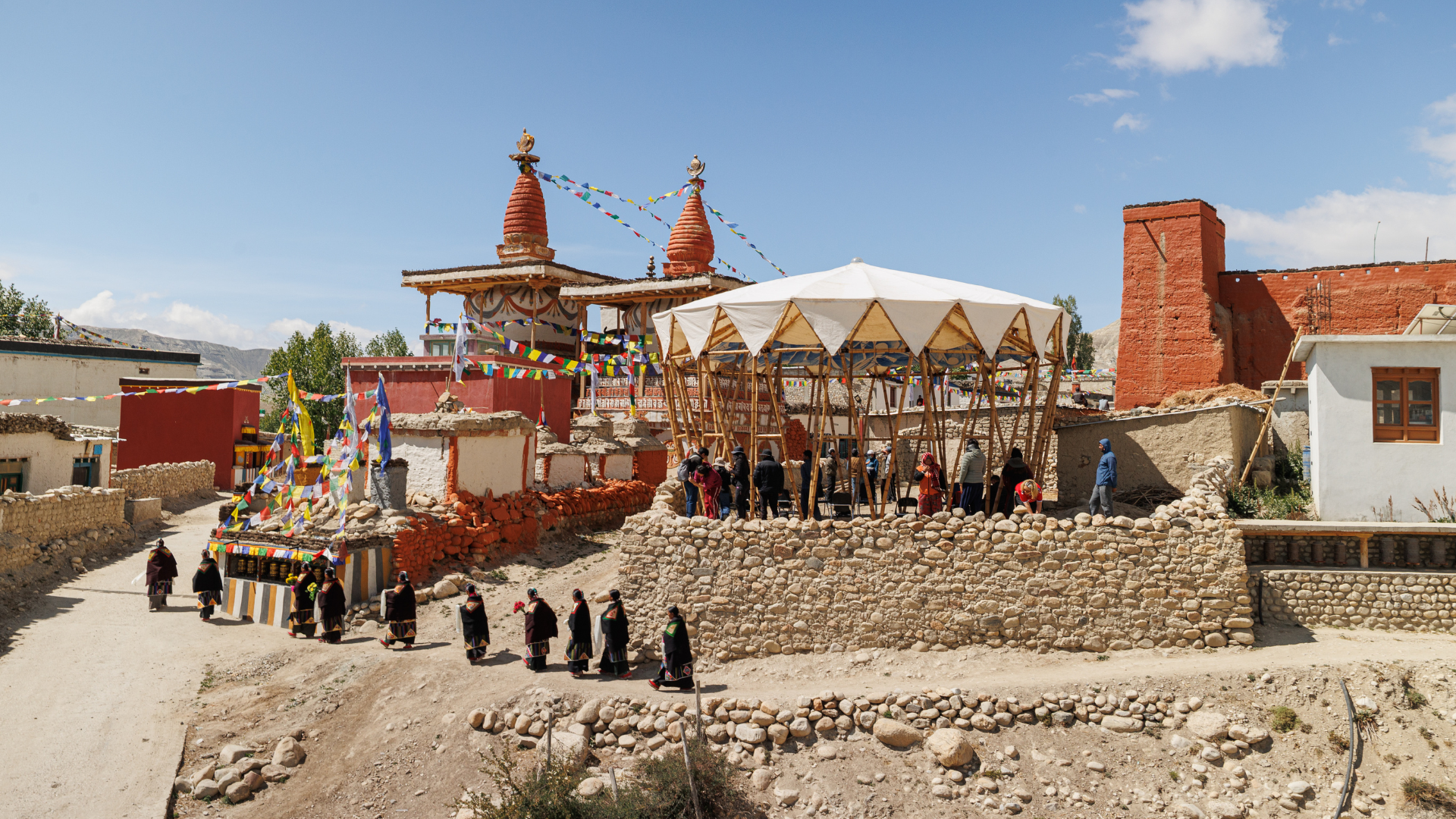
Installation view of Traveling Chautaris in Lo Manthang, Upper Mustang, Nepal, 2026. Photo: Anushka Malla.
Mittal Institute: What new questions are you exploring through your work right now, and how are they shaping the direction of your practice?
Sneha Shrestha: My newest body of work is a large-scale installation near the Nepal-Tibet border that explores climate change and the unlikely alliances it demands. This work is closely connected to my ongoing investigation of cultural continuity. So much of Nepal’s landscape and architecture is inseparable from its cultural identity. To lose one is to risk losing the other.
Shortly after the installation was completed, the region was struck by a devastating climate-related disaster. Witnessing its impact firsthand gave me a ground-level understanding of how environmental crises affect communities whose experiences are often overlooked in global conversations about climate change. That experience deepened my commitment to continuing Traveling Chautaris, bringing it to new communities as both a space for gathering and a call for climate justice.
In developing Traveling Chautaris, I was interested in how language might function as atmosphere. Building on my practice of painting with Devanagari script, I envisioned a large-scale painted canopy that could create a sense of presence while inviting pause, reflection, and collective awareness. The traditional Nepali chautari, historically a communal place of rest, conversation, and exchange, became the conceptual foundation for imagining how architecture could foster connection and collective stillness.
Developed in collaboration with T.NUA Collective, Siddhartha Arts Foundation, and Abari, the project helped extend my practice from individual artwork into something that becomes activated through the people who gather beneath it.
My practice began with using language to create a sense of home for myself. Now I’m interested in how that language can become a physical space where others can experience belonging, find connection, and care for one another. In the face of environmental change, I’m increasingly curious about how art can carry cultural memory while creating spaces for collective action and solidarity.
☆ The views represented herein are those of the interview subject and do not necessarily reflect the views of the Mittal Institute, its staff, or its steering committee.