
Dr. Tulasi Srinivas, Professor of Anthropology, Religion and Transnational Studies at Emerson College and a Centenary Guggenheim Fellow, was a panelist at the Mittal Institute’s Annual Symposium, Living with Rivers, where she explored the relationship between rivers, design, and urban development. Drawing on her childhood in Bangalore, Srinivas reflects on how a waterway she knew only as a polluted drain was, in fact, a sacred river with deep historical and cultural significance. In the essay below, she traces her journey to uncover the lost Vrishabhavathi River—and reflects on how Bangalore’s transformation has turned a source of life and memory into a conduit for pollution.

Dr. Tulasi Srinivas
The Lost River: Water as Memory in Bangalore
By Tulasi Srinivas
As a child traveling for the summer holidays from Bangalore to my father’s family home in Mysore, my family would cross the Kengeri Mori along the highway—a stinking drain that would announce itself by its stench for miles before we encountered it. As we crossed the waterway flanked by mounds of dirty rags, I would stare at the frothing water disturbed by the grey, thickly bubbling stream, seized by an overwhelming sense of dread. At the bank stood a temple dedicated to Hanuman, the monkey god, the devoted follower of Rama, the son of Vayu, the wind god, believed to remove negativity. Even as a child, I was puzzled by the placement of this sacred shrine beside such a filthy mori.
But as I grew older and my trips to Mysore receded into childhood memory, I forgot about the Kengeri Mori, the stench, the dread. My life became consumed by school, college, graduate applications, and the preoccupations of becoming. And speaking of becoming, I became an anthropologist of religion.
Twenty-five years later, one afternoon, while conducting fieldwork in a temple in Malleshwaram, a northern suburb of Bangalore, my conversation with a priest was shattered by screaming. A child playing cricket had fallen through the earth. When a neighbor was lowered into the hole with a lantern, he discovered himself in a cavern fifty feet below—a beautifully preserved water temple dedicated to Nandi, the Bull vehicle of Shiva. There was no central shrine; instead, there was a void, a deep dark pool where ancient turtles swam. A stream fell from the Nandi idol over a lingam into the pool. I was intrigued—captivated, even—by this strange silent secret pool. Where did the stream go?
Via historical records, archives, and translations of rock edicts, I began to follow the stream that fell on the Nandi. I found that it skirted to the south of Malleshwaram below its hills, and then disappeared into the earth at the Bangalore railway station. I later learned the railway station was built on the banks of one of Bangalore’s largest lakes—the Dharmambudhi lake—which remained full through the colonial era until the 1950s. But with increasing development, the lake began to desiccate into a marshland and was drained entirely in the 1970s to build a central bus terminus. Perhaps the Nandi stream ended there. Disheartened, I abandoned my quest to trace the stream’s flow.
In Hinduism, water exists in many divine forms—Ap in Sanskrit, sacred in sky and earth, flowing through sacred rivers like the Ganga, believed to purify the world itself. The Rig Veda tells us that water is originary, primordial: “In the darkness wrapped around by darkness there was water.” Water is ancient, brought down by the gods, resident in the heavens. Strangely, quantum science verifies this—water is made from stardust, some 2.6 billion years old, holding the fingerprint of microbial life. Water is immemorial; it is memory itself.
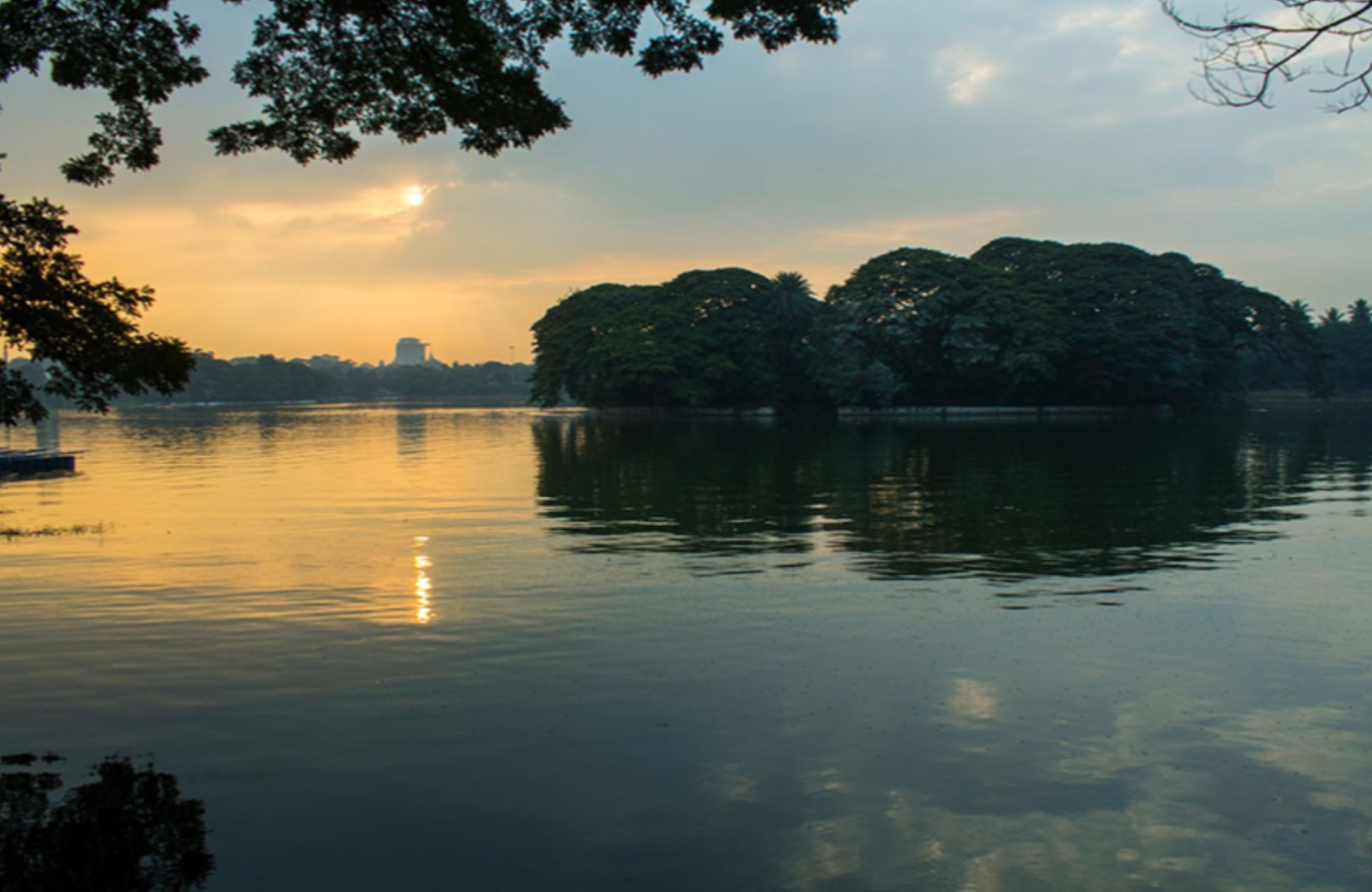
Ulsoor Lake in Bangalore. Photo credit Tulasi Srinivas.
Bangalore was once known as Kalyanagara, the town of liquid auspiciousness, ringed by a thousand water bodies—lakes and temple tanks, streams and rills. But I was always told that Bangalore had no rivers. The greatest river of South India that Bangalore could claim was the Kaveri, which flowed some hundred miles to the south of the city. Bangalore, my hometown, was said to possess no rivers. Instead, the water bodies had been built by great kings to provide water to the thirsty Deccan plateau. These water bodies, collectively called ganga, were sacred repositories where goddesses dwelt at their shores, presiding over water and disease alike.
When I was a child in the 1970s, I remember the undulating Deccan landscape dotted with ancient granite outcrops and rain-fed lakes and tanks that became seasonal lotus-filled ponds. I would daydream by these lakes, walking their banks in wonder. Today, none of this is possible. Today these lakes are covered in sudsy, corrosive froth—their waters burning with industrial toxins. And many have vanished. The number of lakes has shrunk from 250 in 1970 to a mere 100 deeply polluted ones today.
Some ten years after discovering the Nandi temple, I was at the famed Bull temple in the south of the city, where a statue of a Nandi was carved from an ancient granite monolith. The temple itself was built by Bangalore’s founder Kempegowda in 1537 A.D. On the lintel that the priest pointed out were words in Hale (ancient) Kannada: “At the feet of Nandi, the river Vrishabhavati (the Bull’s Hoof) rose and flows westwards.” A river? All my life, I had been told Bangalore had no rivers.
Through archives and oral historians, I learned the truth. The Bull temple and the Nandi tank temple were two origin points of two arms of the same river—the Vrishabhavathi, the Bull’s Hoof river. Working with water advocates, we mapped this lost river through colonial archives. It became devastatingly clear that as the British built Bangalore into a military center in the 18th and 19th centuries, they connected medieval storm water drains to the river channel. It became known as a sewer—the Kengeri Mori. Independent India then chose Bangalore to be a cutting-edge engineering hub with large-scale public industries, and the city allowed industrial waste and toxic runoff to poison the river’s flow. The river died, and with it, the local ecology—the birds, trees, lotuses, and fish. The Bull’s Hoof, like many rivers in India, now runs yellow filled with toxic waste and thickened with raw sewage. According to the city NGO Paani, it is one of the most polluted channels in India.
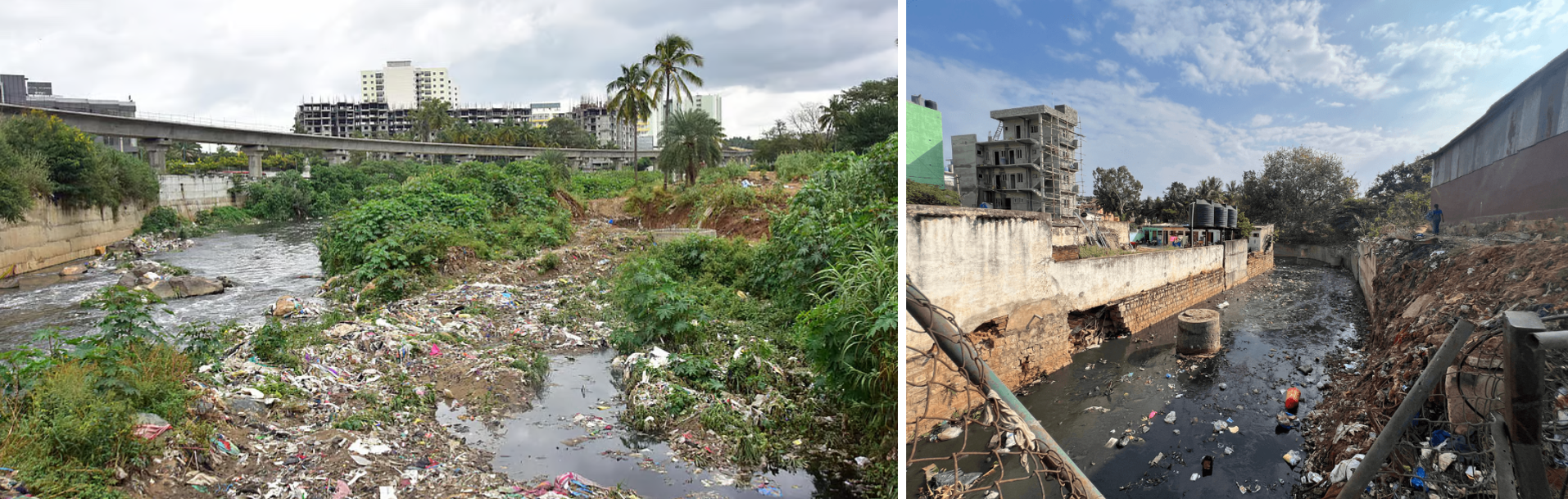
Left image: Vrishabhavathi Valley in Bangalore. Photo Courtesy, The Deccan Herald; Right image: The Vrishabhavathi river. Photo credit. The Question of Cities.
Exploring the city on Google Maps, I was struck by a sudden, humbling realization: the Hanuman Temple that I visited as a child sat not at a drain, but at the sacred sangam, the confluence of two arms of the Bull’s Hoof—one from the Nandi temple in the north and one from the Bull Temple in the south. It was an ancient fording point, a tirtha, where, as Diana Eck has taught us, one might cross from one world to another. I had been crossing this sacred space my entire life, oblivious, knowing it only as a stinking drain.
I returned to the Hanuman temple and found the priest, Sreekumar, offering puja to the deity, covering his nose with his garment. The river used to be pristine, he said, but now it stank. His grandfather had once used these waters to ritually bathe the deity until the 1970s, but they stopped when the waters began to reek and started corroding the stone feet of the god. Now they fear the monsoon rains—the toxic water floods the temple and leaves a foul-smelling sludge they must clean. After using bottled water to bathe the god for years, they have installed an expensive filtration plant in the temple for piped city water to use for ritual.
Yet the Bull’s Hoof, with its solid waste, heavy metals and toxic fluids, still flows into the Arkavathy river that skirts the Bangalore region, where farmers grow the greens that Bangaloreans eat. And the Arkavathy river flows into the mighty Kaveri, which waters the entire southern part of the subcontinent. And in a deathly turn of irony, waters from the Kaveri are tapped for Bangalore’s piped water supply. The river becomes both source and recipient of its own pollution—a circle of water that dissolves memory.
Tulasi Srinivas is Professor of Anthropology, Religion and Transnational Studies at Emerson College and a Centenary Guggenheim Fellow. An award winning author, she is currently working on a book on climate change and water in her hometown of Bangalore.
☆ The views represented herein are those of the subject and do not necessarily reflect the views of the Mittal Institute, its staff, or its steering committee.