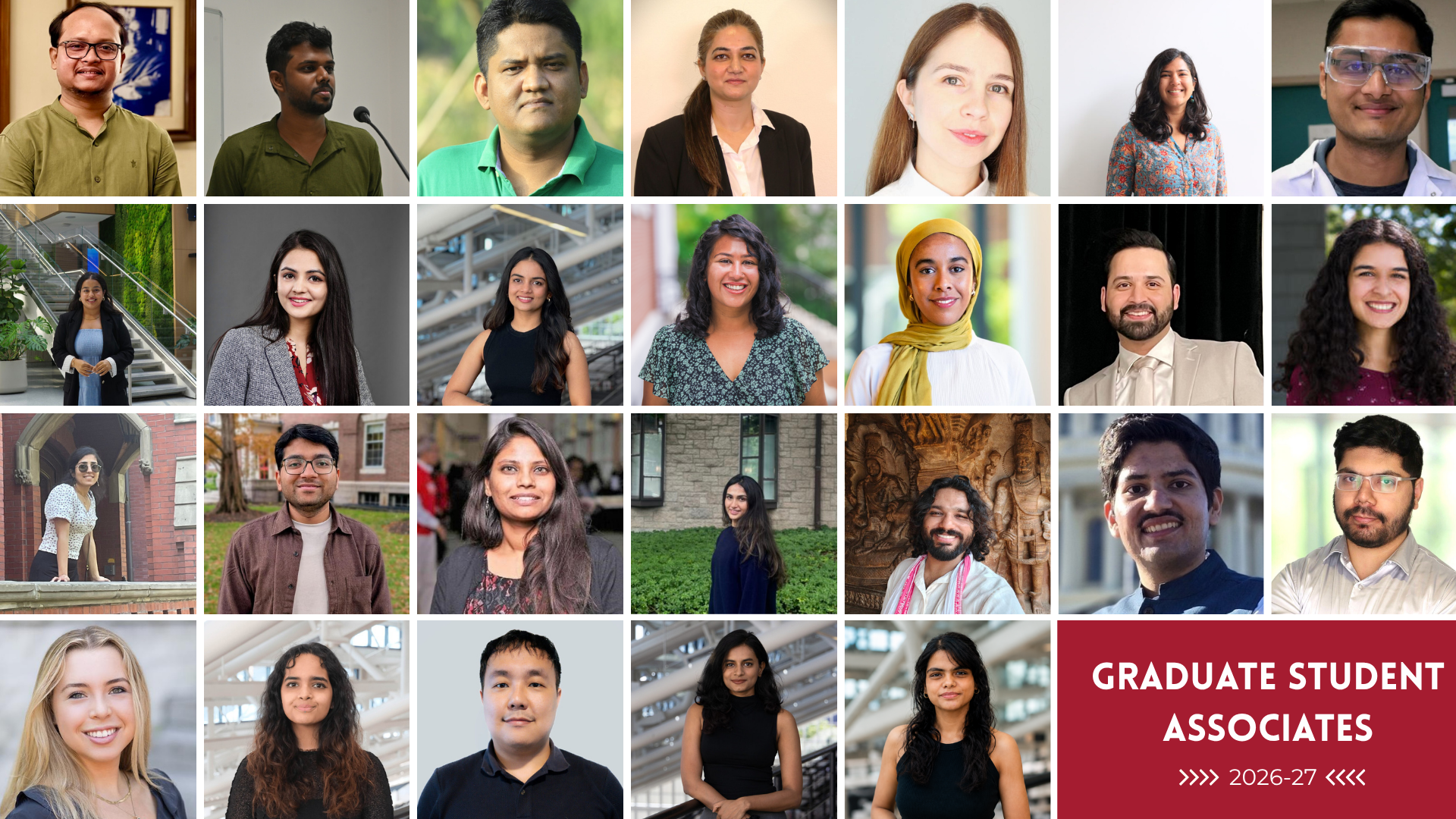
Top row, left to right: Animesh Bag, Thiyagaraj Gurunathan, Md Mafizur Rahman, Zunia Saif Tirmazee, Hannah Ahlblad, Garima Agarwal, Sarthak Agarwal; Second row, left to right: Simran Arora, Divya Bhandari, Arya Dhanda, Zora Haque, Jasmin Higo, Gurwinder Jassal, Madhavi Jha ; Third row, left to right: Sejal Khatri, Nikhil Kumar, Himi Mathur, Aayushi Patel, Akarsh Raghunath, Udbhav Rathore, Sathvik Rayala; Bottom row, left to right: Lauren Rice, Ishita Singh, Ingsa Subba, Serah Yatin, Niharika Yenamandra.
The Mittal Institute’s Cambridge Office fosters South Asian scholarship by hosting Fellows, Visiting Artist Fellows, and Graduate Student Associates. Fellows are scholars and practitioners who come to Harvard to utilize the university’s resources to contribute to self-driven, independent research. Graduate Student Associates (GSAs) are graduate and Ph.D. students from across the different schools at Harvard who conduct research focused on South Asia. This Academic Year 2026-27, we welcome 4 new Fellows and 22 new and returning GSAs.
New Fellows
Animesh Bag is a Raghunathan Family Fellow. He is working with Prof. Sugata Bose, Gardiner Professor of Oceanic History and Affairs, Harvard University Department of History. Dr. Bag is a literary and cultural historian whose postdoctoral project at Harvard examines how early twentieth-century American print culture—including missionary periodicals, newspapers, magazines, and advocacy organizations—shaped racialized understandings of India and Indian immigrants within broader imperial and transnational networks.
Thiyagaraj Gurunathan is the Bajaj Visiting Fellow. During his fellowship, he is working with Prof. David Jones, A. Bernard Ackerman Professor of the Culture of Medicine and the Chair, Department of the History of Science, Harvard University. Dr. Gurunathan is an early-career researcher working at the intersection of health humanities and cultural studies. His research focuses primarily on unpacking the cultural meanings of contagion in South Asia, particularly in the Indian context.
Md Mafizur Rahman is the Mittal Family Climate Fellow who is working with Prof. Dustin Tingley, Thomas D. Cabot Professor of Public Policy in the Harvard Kennedy School of Public Policy and Harvard Government Department. Dr. Rahman is an interdisciplinary scholar of public administration whose research examines the intersection of climate governance, environmental justice, and institutional reform. His work explores how governance systems and institutional arrangements influence climate adaptation, resilience, and sustainable development in Bangladesh and the Global South.
Zunia Saif Tirmazee is the Syed Babar Ali Fellow, Spring 2027. During her fellowship, she is working with Prof. Mashail Malik, Assistant Professor of Government, Department of Government, Harvard University. Zunia Saif Tirmazee’s research sits at the intersection of labor economics, gender, and education, focusing on how market frictions impede development. Broadly, her research examines how structural, social, and psychological barriers such as gender wage gaps, social norms, and aspirations, shape labor market outcomes for women.
Graduate Student Associates
Hannah Ahlblad is an architect and PhD student in the Theory and History of Architecture at the Harvard Graduate School of Design, and an A.M. candidate in the History of Science. Her research bridges spatial history and American foreign relations, with a focus on how Cold War nuclear physics, modernist architecture, and state-backed science programs reconfigured both local environments and global narratives of national sovereignty in the Indian subcontinent and Latin America.
Garima Agarwal is a Master’s in Public Policy candidate at the Harvard Kennedy School and a Visiting Research Fellow at the United Nations University Operating Unit on Electronic Governance (UNU-EGOV). Her research interests lie at the intersection of urban development, gender, and the future of work, with a focus on advancing women’s economic mobility in India.
Sarthak Agarwal is a PhD candidate in Population Health Sciences at Harvard University. His dissertation investigates school feeding programs as a policy tool to advance public health, equity, and access for children.
Simran Arora is a second-year MPP candidate at Harvard Kennedy School with experience spanning global philanthropy, refugee education, and gender-responsive development. Her research examines climate-led displacement in South Asia through three connected threads: contemporary migration patterns, displacement rooted in the history of Partition, and forward-looking analysis of climate displacement and the policy frameworks needed to anticipate it.
Divya Bhandari is a doctoral candidate in Population Health Sciences at the Harvard T.H. Chan School of Public Health. Her research uses population health modeling and epidemiologic methods to examine how maternal and early-life interventions shape health across the life course and across generations.
Arya Dhanda is an architect from India, currently pursuing a graduate program in Urban Design at the Harvard Graduate School of Design. Her research examines the uneven geographies of extreme heat in warming cities and their implications for the design of public space, with a focus on New Delhi.
Zora Haque is a PhD Candidate in Education at the Harvard University Graduate School of Education, with a concentration in Culture, Institutions, and Society (CIS). Her research sits at the intersection of education, race and ethnicity, gender, and inequity, and examines the links between imperialism in the South Asian subcontinent, family socialization, and women’s academic pathways.
Jasmin Higo is a PhD student specializing in health systems and health economics at the Harvard Graduate School of Arts and Sciences and the Harvard School of Public Health. She is also a Doctoral Fellow with the Harvard Environmental Economics program. Her research examines how shocks, including environmental shocks, affect health outcomes, and livelihoods with a focus on resilience and the dynamics of vulnerability and recovery across contexts.
Gurwinder Jassal is a healthcare operations leader who is pursuing graduate studies in clinical operations at Harvard Medical School and is passionate about healthcare innovation, operational excellence, data-driven decision-making, and improving patient care and system efficiency.
Madhavi Jha is a PhD student in Economics at Harvard University. Her research focuses on development economics and public finance, with an emphasis on health and education in low-resource settings.
Sejal Khatri is a second-year PhD student in the Intelligent Interactive Systems Group at Harvard. Her research in human-computer interaction explores how AI language models can support science learning in everyday life and help people reason about scientific phenomena.
Nikhil Kumar is a PhD candidate in Public Policy (Economics Track). His research focuses on education and labor markets in developing countries.
Himi Mathur is a Doctor of Public Health (DrPH) candidate at Harvard T.H. Chan School of Public Health, and her research focuses on understanding human oversight mechanism and responsible AI governance standards for AI-enabled clinical decision support systems.
Aayushi Patel is a Master of Theological Studies candidate at Harvard Divinity School, concentrating in Ethics and Politics. Her research is rooted in a deep curiosity about food and its ecosystem, particularly India’s millet ecosystem and how it can be taken seriously as an ecological inheritance, ethical obligation, and an economic opportunity to build a scalable, climate-resilient startup model that advances farmer livelihoods, nutrition security, and climate adaptation simultaneously.
Akarsh Raghunath is a PhD Candidate at the Department of History of Art and Architecture where he studies the trans-regional interactions of early religious material culture with a focus on locating Tamiḻakam in the South-Southeast Asian cultural encounters of Southern Buddhism.
Udbhav Rathore is currently a second year Masters in Public Administration in International Development (MPA/ID) student at Harvard Kennedy School. He is deeply interested in security and international relations, particularly how economic resilience, technology, and geopolitics shape a country’s strategic position.
Sathvik Rayala is a Ph.D. student in the Department of the History of Science at Harvard University. His research geographically centers medieval and early modern South Asia, particularly southern India. He is interested in the study of early Indian medicine (Āyurveda), premodern sciences and technology, the entanglements between early sciences and religion, and Indic intellectual traditions and textual cultures (śāstras).
Lauren Rice is a PhD candidate in Business Economics, studying development and health economics. Her research investigates the role of technology in healthcare markets in low-and middle- income countries.
Ishita Singh is a second-year Master of Architecture in Urban Design (MAUD) student at the Harvard Graduate School of Design. Her work focuses on inclusive urban form and governance, and on how data and digital tools can support more accessible and responsive cities.
Ingsa Subba is a Master in Design Studies candidate at the Harvard Graduate School of Design. His work explores the intersections of computation, language, sound, culture, and design. His current research project, Sound Topographies, investigates how the linguistic and sonic structures of Eastern Himalayan languages can be mapped, modeled, and translated into new computational and interactive forms.
Serah Yatin is a second-year student in the Master of Architecture in Urban Design (MAUD) at Harvard Graduate School of Design, where her research explores social equity, climate resilience, and the needs of existing communities.
Niharika Yenamandra is an architect and urban designer currently pursuing a Master of Architecture in Urban Design at the Harvard Graduate School of Design. Her interests lie in people-centered design and in understanding how landscape, infrastructure, and the public realm can create more connected, inclusive, and meaningful urban environments.